
Wel's Dermatology Thermage FLX: Study Results Showing Skin Age Rejuvenated by 5.3 Years Released
Hello.
I am Choi Won-woo, a dermatologist with 23 years of experience.
Today, I would like to talk about something a little special.
When discussing the effects of lifting procedures, people often rely on before-and-after photos or subjective satisfaction surveys.
But I have long wondered:
"Is there a way to objectively
and scientifically prove the effects of a lifting procedure?"
So at Wel's Dermatology, we conducted a study to verify the effects of Thermage FLX through skin microbiome analysis.
Today, I would like to share the results of this study based on data from a total of 480 patients.
Table of Contents
-
What is precision anti-aging treatment?
-
What is skin microbiome analysis?
-
Study design: Verifying the effects of Thermage FLX
-
Study result 1: Biological changes in the skin
-
Study result 2: Changes in beneficial skin bacteria
-
Study result 3: Changes in skin age
-
Clinical significance
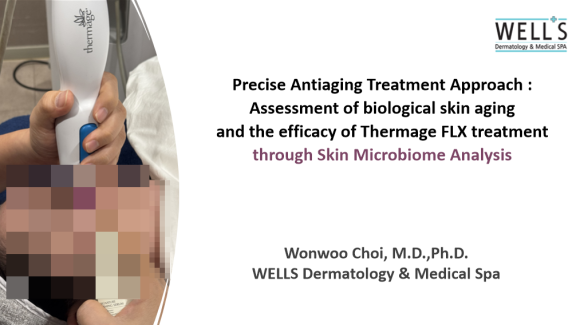
- What is precision anti-aging treatment?
Recently in dermatology, the concept of "precision anti-aging treatment" has been attracting attention.
Moving away from conventional one-size-fits-all procedures, this is an approach that evaluates skin aging and measures treatment effects based on individual data.
In precision anti-aging treatment, the following personal data are used.
An individual's lifestyle data, skin phenotype data, and skin microbiome data,
and in the future, even skin multi-omics data will be used to more precisely promote collagen synthesis, strengthen skin barrier function, assess skin aging, and measure treatment effects.
The key to this approach is to scientifically prove the effectiveness of procedures by collecting objective data through non-invasive methods.
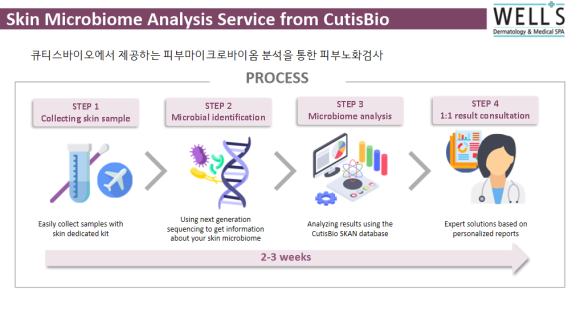
- What is skin microbiome analysis?
The skin microbiome refers to the community of microorganisms that inhabit the skin.
According to recent studies, the composition of the skin microbiome can be an important indicator reflecting skin health and the degree of aging.
We used the skin microbiome analysis service provided by CutisBio to measure biological changes in the skin before and after Thermage FLX.
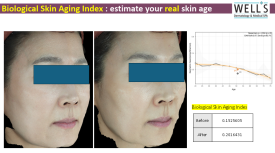
Through this analysis, a biological skin aging index can be calculated, which is used to objectively assess skin age.
- Study design: Verifying the effects of Thermage FLX
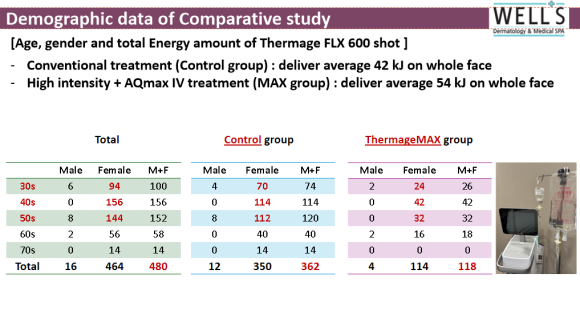
In this study, we analyzed the effects of Thermage FLX in a total of 480 patients.
Study population:
Patients ranging in age from their 30s to their 70s were included, with 16 men and 464 women.
By age group, 100 patients in their 30s, 156 in their 40s, 152 in their 50s, 58 in their 60s, and 14 in their 70s participated.
Study group classification:
The patients were divided into two groups for comparative analysis.
Control group (118 patients): Standard Thermage FLX treatment, delivering an average of 42 kJ of energy to the entire face.
Thermage MAX group (362 patients): High-intensity Thermage FLX treatment combined with AQmax IV pretreatment, delivering an average of 54 kJ of energy to the entire face.
Measurement time points:
On the day of treatment (Day 1), 3D photography and skin microbiome sampling were performed, followed by Thermage FLX treatment.
Twenty-eight days after treatment (Day 28), the same 3D photography and skin microbiome sampling were performed to compare and analyze the pre- and post-treatment results.
- Study result 1: Biological changes in the skin
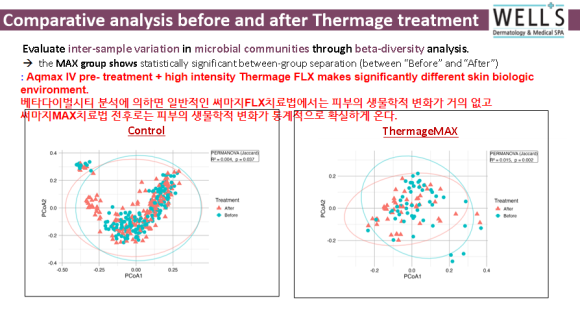
First, we evaluated changes in the skin microbial community before and after treatment using beta-diversity analysis.
Beta-diversity analysis is a method for evaluating variations in microbial communities between samples, allowing us to measure how much the skin's biological environment has changed.
Analysis results:
In the control group, there was little to no biological change in the skin before and after treatment.
In contrast, in the Thermage MAX group, statistically significant changes in the skin biological environment were observed before and after treatment.
This shows that the combination treatment of AQmax IV pretreatment and high-intensity Thermage FLX meaningfully changes the skin's biological environment.
- Study result 2: Changes in beneficial skin bacteria
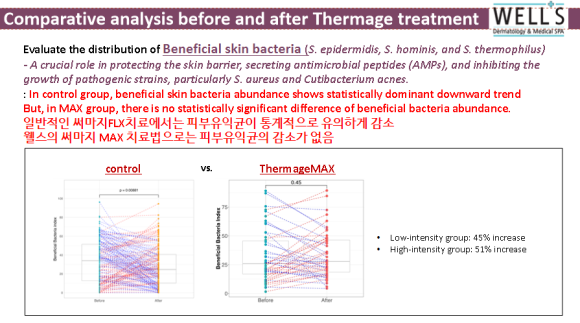
Next, we analyzed changes in the distribution of beneficial skin bacteria.
The beneficial skin bacteria analyzed were S. epidermidis, S. hominis, and S. thermophilus.
These beneficial bacteria play important roles in protecting the skin barrier, secreting antimicrobial peptides (AMPs), and suppressing the growth of pathogenic strains such as S. aureus and acne-causing bacteria (C. acnes).
Analysis results:
In the control group, beneficial skin bacteria tended to decrease significantly after treatment.
In contrast, no decrease in beneficial skin bacteria was observed in the Thermage MAX group.
This result has very important clinical significance.
During radiofrequency lifting procedures, thermal energy is delivered to the skin and can affect the skin microbiome environment,
which means that with appropriate pretreatment and treatment protocols, effective lifting results can be achieved while preserving beneficial skin bacteria.
- Study result 3: Changes in skin age
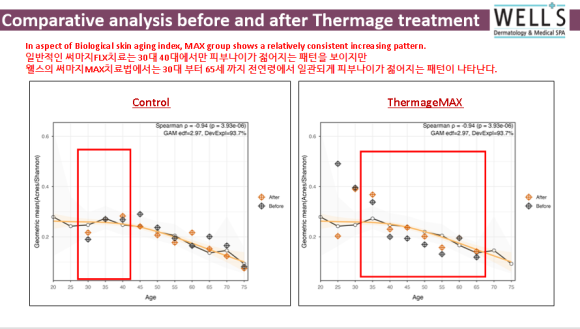
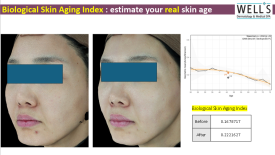
Finally, we analyzed changes in skin age using the biological skin aging index.
Analysis results:
In the control group, a skin-aging-reversal pattern was observed only in patients in their 30s and 40s.
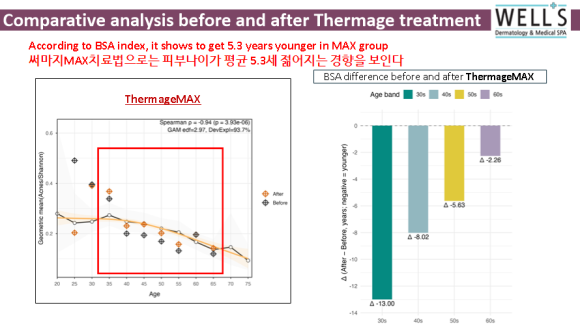
In contrast, in the Thermage MAX group, a consistent skin-aging-reversal pattern was seen across all age groups from the 30s to age 65.
What is especially noteworthy is that the Thermage MAX treatment showed a tendency to rejuvenate skin age by an average of 5.3 years.
This is not simply a change in appearance, but a change in biological skin age objectively measured through skin microbiome analysis.
- Clinical significance
Through this study, we were able to draw several important conclusions.
First, the effects of Thermage FLX can vary greatly depending on the treatment protocol.
Even when the same device is used, the biological response of the skin differed depending on the amount of energy delivered and whether pretreatment was performed.
Second, combining high-intensity treatment with appropriate pretreatment can produce more effective anti-aging results while preserving beneficial skin bacteria.
Third, skin microbiome analysis can be a useful tool for objectively evaluating the effects of lifting procedures.
In the past, treatment effects were evaluated only by subjective satisfaction or changes in appearance, but now a more scientific evaluation is possible through biological data.
In closing,
This study is the result of a long effort to scientifically verify the effects of lifting procedures.
By analyzing a substantial amount of patient data from 480 people, we were able to confirm the possibility that Thermage FLX treatment can improve not just the skin's tightness, but the skin's biological environment itself.
Of course, this study is not perfect, and more research and validation will be needed in the future.
However, at Wel's Dermatology, we will continue to work toward the goal of "precision anti-aging treatment" and strive to provide scientific skin treatment based on data.
Thank you for reading this long post.
This has been CEO and Chief Physician Choi Won-woo.
[Related posts worth reading]
Best 1. Introduction
Best 2. Thermage MTL forum lecture
Best 3. Wel's Dermatology's hair loss solution, recognized worldwide
| Wel's Dermatology main phone number (click the number below to connect) |
|---|
| 02 - 542 - 2372 |
| Clinic hours |
|---|
| Weekdays 10:00 ~ 20:00 |
| Saturday 10:00 ~ 17:00 |
| Lunch break 13:00 ~ 14:00 |
| Closed on Sundays and public holidays |
This post was written directly by Wel's Dermatology Clinic and complies with all laws related to medical advertising, except Article 56, Paragraph 1 of the Medical Service Act.
All surgeries and procedures may be accompanied by side effects depending on the individual, so please make a careful decision about whether to undergo treatment after receiving sufficient guidance from the medical staff.