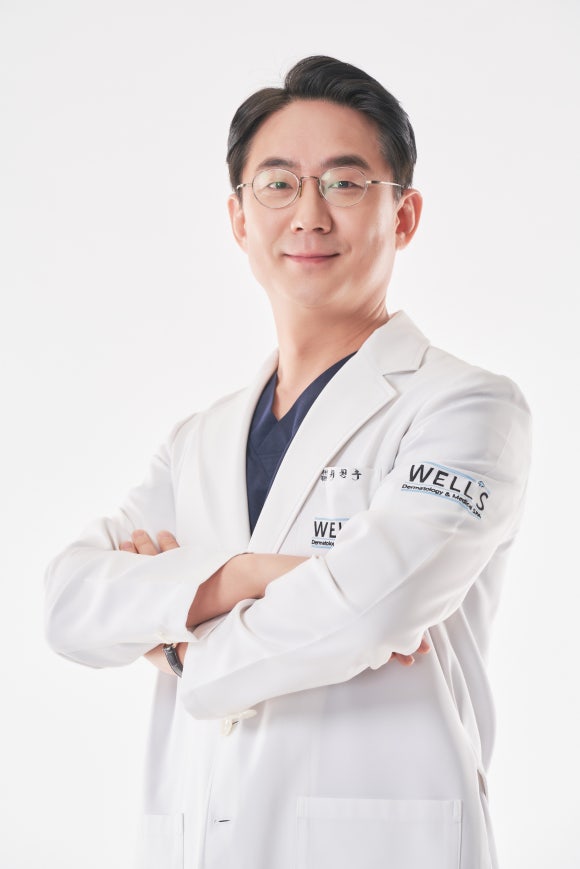
Hello.
I am Choi Won-woo, a dermatologist with 23 years of experience.
Until now, the effects of lifting procedures have mostly been evaluated through visible changes or the level of satisfaction felt by patients.
But while meeting patients in clinical practice, I have always thought this.
"How great would it be if we could prove, with numbers, the biological changes happening inside the skin—not just the changes we can see?"
That is why we at Wells Dermatology conducted a joint study with CutisBio, a company specializing in the skin microbiome.
CutisBio is a bioinformatics company that has recently attracted attention in the field of dermatology science by signing business agreements with Kakao Healthcare and the L'Oréal Group.
I will discuss the findings based on the research results published in the February 2026 issue of the Korean Dermatological Association journal.
Table of Contents
-
The relationship between skin aging and the microbiome
-
Biological skin age BSA
-
Microbiome changes after Thermage treatment
The relationship between skin aging and the microbiome
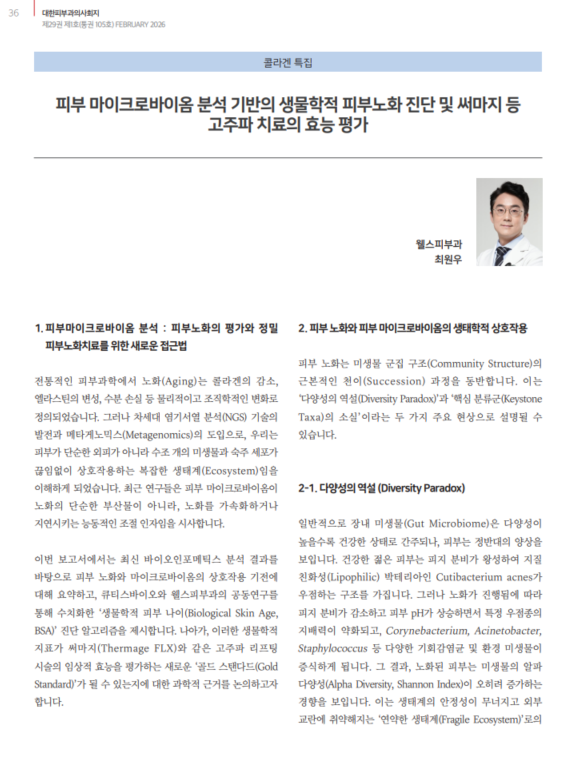
Recent studies have revealed that the skin microbiome is an active regulatory factor that can accelerate or delay aging.
Healthy young skin has a structure dominated by Cutibacterium acnes.
This bacterium breaks down sebum to keep the skin slightly acidic, defend against pathogenic invasion, and protect the skin from oxidative stress by secreting the antioxidant protein RoxP.
However, as aging progresses, sebum production decreases and skin pH rises, leading to a reduction in C. acnes and an increase in opportunistic bacteria such as Acinetobacter and Staphylococcus.
In particular, these changes become more pronounced starting around age 35, and an increase in Acinetobacter has been identified as a strong biomarker of early aging.
Biological skin age BSA
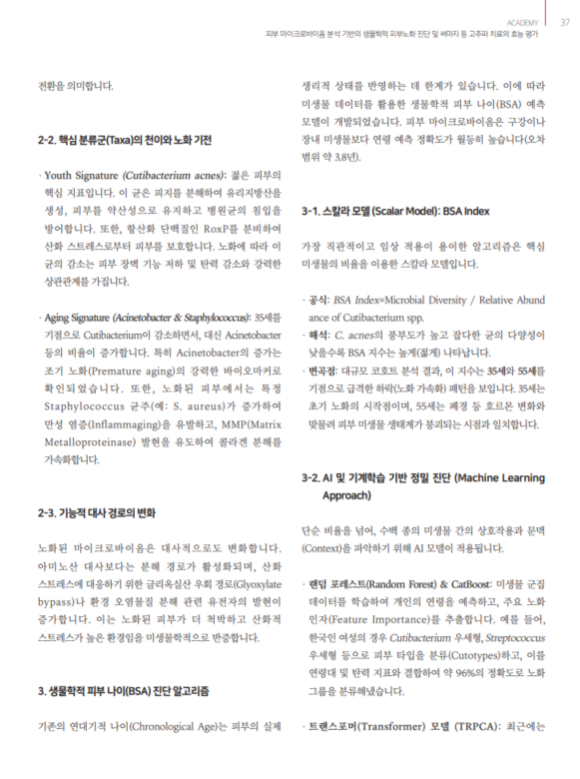
Our research team developed a biological skin age prediction model using microbial data.
Skin microbiome-based age prediction has an error range of about 3.8 years, with far higher accuracy than oral or gut microbiome data.
The higher the abundance of C. acnes and the lower the microbial diversity, the younger the BSA index appears.
When an AI machine learning model is applied, aging groups can be classified with about 96% accuracy.
Microbiome changes after Thermage treatment
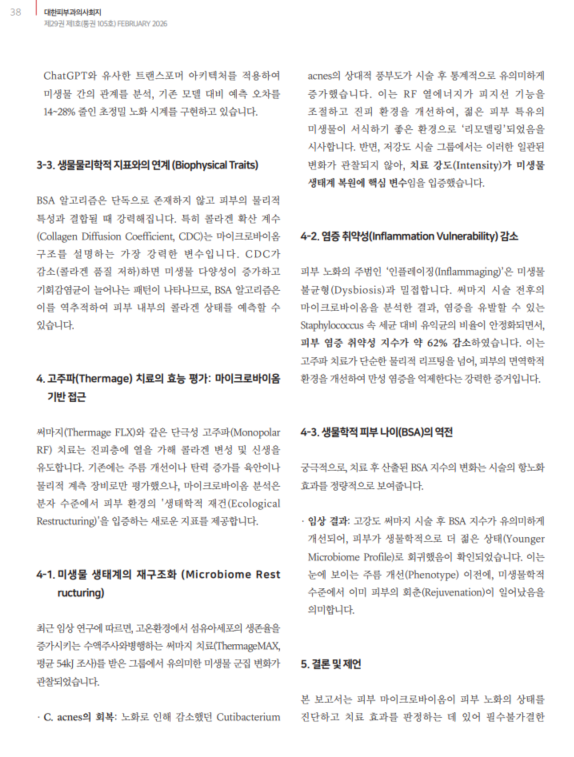
In our clinical study, significant changes were observed in the group that received high-intensity Thermage treatment (Thermage MAX, average 54 kJ).
First, the abundance of C. acnes, which had decreased with aging, increased significantly after the procedure.
The RF thermal energy improved the dermal environment, remodeling it into a setting more favorable for microorganisms characteristic of younger skin.
Second, as the ratio of beneficial bacteria to inflammation-causing bacteria stabilized, the skin inflammation susceptibility index decreased by about 62%.
This is evidence that radiofrequency treatment improves not only physical lifting but also the immunological environment.
Third, the BSA index improved significantly, confirming that the skin had returned to a biologically younger state.
Rejuvenation had already occurred at the microbiological level before visible wrinkle improvement.
By contrast, these changes were not observed in the low-intensity treatment group, proving that treatment intensity is a key variable in restoring the microbial ecosystem.
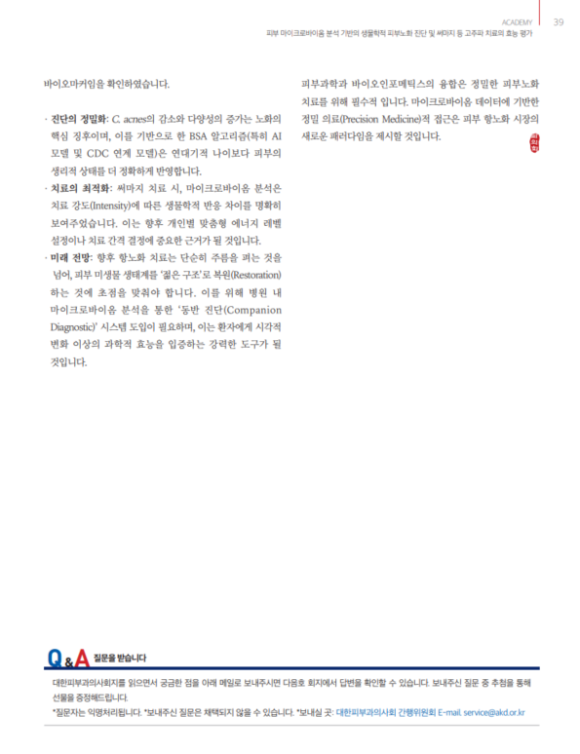
In closing,
Through this study, we were able to confirm that Thermage FLX is not simply a lifting procedure, but a scientific treatment that restores the skin's ecological environment to a more youthful state.
At Wells Dermatology, we will continue striving to provide precision anti-aging treatments based on scientific evidence.
Thank you for reading this long post.
This has been Choi Won-woo of Wells Dermatology.
[Posts you may also like]
Best 1. Introduction
Best 2. Ulthera and fitting lifting are even better when received together.
Best 3. Research findings on the tendency for the Thermage MAX program to make you 5.3 years younger on average
| Wells Dermatology main phone number (click the number below to connect) |
|---|
| 02 - 542 - 2372 |
| Clinic hours |
|---|
| Weekdays 10:00 ~ 20:00 |
| Saturday 10:00 ~ 17:00 |
| Lunch break 13:00 ~ 14:00 |
| Closed on Sundays and public holidays |
This post was written directly by Wells Dermatology Clinic and complies with all laws and regulations regarding medical advertising, except Article 56, Paragraph 1 of the Medical Service Act.
All surgeries and procedures may be accompanied by side effects depending on the individual, so please receive sufficient consultation and guidance from medical staff before carefully deciding whether to proceed with the treatment.