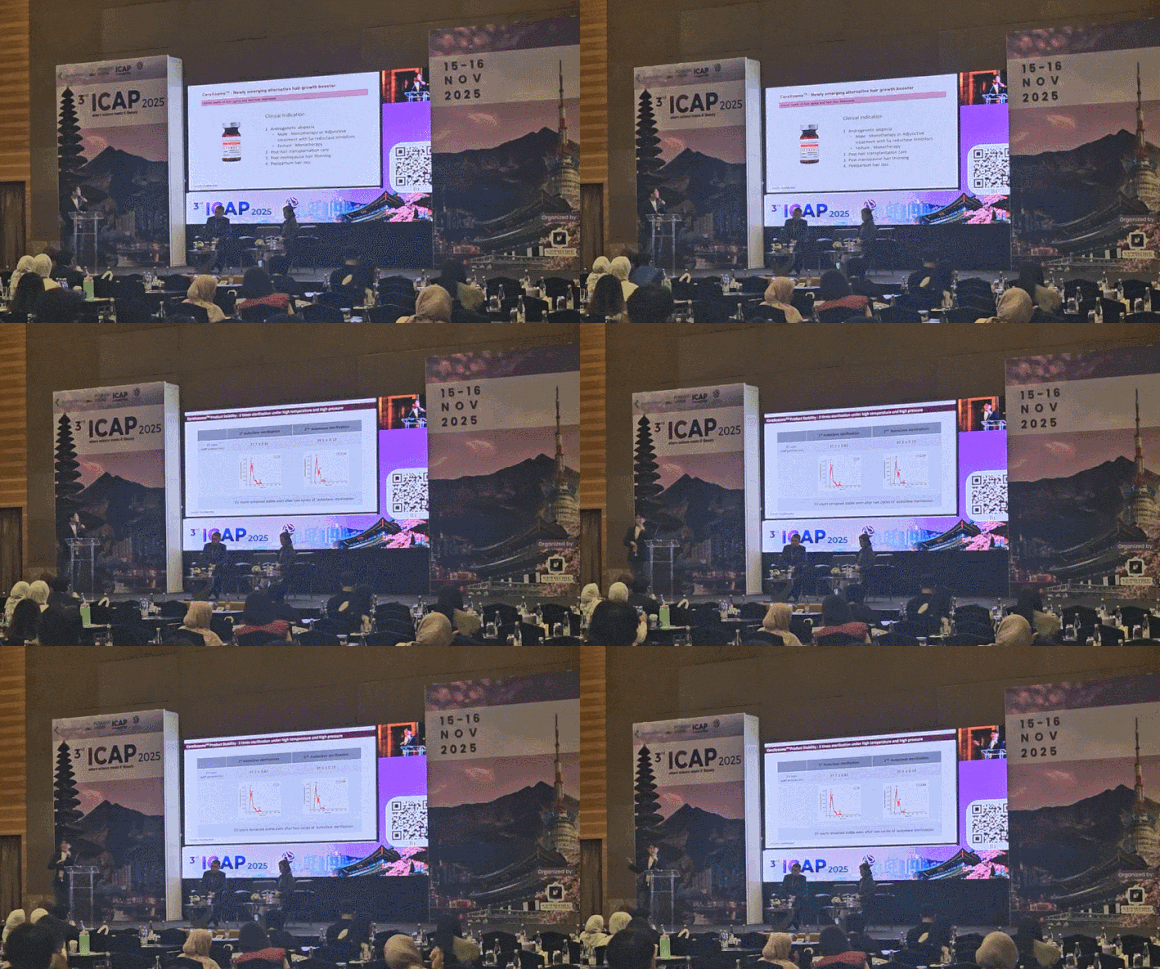
2025 Jakarta Cera Exosome Invitation Lecture
Hello.
I am Choi Won-woo, a dermatologist at Wells Dermatology with 23 years of clinical experience.
In consultations about hair loss, I often hear things like this:
“It's not like my hair is falling out as much as before, but somehow it looks like I have less hair.”
“My hair has become so thin that the top of my head looks sparse.”
When many people think of hair loss, they first imagine hair shedding in large amounts.
However, the hair changes felt after the age of 40 are a little different from simply hair falling out.
Rather than a sudden decrease in the number of hairs, each strand often becomes thinner and loses strength, making the overall density look lower.
Just as skin loses elasticity and becomes thinner with age, hair also undergoes aging at the cellular level.
Today, I will explain why hair loss treatment after middle age requires a different approach, with a focus on Cera Exosome.
목차
-
Shedding hair loss and thinning hair loss are different
-
What happens when a hair follicle ages?
-
What signals does Cera Exosome deliver to hair follicles?
-
Why Wells Dermatology sees Cera Exosome as a hair rejuvenation therapy
- Shedding hair loss and thinning hair loss are different
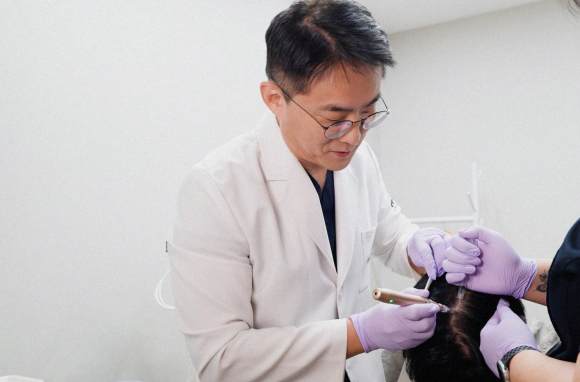
The first thing to do in hair loss treatment is to distinguish how the current problem is progressing.
Hereditary hair loss that begins in the 20s or 30s has a relatively clear pattern.
In men, the hairline often recedes into an M shape, or the crown area appears round and sparse; in women, the part line often gradually widens.
Because this type of hereditary hair loss is greatly influenced by a hormone called DHT, medication that regulates hormones plays an important role.
On the other hand, the changes that gradually become noticeable after the age of 40 are a little different.
Rather than suddenly losing a large amount of hair, the main changes are that the hair becomes thinner, shorter, and weaker than before.
Even though the amount of hair falling out while shampooing has not increased much, the scalp looks more visible in the mirror, and volume does not last even after blow-drying.
In such cases, rather than seeing it simply as “hair is falling out,” it is necessary to understand that the hair follicles are no longer functioning as well as they used to.
- What happens when a hair follicle ages?
A hair follicle is not just a hole where a hair is inserted.
It is a highly active tissue that makes hair, grows it, lets it rest, and then produces new hair again.
But as we age, changes begin to appear little by little in this process.
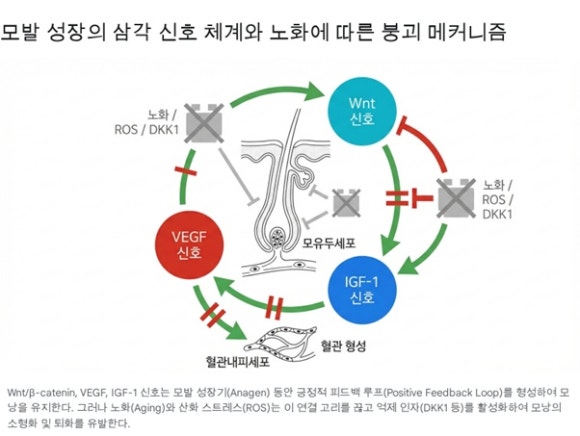
The cells around the hair follicle are repeatedly exposed to oxidative stress and aging stimuli, and the growth signals that tell hair to stay thick and long gradually weaken.
As a result, the growth phase shortens, the resting phase lengthens, and newly growing hairs become thinner and weaker than before.
The change patients notice most often at this time is miniaturization.
Thick, resilient hair turns into thin, weak hair like vellus hair.
In fact, when we examine the scalp under magnification in the clinic, there are often very thin hairs remaining rather than no hair at all.
The problem is that these thin hairs cannot grow thick and long enough.
That is why treatment for age-related hair loss should not end with simply preventing shedding.
We need to look at both the scalp environment and cellular function so that the hair follicles can respond to growth signals again.
- What signals does Cera Exosome deliver to hair follicles?
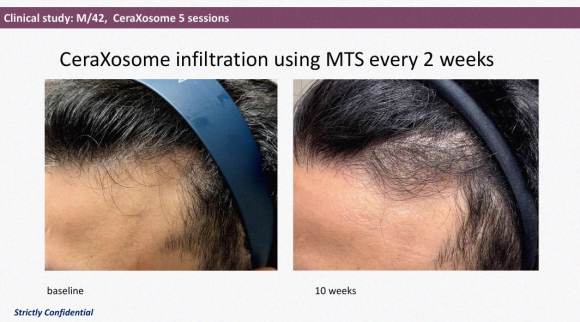
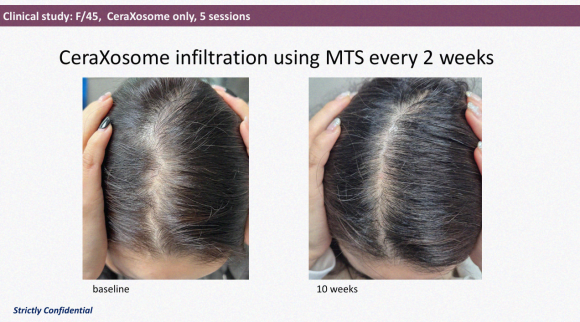
Recently, one ingredient we have been focusing on in hair aging treatment is Cera Exosome.
Exosomes are very small vesicles involved in cell-to-cell signaling.
Simply put, you can think of them as carriers that contain messages sent from one cell to another.
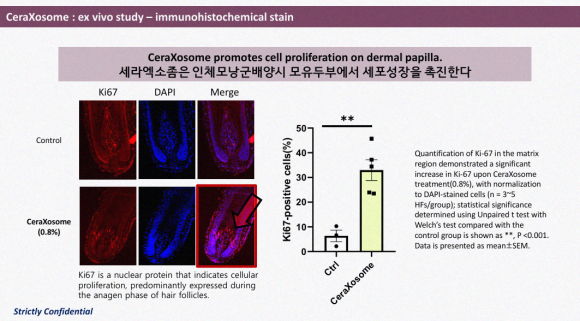
Cera Exosome is a microbiome-derived exosome treatment focused on penetrating the scalp and skin barrier to deliver effective signals around the hair follicle.
The important point is that it is not simply about applying nutrients.
An aged hair follicle is not only lacking nutrients.
It is also in a state where it does not receive growth signals well and has weakened ability to respond to those signals.
Cera Exosome works in a direction that delivers the signals needed for growth and regeneration back to the weakened follicular environment.
Even if you sow good seeds in a field that has not been cared for for a long time, if the soil is hardened, the sprouts will have difficulty growing properly.
First, the soil must be loosened, and the environment must be arranged so that water and air can pass through.
In this way, Cera Exosome helps organize the scalp environment so that hair can grow again and supports weakened hair follicles in receiving growth signals again.
- Why Wells Dermatology sees Cera Exosome as a hair rejuvenation therapy
At Wells Dermatology, we do not view Cera Exosome as just a standalone procedure name.
Within the larger flow of hair aging, we see it as one key axis for restoring the follicular environment.
Hair loss after middle age is difficult to explain by a single cause.
Some patients still have hormonal influences, while others have accompanying scalp inflammation or barrier damage.
Some still have living hair follicles whose function has declined, while others have had the condition progress for a long time, limiting their regenerative potential.
Therefore, Cera Exosome cannot be applied in exactly the same way to everyone.
First, we need to check the current hair thickness, density, scalp condition, and pattern of hair loss, and determine whether medication is needed and whether regenerative treatment can be combined.
What we call hair rejuvenation therapy is not simply repeating one procedure.
It is the process of looking at the signal system of weakened hair follicles due to aging and the scalp environment together, and, when necessary, combining Cera Exosome, Hair Booster, and Dirology NMN to create the conditions for hair follicles to respond again.
If Cera Exosome plays the role of delivering regeneration signals to the follicle, NMN helps aging cells use energy efficiently again.
However, hair is a tissue whose changes appear more slowly than those of the skin.
Rather than expecting all results after one or two treatments, it is important to assess how much the current follicles can respond and then set a treatment plan step by step.

In closing
Hair loss can no longer be seen simply as a matter of hair falling out.
Especially the changes that appear after the age of 40 may be a process in which hair and hair follicles age together, much like skin aging.
Cera Exosome is a method that may help reorganize the weakened follicular environment and deliver growth signals in the treatment of this type of hair aging.
However, we cannot guarantee the same results for everyone.
Whether the hair follicles are still able to respond, whether existing treatment should be combined, and what interval and intensity of treatment should be used all differ from person to person.
Therefore, rather than deciding on a specific procedure first, we recommend accurately checking your current scalp and hair condition and then making a hair anti-aging plan that suits you.
Thank you for reading this long post.
This has been Choi Won-woo from Wells Dermatology.
[Additional posts worth reading]
Best 1. Introduction
Best 2. Explained based on clinical results of malt treatment.
Best 3.
| Wells Dermatology main phone number (click the number below to connect) |
|---|
| 02 - 542 - 2372 |
| Clinic hours |
|---|
| Weekdays 10:00 ~ 20:00 |
| Saturday 10:00 ~ 17:00 |
| Lunch break 13:00 ~ 14:00 |
| Closed on Sundays and public holidays |
This post was written directly by Wells Dermatology Clinic and complies with all laws regarding medical advertising, except Article 56, Paragraph 1 of the Medical Service Act.
All surgeries and procedures may involve side effects depending on the individual, so please make a careful decision about whether to undergo a procedure after receiving sufficient guidance from medical staff.