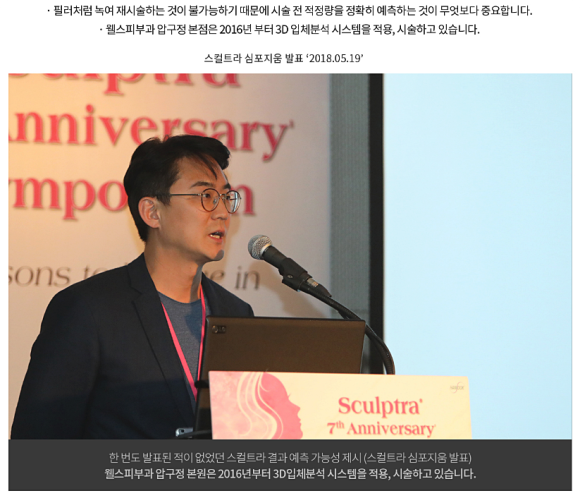
Presentation at the Sculptra Symposium
Hello.
I’m Choi Won-woo, a dermatologist with 23 years of experience.
As more people have recently been looking for natural-looking volume improvement, interest in Sculptra has also been increasing.
In particular,
“Fillers are 부담스럽다 when they look obvious right away”
“It would be nice if it felt like volume was filling in naturally”
Many people have been coming in for Sculptra consultations with concerns like these.
However, during consultations, there is one topic that almost always comes up.
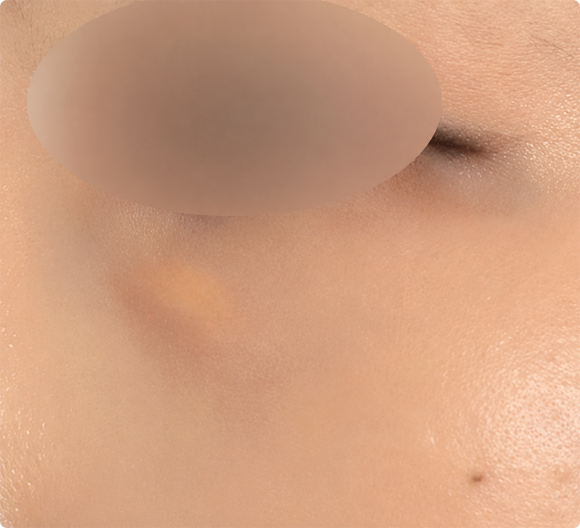
It is concern about “nodules.”
Online,
“I got Sculptra and it clumped up under the skin”
“I can feel something hard”
After seeing reviews like these, many people end up hesitating about the procedure itself.
In fact, Sculptra is a procedure that delivers good results,
which is why how it is prepared and how it is injected is extremely important.
So today, I’ll explain in a little more detail why Sculptra nodules occur,
and how Wells Dermatology approaches reducing them.
- Sculptra is not a ‘filling’ procedure,
but a ‘collagen-building’ procedure.
First, let me briefly explain Sculptra.
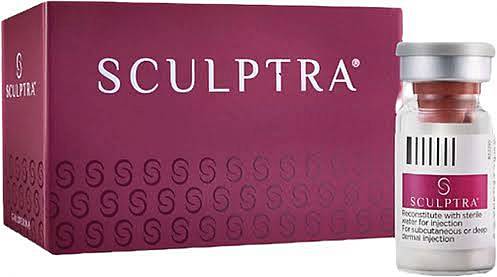
Sculptra is a collagen booster based on PLLA.
It does not directly fill empty spaces like a filler,
but instead induces collagen production within the skin, gradually creating volume and firmness over time.
That is why the change appears gradually over several months rather than immediately after treatment.
It is especially used for cases such as
sunken cheeks
loss of volume in the nasolabial fold area
hollow temples
general loss of elasticity
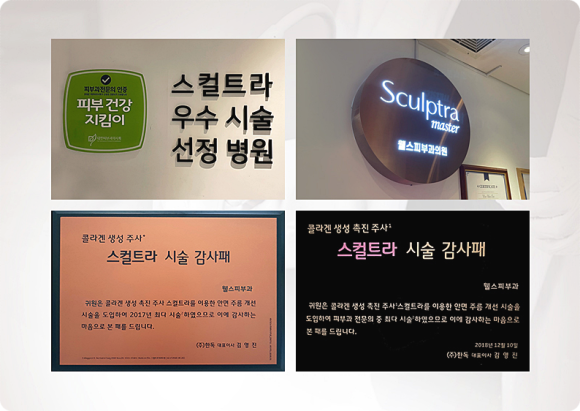
Because collagen that has formed tends to last relatively long, many people prefer it when they want a natural-looking improvement in facial impression.
But on the other hand,
because it is a procedure that induces collagen, the injection process becomes even more important.
This part is also connected to nodules.
- Why do Sculptra nodules occur?
Nodules occur when the injected product does not spread evenly through the skin and instead clumps in one area.
In such cases,
it may feel hard under the skin,
there may be a sense of foreign body sensation when moving,
and in severe cases, it may even become visibly raised.
So why does this happen?

One of the most important reasons is the ‘hydration process.’
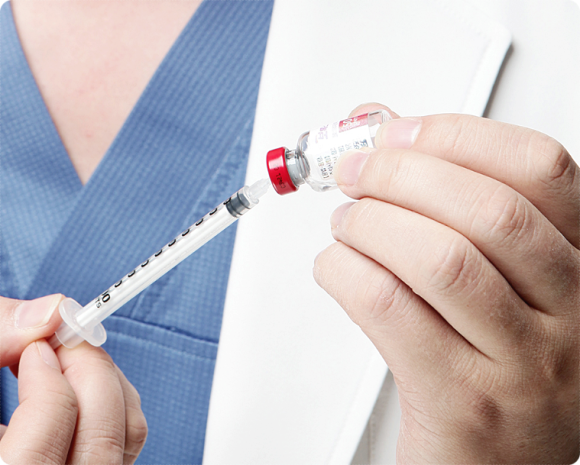
Sculptra is used after fully dissolving PLLA in powder form,
and if this process is not done properly, the particles may not disperse evenly.
In other words,
dilution concentration
hydration time
particle dispersion process
If these steps are not prepared properly, the risk of nodules can increase.

In addition,
depth of injection
layer selection
dose adjustment by area
These factors also have an influence.
That is why Sculptra is not a procedure where only the product matters,
but one in which the preparation process and the clinician’s experience have a very large impact on the outcome.
- Wells Dermatology predicts and analyzes in advance.
<3D stereoscopic imaging device>
Before Sculptra treatment at Wells Dermatology,
we first analyze facial volume and the degree of hollowness using a 3D stereoscopic imaging device.
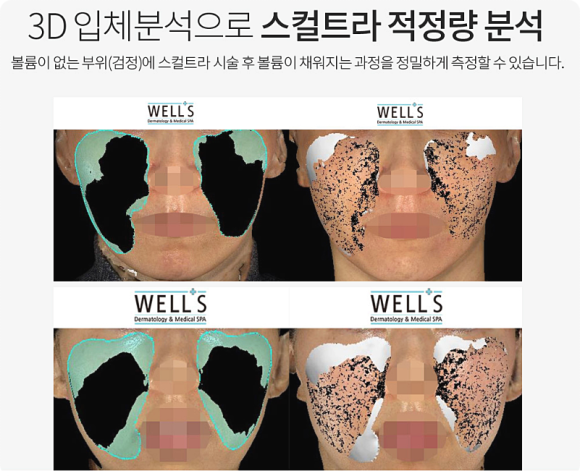
Rather than looking only with the eyes,
this is a process of stereoscopically checking which areas are actually sunken and how much volume correction is needed.
Through this process,
we reduce unnecessary excessive dosing,
and design the appropriate amount for each area more precisely.
Another important point is that
the actual treatment results can be directly compared and checked using data.
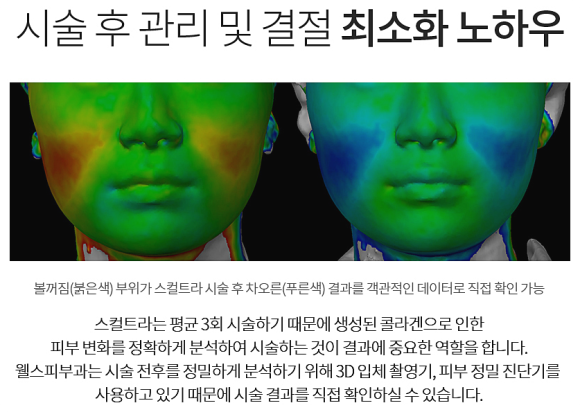
Through this process, we have continuously analyzed the clinical predictability of Sculptra results—something that had never been clearly presented before—and also gave a symposium presentation.
Simply put,
we continuously track
which facial structures,
which layer,
and what amount is injected,
and in what direction changes appear.
The reason this is important is that the more predictable the result becomes, the more we can reduce overcorrection or concentrated injection into specific areas,
which can ultimately help prevent side effects such as nodules.
Of course, that is not the end of it.
Sculptra is a procedure in which sufficient hydration and real-world clinical experience are extremely important.
Even with the same dose,
which layer it is placed in,
how it is dispersed,
how it is adjusted depending on skin thickness,
can lead to large differences in outcome.
That is why, rather than simply being a procedure that “injects a lot,” we place greater importance on how evenly and stably it is designed to spread.
In closing,
Sculptra nodules are not a side effect that will definitely happen.
Rather,
a sufficient hydration process
appropriate dose design
accurate layer selection
extensive clinical experience
These are areas that can be sufficiently reduced depending on how carefully they are managed.
So rather than simply thinking, “Sculptra is scary,”
it is important to first check how the procedure is prepared and carried out.
If you have been considering Sculptra but hesitating because of nodules, I hope today’s post was even a little helpful.
Thank you for reading this long post.
This has been Choi Won-woo, CEO of Wells Dermatology.
[Posts you may also like]
Best 1. Introduction
Best 2. Differences between Sculptra and fillers
Best 3. Causes and prevention of Sculptra nodules
| Wells Dermatology main phone number (click the number below to connect) |
|---|
| 02 - 542 - 2372 |
| Clinic hours |
|---|
| Weekdays 10:00 ~ 20:00 |
| Saturday 10:00 ~ 17:00 |
| Lunch break 13:00 ~ 14:00 |
| Closed on Sundays and public holidays |
This post was written directly by Wells Dermatology Clinic and complies with all advertising regulations for medical services, including Article 56, Paragraph 1 of the Medical Service Act.
All surgeries and procedures may be accompanied by side effects depending on the individual, so please receive sufficient guidance from medical staff and carefully decide whether to proceed with treatment.