
Hello.
I am Ryu Hyo-seop, a dermatologist with 23 years of experience.
Perhaps you have experienced a moment on your way to work, when you hesitated before reaching for a handrail on a crowded subway. Or perhaps you have felt embarrassed when sweat began to soak through your shirt as you turned the pages of presentation materials before an important meeting. Some people sweat uncontrollably in specific areas whenever the weather gets just a little warmer or they feel psychologically tense.
The underarms are particularly noticeable because clothing can become wet easily, making you more conscious of other people's attention. As a result, it is easy to experience psychological withdrawal in interpersonal relationships or everyday social situations. If the condition has reached a level that lowers your quality of life, it is wise to actively seek improvement through a medical approach rather than leaving it untreated.
Today, I will take a close look at why excessive secretion tends to be concentrated in this area, the treatment methods designed to improve hyperhidrosis quickly and efficiently, and the essential criteria you should check to make a well-informed choice.
Contents
-
How sweating is reduced and when results appear
-
Why precise, personalized treatment by a medical professional is important
-
Tips for reducing pain and precautions after treatment
-
Why you should prepare for underarm Botox treatment for hyperhidrosis now
-
Conclusion
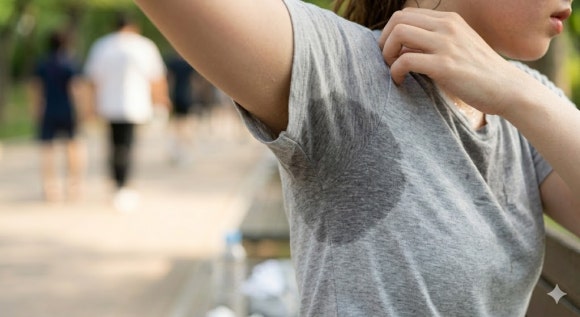
How sweating is reduced and when results appear
Hyperhidrosis refers to a condition in which the body continuously produces excessive secretions beyond the normal range required for regulating body temperature. When this occurs predominantly in specific areas such as the hands, feet, face, or underarms, it is called the “localized” form. These areas have a particularly high density of eccrine and apocrine glands due to their anatomical structure. They respond sensitively even to small emotional changes or slight increases in temperature, inducing excessive secretion.
The most representative and widely used option for treating localized hyperhidrosis is Botox injections. How can a substance known for smoothing wrinkles reduce the flow of sweat? The principle is surprisingly clear.
For a signal to be transmitted, an instruction sent from the brain must cause the nerve endings to release a substance called “acetylcholine,” which stimulates the glands. The medication temporarily blocks the release of this substance. As the signaling system is interrupted, the glands no longer receive the instruction, naturally suppressing excessive secretion as a result.
About 3–7 days after the injections, you may begin to notice the area gradually becoming drier, and after approximately two weeks, it generally reaches a stable state. The duration varies depending on each person's metabolic rate and activity level, but it usually lasts about 4–6 months.
However, the interval may be brought forward by approximately 1–2 months depending on how active the glands normally are and on the condition of the skin. It is therefore advisable to plan the next treatment according to your individual condition.
Why precise, personalized treatment by a medical professional is important
Some people regard this treatment for the underarms as nothing more than a simple injection and choose a clinic based only on cost. However, the skin in this area is thin, and fine nerves and blood vessels pass through it in a complex arrangement. To achieve satisfactory results and reduce the risk of side effects, precise, personalized treatment design by an experienced specialist must come first.
The size of the treatment area differs from person to person, as does the central area where the major glands are densely distributed. In some people, sweating appears evenly across a broad area, while in others it is concentrated in a particular localized area. Therefore, it is essential to accurately determine the overall treatment range and carefully design the injection points.
The depth of the skin layer into which Botox is injected is also crucial. When correcting hyperhidrosis, it should be injected very shallowly and evenly into the dermal layer, where the glands are located, rather than into the muscle layer. If the injection is too deep and the medication reaches the muscles, temporary weakness or an awkward sensation in the surrounding muscles may occur. Conversely, if the injection is too shallow or the distribution is uneven, the medication may not be properly absorbed, reducing the blocking effect.
An experienced specialist accurately assesses each person's skin thickness, elasticity, and distribution through visual examination and palpation, then injects the appropriate dose closely spaced at a consistent depth. These differences in detail are what determine the quality of the result and its duration.
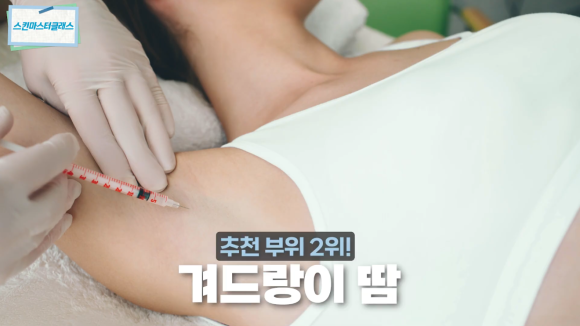
Tips for reducing pain and precautions after treatment
One of the main reasons many people hesitate to proceed is fear of “pain” and “side effects.” Since the underarms are a sensitive area with many nerves, you may feel the needle more acutely as it enters. To minimize this, sufficient numbing cream may be applied before treatment, or a cooling system may be used immediately beforehand to cool the area and reduce sensation.
In addition, because very fine nano-needles are used, people who have undergone the treatment often say, “It was tolerable because it only stung briefly and was less painful than I expected.”
Immediately after Botox injections, the injection sites may become raised, resembling mosquito bites. This is a natural reaction that can occur as the medication remains in the skin layer and is absorbed, and it usually disappears within approximately 2–3 hours.
To maintain successful results safely for a long time, it is also important to be familiar with the aftercare instructions. To help prevent inflammation, it is advisable to avoid hot saunas and strenuous exercise for about one week.
In particular, excessive alcohol consumption can dilate the blood vessels and encourage the medication to spread, so it is better to refrain from drinking for the time being. Skin reactions vary from person to person, so if unusual symptoms persist, it is advisable to visit the clinic.

Why you should prepare for underarm Botox treatment for hyperhidrosis now
Unlike surgical methods that remove the sweat glands entirely, this approach for treating hyperhidrosis does not involve incisions or require a separate recovery period, allowing you to return to daily activities immediately afterward. So when is the best time to receive it? As mentioned earlier, it takes approximately 1–2 weeks for the effects to fully appear. Therefore, the most appropriate “golden timing” is before the intense summer heat begins or before an important long-term schedule or job interview.
Finally, I will summarize clear criteria for choosing the right medical institution for satisfactory results.
First, rather than being swayed solely by an inexpensive promotional price, check whether an authentic product is used and whether the exact dosage is disclosed and the treatment is carried out transparently.
Second, determine whether the clinic is a place where a specialist with extensive clinical experience in accurately assessing differences in individual skin thickness and gland density personally provides the consultation and performs the procedure.
Third, it is important to check whether it is a trustworthy facility that provides aftercare instructions and systematic follow-up management.
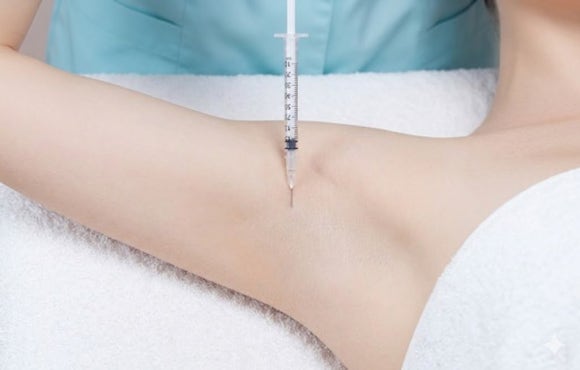
Conclusion
Excessive sweating in the underarms can become a major concern that takes away your confidence in daily life, going beyond being simply a matter of individual constitution. Rather than enduring the stress alone with antiperspirants, we hope you can regain a confident, dry everyday life this season with precise medical assistance.
Thank you.
[Recommended reading]
Four cost-effective treatments most frequently sought by men at dermatology clinics (including Botox and hair removal)
How to reduce the appearance of pores, from home care to professional treatments <Why pores become enlarged and how to manage them>
“Make sure to get Botox in these areas!” A dermatologist with 23 years of experience explains the golden spots for Botox and how to receive treatment without side effects!