Hello.
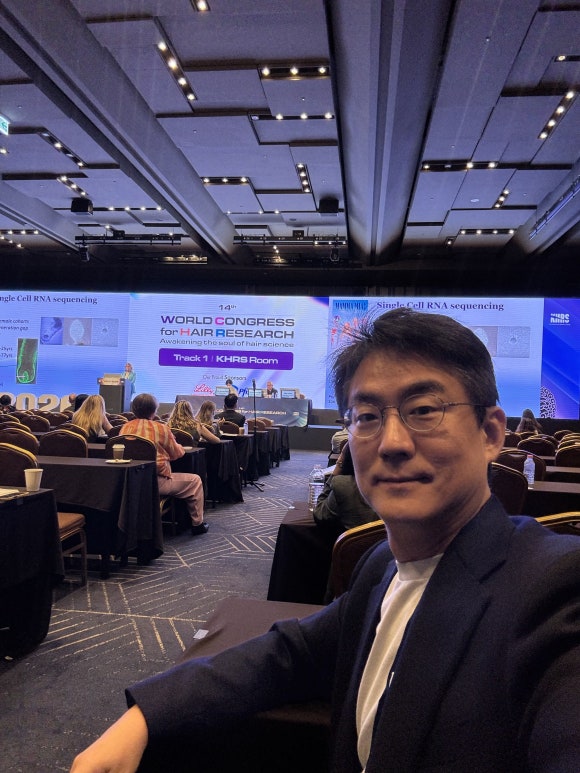
I am Choi Won-woo,
Director of Apgujeong Wells Dermatology
and a board-certified dermatologist.
When I meet patients in the consultation room, I often see people who are concerned about their hair density and scalp—not only those in their 20s and 30s, but also those entering middle and older age after their 40s, unlike in the past.
“Doctor, I think my forehead hairline has become wider than before.”
“My hair has become thin and limp, and it keeps falling out, so the crown looks sparse.”
Many patients express concerns like these.
When hair begins to fall out, it is easy to think only of hereditary hair loss. However, the changes experienced after middle age should be approached not simply as androgenetic hair loss, but as “hair aging”—a process in which the scalp and hair itself age—in order to determine the right direction for treatment.
In today’s post, I will medically examine the fundamental reasons hair becomes thinner and loses its strength with age, and provide a detailed introduction to the scientific principles and clinical effects of CeraXosome, an innovative hair-aging treatment substance that has recently attracted intense interest from leading international dermatology research societies and the global medical community.
Table of Contents
-
Why Hair Becomes Thinner and Loses Its Strength: The Mechanism of Hair Aging
-
A New Paradigm for Scalp Health: The Essence of CeraXosome
-
Scientific Effects Highlighted by the Leading Dermatology Journal Experimental Dermatology
-
Wells Dermatology’s Systematic CeraXosome Program
-
Conclusion
Why Hair Becomes Thinner and Loses Its Strength: The Mechanism of Hair Aging
Just as our skin develops wrinkles and loses elasticity with age, the scalp and hair follicle cells also undergo a precise aging process.
According to clinical research data, hair diameter decreases noticeably with age compared with childhood or young adulthood, while hair hardness and elastic modulus also show a significant decline. In other words, the physical thinning and weakening of the hair itself are key characteristics of aging.
The fundamental cause of this miniaturization and thinning of the hair lies in the aging of dermal papilla cells (DPCs) in the scalp. Accumulated oxidative stress (ROS) and androgenic stress, including DHT, promote the premature aging of dermal papilla cells.
As cellular aging progresses, Wnt/β-catenin signaling, a key signaling system that induces hair growth, decreases sharply. At the same time, inflammatory secretory factors that accelerate the transition from the hair growth phase (Anagen) to the regression phase (Catagen) increase, eventually causing the hair follicles to undergo progressive miniaturization. As the follicles become smaller, the hair growing from them inevitably becomes thinner as well. Therefore, the key to treating hair aging is to awaken aged and miniaturized follicle cells and reactivate the signaling systems essential for hair growth.
A New Paradigm for Scalp Health: The Essence of CeraXosome
The key substance actively used at Wells Dermatology to treat hair aging and miniaturization, and one attracting attention from the medical community worldwide, is CeraXosome.
CeraXosome originates from a type of highly beneficial scalp microorganism called Sphingomonas. This beneficial microorganism, which plays an important role in the microbiome ecosystem of the scalp, is precisely fermented, after which only exosomes—ultrafine particles that mediate intercellular signaling—are purified and extracted. The resulting substance is CeraXosome.
In particular, CeraEV, the core component of CeraXosome, is predominantly composed of sphinganine, an ingredient that firmly supports the skin barrier and hair structure. This creates an excellent synergistic effect in strengthening the scalp barrier and activating follicle cells. It also has exceptional thermal stability: the concentration and size of its active cellular components remain uniform and stable even after undergoing high-temperature sterilization at least twice. This gives it the distinctive advantage of delivering its full active energy deep into the scalp when combined with medical care such as scalp lasers or MTS.
Scientific Effects Highlighted by the Leading Dermatology Journal Experimental Dermatology
The effects of CeraXosome in promoting hair growth and improving hair thickness do not rely merely on subjective experience; they have been demonstrated through rigorous scientific experiments and clinical data. In fact, research findings related to CeraXosome are scheduled to be published soon in Experimental Dermatology, a globally prestigious dermatology research journal, and its academic value and innovation have been officially recognized by the international dermatology community.
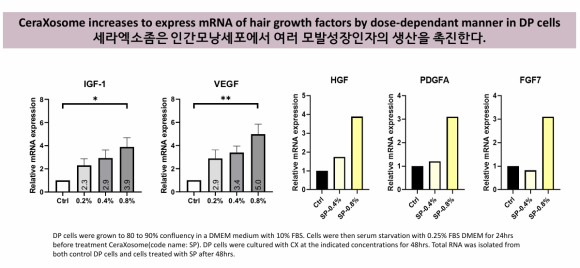
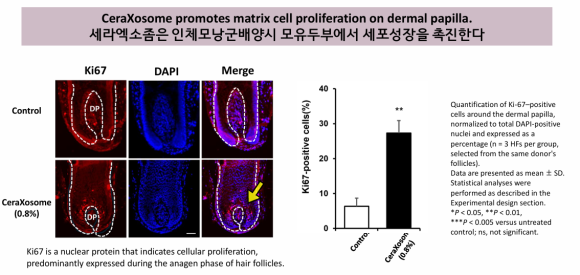
According to the study, when applied to human hair follicle cells, CeraXosome significantly increased, in a concentration-dependent manner, the mRNA expression of representative hair-growth factors such as IGF-1, VEGF, HGF, and FGF7. It also strongly reactivated the Wnt/β-catenin signaling pathway, which had been halted by aging within the follicle cells, and substantially increased Ki67, a marker that helps prevent cell death and supports cell proliferation.
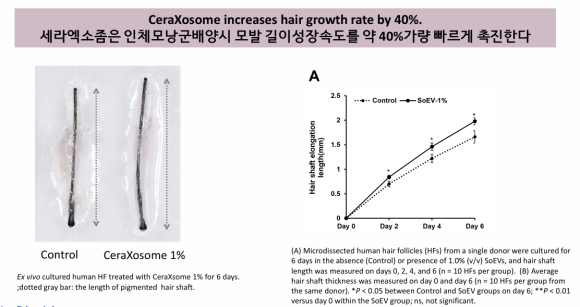
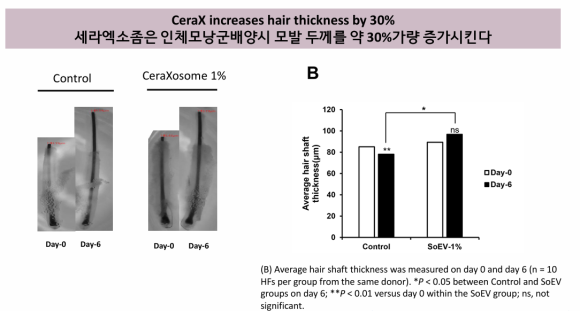
The most notable finding came from an ex vivo study of human hair follicle groups. When CeraXosome was administered and observed under conditions similar to an aged scalp environment, the rate of hair-length growth was promoted by approximately 40% compared with the control group, while hair thickness increased by approximately 30%. Its excellent scalp permeability, allowing it to penetrate deeply to a depth of approximately 112 ± 10.5 μm, enables it to act directly on the signaling systems of follicle cells, producing these dramatic changes.
Wells Dermatology’s Systematic CeraXosome Program
At Apgujeong Wells Dermatology, we provide customized CeraXosome programs after precisely assessing each patient’s stage of scalp aging and hair condition based on this academic evidence.
Treatment is generally conducted systematically at two-week intervals. Before the procedure, we scientifically assess the current scalp environment through detailed photography and scalp microbiome analysis. We then carefully apply a local anesthetic spray to the scalp and hairline, taking even the minor pain that may occur during the procedure into consideration, and wait approximately three minutes.
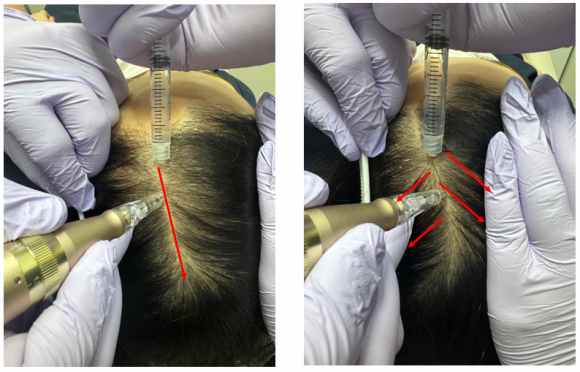
Once the anesthesia has taken effect, a concentrated dose of the active ingredients in one vial of CeraXosome (2.5 ml) is carefully introduced into the crown (Vertex) and hairline areas using autoMTS, a microneedling treatment device. This process is performed safely with a precisely controlled needle depth of 0.25 mm or less to minimize epidermal damage while allowing the active ingredients to fully reach the depth at which the dermal papilla cells are located.
In addition, to maximize the effects of in-clinic treatment, home care with D'tology NMN supplies energy to aged follicles and physically extends the hair growth phase (Anagen), creating a complete treatment synergy that fills from within and supports from the outside.
Very satisfactory improvements in hair volume have been observed in women with hair loss around menopause and in patients with scalp aging whose part has widened with age.
Conclusion
Just as we receive anti-aging treatments to prevent skin aging, our scalp and hair also require professional anti-aging care before they become thinner and lose their strength. Rather than leaving age-related hair changes unattended as a natural part of aging or relying solely on unverified home care, it is wise to begin scientific treatment that restores hair-growth signals at the cellular level.
Wells Dermatology has board-certified dermatologists with more than 20 years of extensive clinical experience on staff and provides the safest and most effective scalp revitalizing solutions based on the latest medical approaches, including CeraXosome, which is receiving worldwide attention.
If you have become increasingly concerned about noticeably thinner hair and weaker volume whenever you look in the mirror, please feel free to visit us at any time for a systematic diagnosis and treatment.
Thank you.
[Related Articles]
It May Be “Hair Aging,” Not Hair Loss: Reconsidering Hair-Loss Treatment in Middle Age with CeraXosome
Hair Rejuvenation Therapy: Revitalizing Hair with CeraXosome and D'tology NMN
Hair That Is Gradually Becoming Thinner and Less Dense… Hair Loss That Also Affects Women: How Should It Be Treated?