
What Is the Difference Between a Dermatology Specialist and a Non-Specialist? <How to Tell Them Apart>
Hello.
I am Choi Won-woo, a dermatologist with 23 years of experience.
Recently, when watching variety shows or browsing social media,
"Doctor, are you a specialist?"
seems to be a line that has attracted a lot of attention.
In fact, many people are curious about "the difference between a dermatology specialist and a non-specialist."

The truth is that this question is more difficult to answer than you might expect.
That is because I have friends who are not dermatology specialists but perform cosmetic dermatology procedures.
So rather than saying who is better or who performs better,
I think it is more appropriate to explain what training a dermatology specialist undergoes
and where the differences arise.
Today, I will focus on the questions I am most often asked about dermatology specialists.^^
What do dermatology specialists learn during their four years of training?
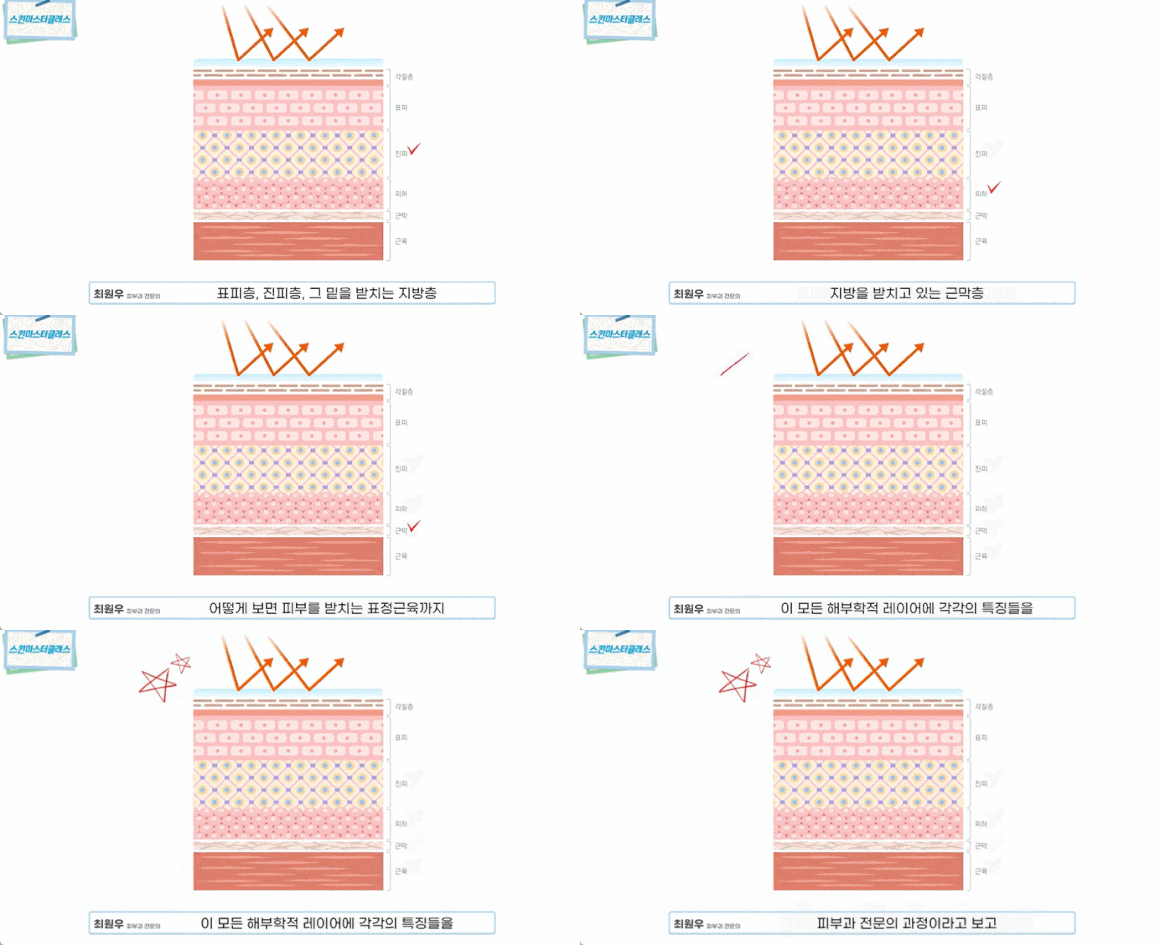
After graduating from medical school and obtaining a medical license,
a dermatology specialist completes an internship and then undergoes four years of dermatology residency training.
During this process, they study the skin as an organ in its entirety.
The stratum corneum,
the epidermis,
the dermis,
the subcutaneous fat layer,
the fascia,
and even the muscles that move the skin.
They learn the structure and functions of every layer that makes up the skin.

It is not simply a matter of saying, "The pigmentation improved after using this laser."
They learn why it improved,
which layer was affected,
what side effects can be expected,
and how to address a problem if one occurs.
Rather than gaining experience only with specific procedures and their visible effects, dermatology specialist training is a process of building systematic knowledge about the anatomical effects of the procedures being performed on the skin,
what problems can be expected,
and how to find anatomical solutions when such problems arise.
Skin diseases are more difficult to diagnose than you might think.
Many people think that skin diseases can be identified simply by looking at them.
However, even skin that appears red and raised
could be simple dermatitis,
an infection,
or an immune-related disease.

Even scaling that looks similar
could be simple dryness
or psoriasis.
As you can see, even when conditions look similar on the surface,
their causes and treatment methods can often be completely different.
That is why dermatology specialist training includes gaining experience in diagnosing and treating
not only normal skin but also a wide range of skin diseases.

During my own training,
I treated patients with a variety of skin diseases, including
atopic dermatitis,
psoriasis,
acne,
rosacea,
and allergic diseases,
and also conducted related research.
So even when sudden changes occur in the skin,
I first look into why those changes occurred rather than looking only at the symptoms.
How can you tell whether someone is a dermatology specialist?
This is something that more people are unaware of than you might expect.
A dermatology specialist can also be identified by the clinic sign.

For example, when dermatology is used as part of the official name, such as "Wells Dermatology Clinic," it is a medical institution operated by a dermatology specialist.
On the other hand, some clinics may be named "Wells Clinic,"
with small text underneath stating, "Department of Practice: Dermatology."
In this case, the doctor may not be a dermatology specialist.
Of course, it is not possible to determine everything based on this alone.
That is why I recommend checking one more thing.

It is the dermatology specialist certification mark.
The Korean Association of Dermatologists provides a specialist certification mark that may be used by medical institutions staffed by dermatology specialists.
It can often be found on a clinic's website, in its internal informational materials, or on its sign.
If this mark is present, you may consider the medical institution to be one where a dermatology specialist provides care.
Therefore, if you need care for a skin disease or are considering a dermatological procedure for the first time, checking this information may also be helpful.
In closing,
My intention is not to simply compare dermatology specialists and non-specialists.
A dermatology specialist
is a doctor who has undergone systematic, long-term training in
normal skin,
skin diseases,
skin anatomy,
and an understanding of a variety of procedures.

So when you develop a skin problem,
when you are unsure which procedure you need,
or when you cannot tell whether it is a skin disease or simply a minor skin concern,
I recommend first consulting a dermatology specialist.
A good procedure is important,
but before that, accurately diagnosing your current skin condition is the priority.
Thank you for reading this lengthy post.
I am Choi Won-woo, Medical Director of Wells Dermatology Clinic.
[Recommended Related Posts]
Best 1. Introduction
Best 2. Clarity2, Invited Lecture at APEC Shanghai
Best 3. Thermage MAX Research Results: Skin Age Rejuvenated by 5.3 Years.
| Wells Dermatology Clinic Main Number (Click the number below to connect.) |
|---|
| 02 - 542 - 2372 |
| Clinic Hours |
|---|
| Weekdays 10:00 ~ 20:00 |
| Saturdays 10:00 ~ 17:00 |
| Lunch Break 13:00 ~ 14:00 |
| Closed on Sundays and public holidays |
This post was written directly by Wells Dermatology Clinic and complies with Article 56, Paragraph 1 of the Medical Service Act and all other laws concerning medical advertising.
All surgeries and procedures may be accompanied by side effects depending on the individual. Please receive sufficient information and guidance from your medical provider before carefully deciding whether to undergo a procedure.