※ This post is intended to provide medical information.
It is not subject to review under Articles 56(2) and 57 of the Medical Service Act,
and we would like to clarify that it is not a post intended for advertising purposes.
Hello,
I am Seong Hyeon-ju, director of Cheongdam OK Clinic.
| ▶ Full member of the Korean Academy of Aesthetic Plastic Surgery (KACS) |
|---|
| ▶ Full member of the Korean Society for the Study of Obesity (KSSO) |
| ▶ Full member of the Korean Academy of Aesthetic Medicine and Body Contouring (KAAM) |
| ▶ Full member of the Korean Society of Liposuction and Aesthetic Surgery (KSSL) |
| ▶ Full member of the Korean Society of Aesthetic Surgery (KSAS) |
When consulting with patients about inner-thigh liposuction,
there are several questions I hear more often than expected.
“The lines have become uneven.”
“It still feels hard and lumpy.”
“I lost weight, but it actually looks more saggy.”
The inner thighs are particularly sensitive to changes after surgery
because the skin is thin
and the area moves frequently.
Today, I will explain
why uneven lines,
fibrotic lumpiness, and sagging are often discussed
after inner-thigh liposuction.
| Table of Contents |
|---|
| 1. Why the inner thighs are particularly prone to becoming uneven 2. Why does fibrotic lumpiness occur? 3. Why can sagging occur after fat is removed? 4. Important care points during the recovery process |
- Why the inner thighs are particularly prone to becoming uneven
The skin on the inner thighs is naturally thin,
and the fat layer is not uniform in this area.
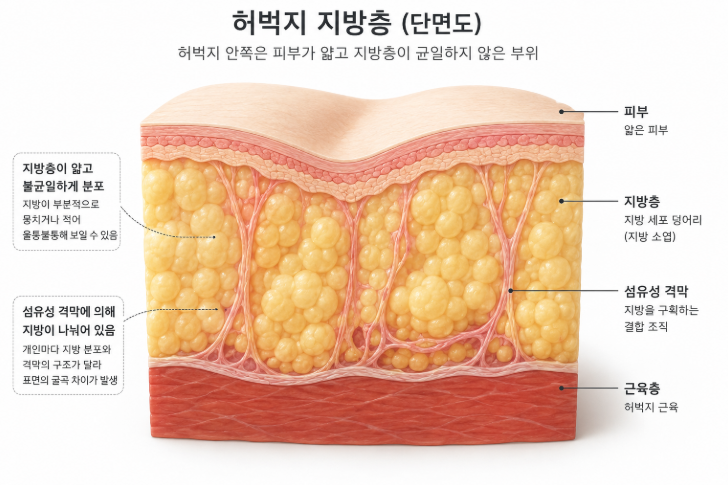
In addition, friction and movement are repeated with every step,
so tissue reactions can be more pronounced
during the recovery process.
If too much fat is removed from one side in this state,
or the layers are not contoured evenly,
the lines may not appear smooth.
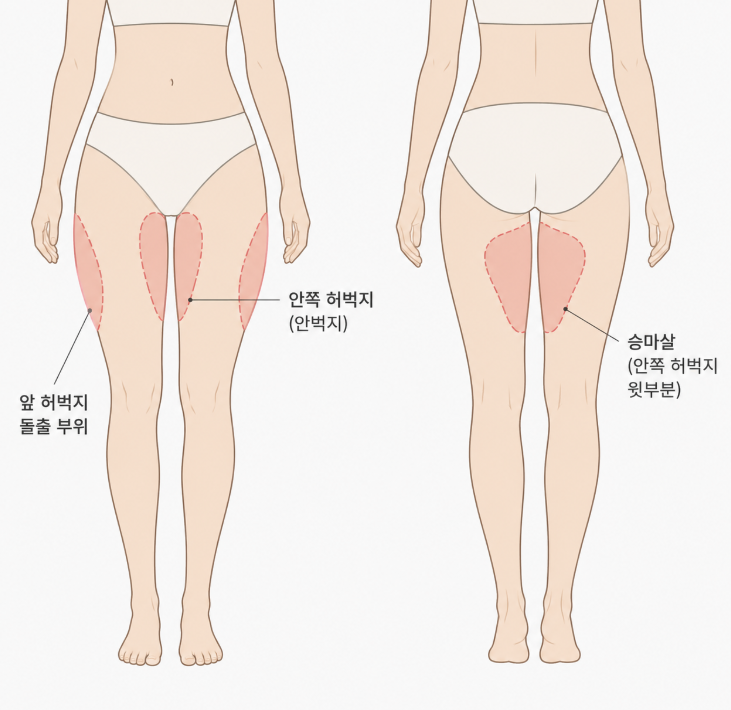
When only the layer directly beneath the skin is suctioned excessively,
indentations or
an uneven surface may become more apparent.
With liposuction, the important point is not simply removing a large amount of fat.
The degree to which the lines are refined depends on
which layers are treated and how evenly they are contoured.
- Why does fibrotic lumpiness occur?
The “fibrotic lumpiness” often mentioned after liposuction
refers to the fibrotic response that occurs during recovery.
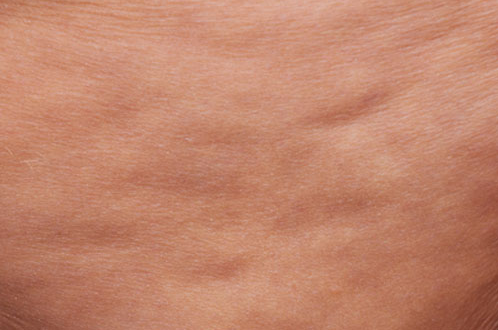
Fibrotic lumpiness
As the tissue recovers after surgery,
the inside of the skin may become firm,
or it may feel lumpy.
This response may be felt for a longer period,
especially in areas with frequent movement and repeated pressure,
such as the inner thighs.
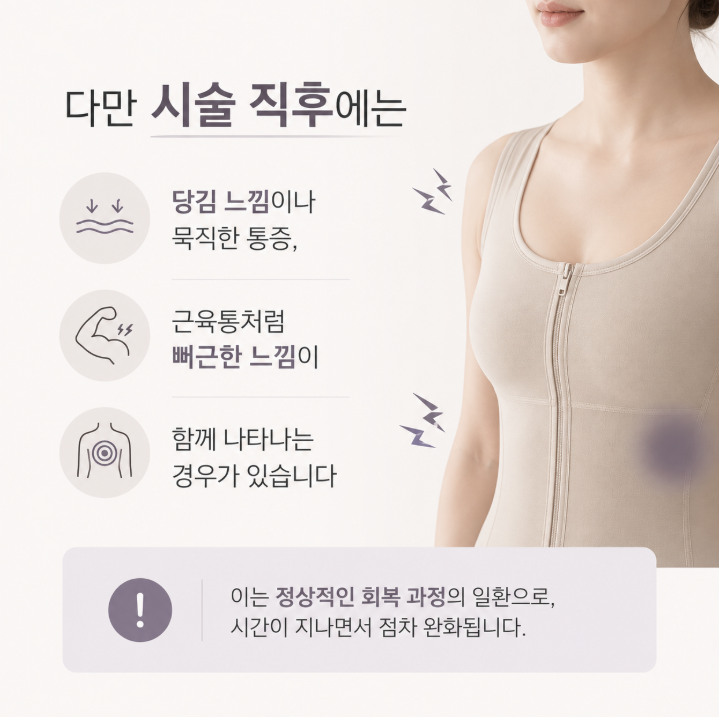
Although the area may initially feel hard and uneven to the touch,
it often gradually becomes softer over time.
However, repeated vigorous massage or strong stimulation
during recovery
can instead increase tissue irritation,
so caution is necessary.
The recovery rate may vary depending on skin elasticity, the extent of suction,
and the amount of fat present beforehand.
- Why can sagging occur after fat is removed?
Some people feel that their lines look less firm even though the amount of fat has decreased.
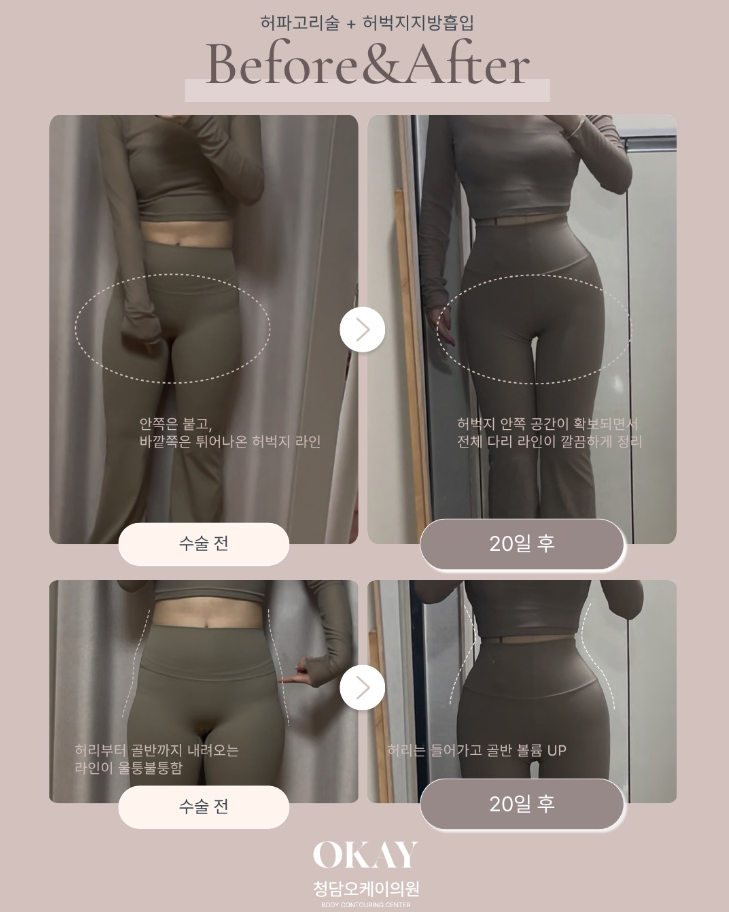
Inner-thigh liposuction
This is because the rate at which the skin contracts
is not the same as the rate at which fat is reduced.
If the amount of fat decreases substantially
while the skin does not have sufficient elasticity,
excess skin may remain on the inner thigh,
creating a sagging appearance.
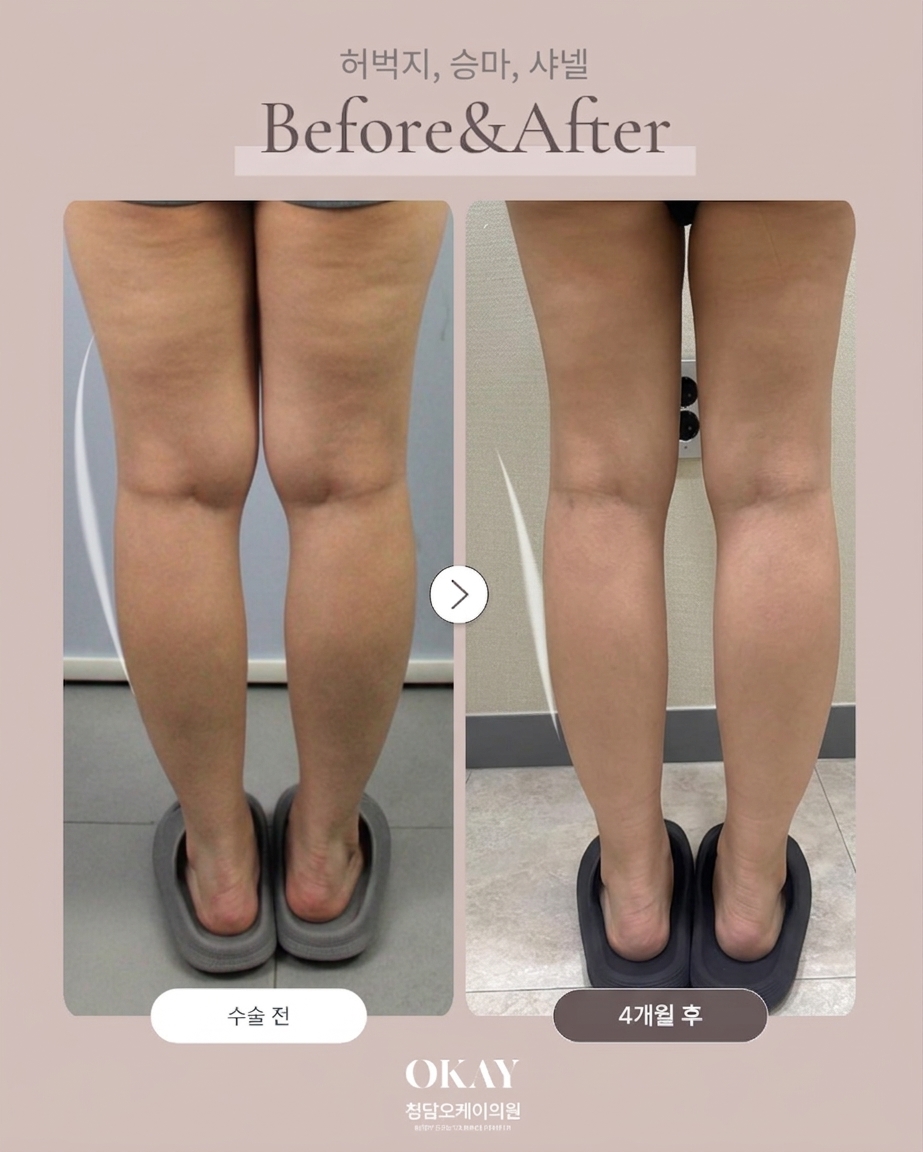
Inner-thigh liposuction
The inner thighs are naturally strongly affected by gravity,
so changes may appear more pronounced
when the skin has reduced elasticity.
In addition, if excessive suction reduces even the fat layer
that was providing support,
the skin may instead appear thin and lacking firmness.
Therefore, inner-thigh liposuction should not be approached with the goal of removing as much as possible.
It is important to consider the overall proportions
and the condition of the skin together.
- Important care points during the recovery process
After inner-thigh liposuction,
early swelling and tissue reactions may persist longer than expected.
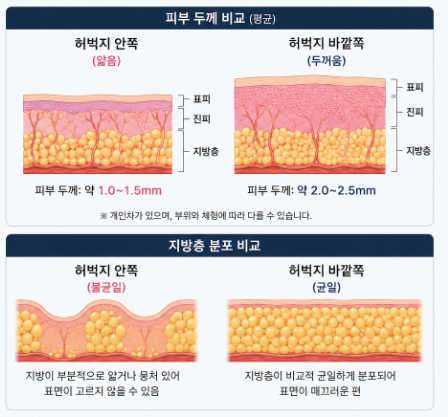
Inner-thigh liposuction
Because the area is continuously stimulated when sitting or walking,
recovery also tends to progress relatively slowly.
The most important factors during this period
are wearing compression garments and managing daily habits.
Remaining in positions that are excessively tight for a long time,
or repeatedly doing strenuous exercise early on,
may worsen swelling and tissue irritation.
Conversely, remaining completely inactive
may also affect the recovery process,
so maintaining light walking can be helpful.
Inner-thigh liposuction
Most importantly, the lines should be designed according to
the current elasticity of the skin and the condition of the fat layer.
Because even small differences can be highly visible in the lines of the inner thighs,
it is important to consider not only the amount removed,
but also overall balance and the recovery process.
↓↓↓ Related content ↓↓↓
-Operating Hours-
| Weekdays 10:00–19:00 (last registration at 18:30)Saturdays 10:00–16:00 (last registration at 15:30)Public holidays / Wednesdays and Sundays regularly closed |
-Inquiries-
| ▶ Cheongdam OK Clinic |
|---|
| Consultation phone: 02-3446-7588KakaoTalk inquiries |
-Directions-
Inner-thigh liposuction