※ This post is content intended to provide medical information.
Under Articles 56(2) and 57 of the Medical Service Act, this content is not subject to review,
and we would like to inform you that this post is not intended as an advertisement.
Hello,
I am Seong Hyeon-ju, director of Cheongdam OK Clinic.

| ▶ Full Member of the Korean Academy of Aesthetic Plastic Surgery (KACS) |
|---|
| ▶ Full Member of the Korean Society for the Study of Obesity (KSSO) |
| ▶ Full Member of the Korean Association for Aesthetic Medicine (KAAM) |
| ▶ Full Member of the Korean Society of Liposuction Surgery (KSSL) |
| ▶ Full Member of the Korean Society for Aesthetic Surgery (KSAS) |
Recently, as interest in body lines has grown alongside interest in the face,
more people have been asking about pelvic fillers.
In particular, many people seek consultations when
their pelvis appears narrow or
hip dips appear prominent,
hoping for a smoother body line.

However, no procedure has
only advantages.
With pelvic fillers as well,
it is important to fully understand
possible side effects and precautions
before the procedure.
Today, we will look at information
that people considering pelvic fillers
may find helpful to know in advance.
| Table of Contents |
|---|
| What are pelvic fillers? Symptoms that may appear after the procedure Why side effects occur Checkpoints for a safe procedure |
- What Are Pelvic Fillers?
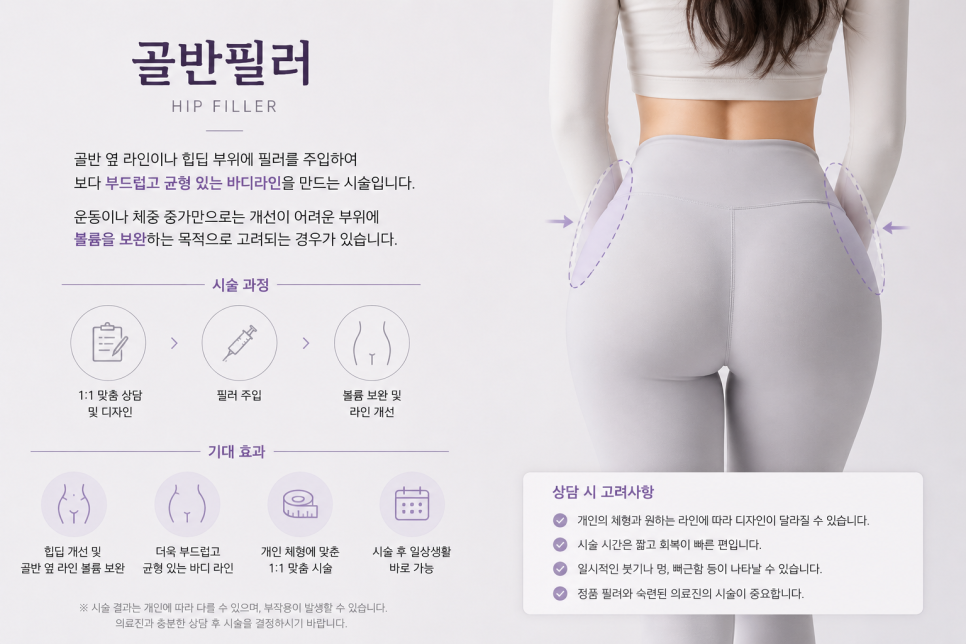
Pelvic fillers are a procedure in which
filler is injected into the side contour of the pelvis or the hip-dip area
to create
a smoother and more balanced
body line.
They may be considered
for the purpose of supplementing volume
in areas that are difficult to improve
through exercise or weight gain alone.

Many people are particularly interested
in creating a more natural-looking curve
from the waist to the pelvis.
However, since this is an area
where a relatively large amount of filler
may be used,
procedural experience and the design process
may be important considerations.
- Symptoms That May Appear After the Procedure
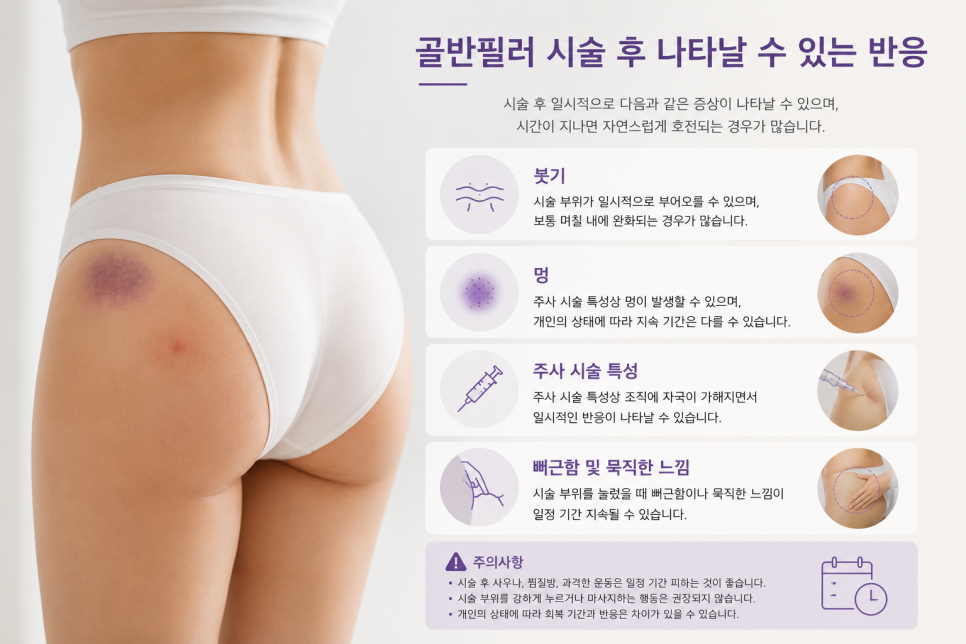
Temporary swelling or bruising
may occur after a pelvic filler procedure.
Because this is an injection-based procedure,
these are often explained as reactions
that may occur when the tissue is stimulated.
In addition, soreness or a heavy sensation
when pressure is applied to the treated area
may continue for a certain period.
In many cases, these symptoms
subside over time,
but recovery speed may vary
depending on the individual’s constitution
and the extent of the procedure.
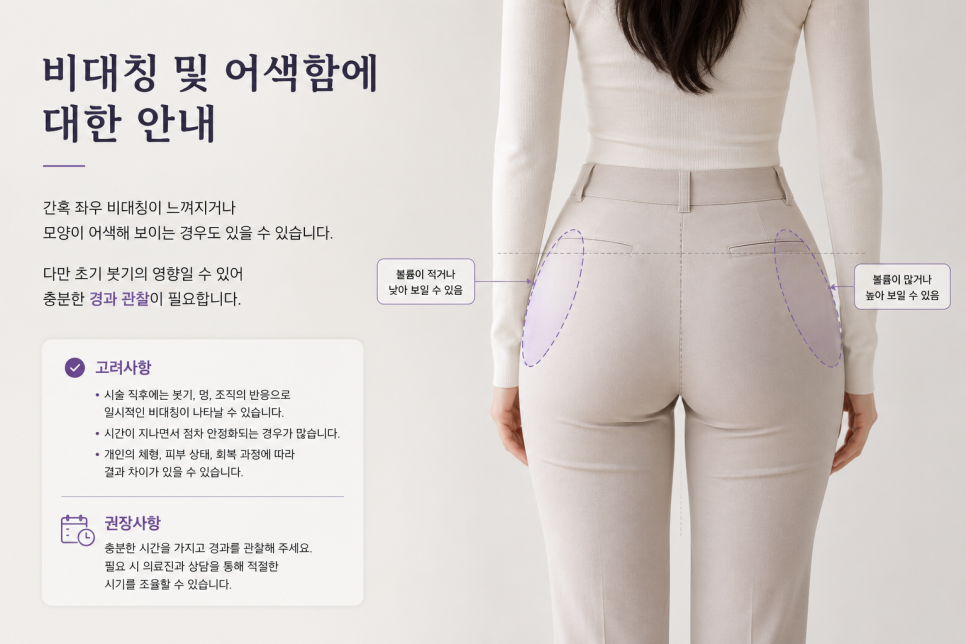
Occasionally, you may notice
left-right asymmetry or an unnatural appearance.
However, this may be due to
swelling during the initial stage,
so sufficient observation over time is needed.
- Why Side Effects Occur
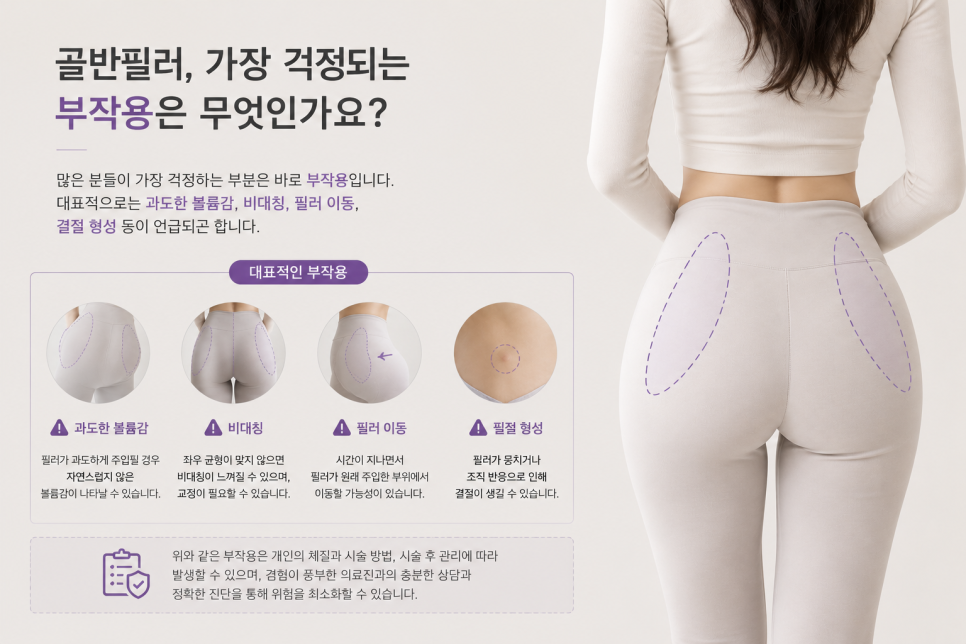
The issue that concerns many people most
is side effects.
Commonly mentioned examples include
excessive volume, asymmetry, filler migration,
and nodule formation.
The pelvic area, in particular,
is an area that moves frequently.
Therefore, a treatment plan that takes
the individual’s body shape and lifestyle
into account is important.
Also, injecting an unnecessarily large amount
does not always lead to
a good result.
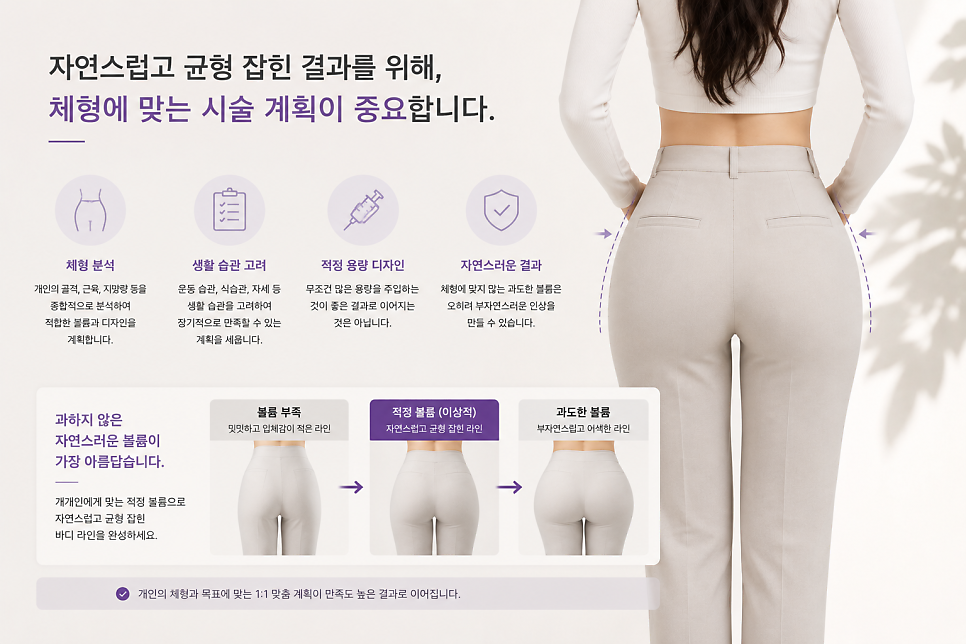
Excessive volume that does not suit the body shape
may instead create an unnatural appearance.
Since results may vary depending on
the type of filler, injection site,
and amount used,
it is important to have a sufficient consultation process.
- Checkpoints for a Safe Procedure
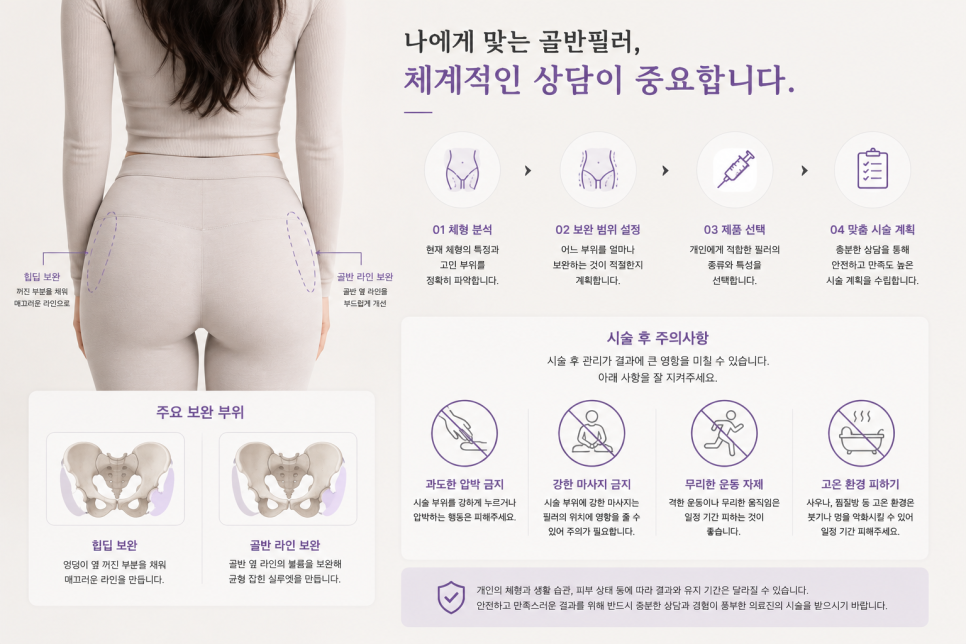
If you are considering pelvic fillers,
rather than comparing prices alone,
it is advisable to also check
the provider’s experience and consultation process.
It is important to receive a thorough consultation
about the characteristics of your current body shape,
which areas should be supplemented
and to what extent,
and which product is appropriate.
It is also important to follow
post-procedure precautions carefully.
Excessive pressure,
strong massage,
and strenuous exercise
may need to be avoided
for a certain period.
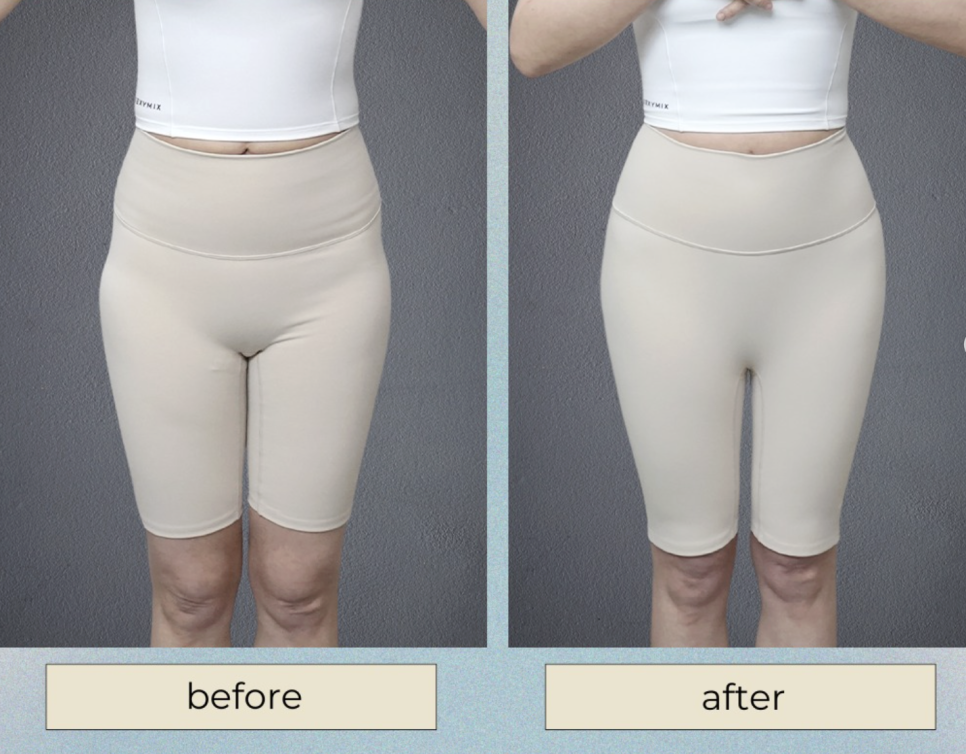
Since pelvic fillers are performed
with consideration for body shape and contours,
a plan suited to the individual is important.
Through a sufficient consultation before the procedure,
accurately confirming the changes that can be expected
and the precautions to observe
may help improve satisfaction.
↓↓↓ Content You May Also Find Helpful ↓↓↓
-Opening Hours-
| Weekdays 10:00–19:00 (last registration at 18:30)<br>Saturdays 10:00–16:00 (last registration at 15:30)<br>Public holidays / Wednesdays and Sundays: Closed regularly |
-Contact-
| ▶ Cheongdam OK Clinic |
|---|
| Consultation phone: 02-3446-7588<br>Contact us via KakaoTalk |
-How to Get Here-