※ This article is content provided for medical information purposes.
Please note that this content does not fall under the scope of review pursuant to Article 56, Paragraph 2 and Article 57 of the Medical Service Act, and is not a post intended for advertising purposes.
Hello,
I am Sung Hyun-joo, director of 청담오케이의원.

| ▶ Full Member of the Korean Academy of Aesthetic Plastic Surgery (KACS) |
|---|
| ▶ Full Member of the Korean Society for the Study of Obesity (KSSO) |
| ▶ Full Member of the Korean Association of Aesthetic Medicine (KAAM) |
| ▶ Full Member of the Korean Society of Liposuction Surgery (KSSL) |
| ▶ Full Member of the Korean Society of Aesthetic Surgery (KSAS) |
When researching hair transplantation,
there is one concern you encounter first.
It is precisely which method to choose:
incision hair transplantation or
non-incision hair transplantation.
There are opinions online that non-incision procedures are better,
while others say that incision procedures are more suitable in certain cases,
which can make the decision even more confusing.
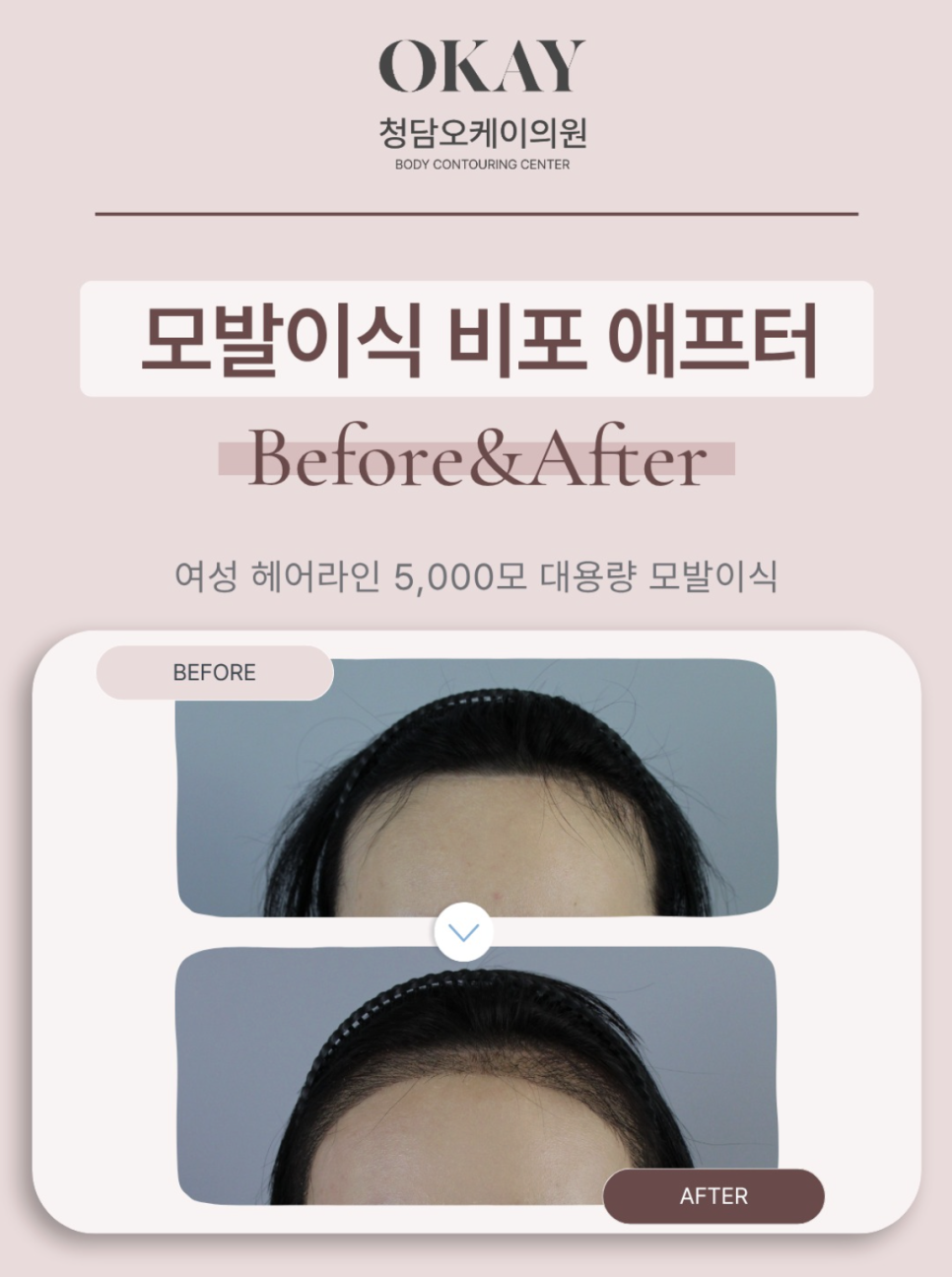
However, the important point is that it is not possible to say that one method is unconditionally
better than the other.
This is because the appropriate method may vary depending on the extent of hair loss, the condition of the donor area,
and the number of follicles needed.
In this article, we will look at the differences between incision and non-incision hair transplantation,
the characteristics of each method, and the criteria that can help you choose between them.
| Table of Contents |
|---|
| 1. What is the biggest difference between incision and non-incision hair transplantation? 2. Characteristics of incision and non-incision hair transplantation 3. What are the criteria for choosing between incision and non-incision hair transplantation? 4. Design is more important than the method itself |
- Incision vs. Non-Incision Hair Transplantation,
What Is the Biggest Difference?
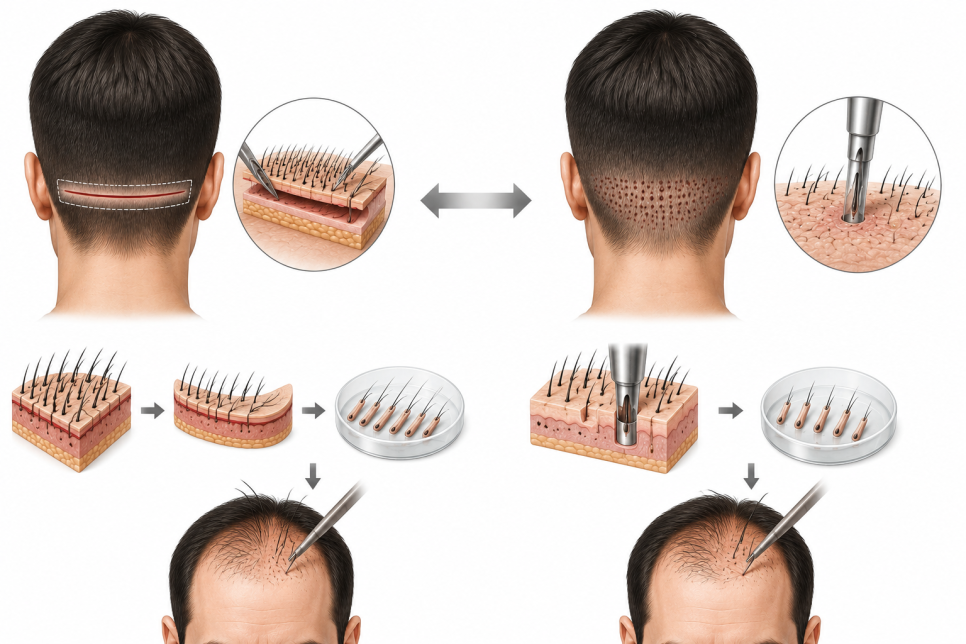
The biggest difference between incision and non-incision hair transplantation
is the method used to harvest the follicles.
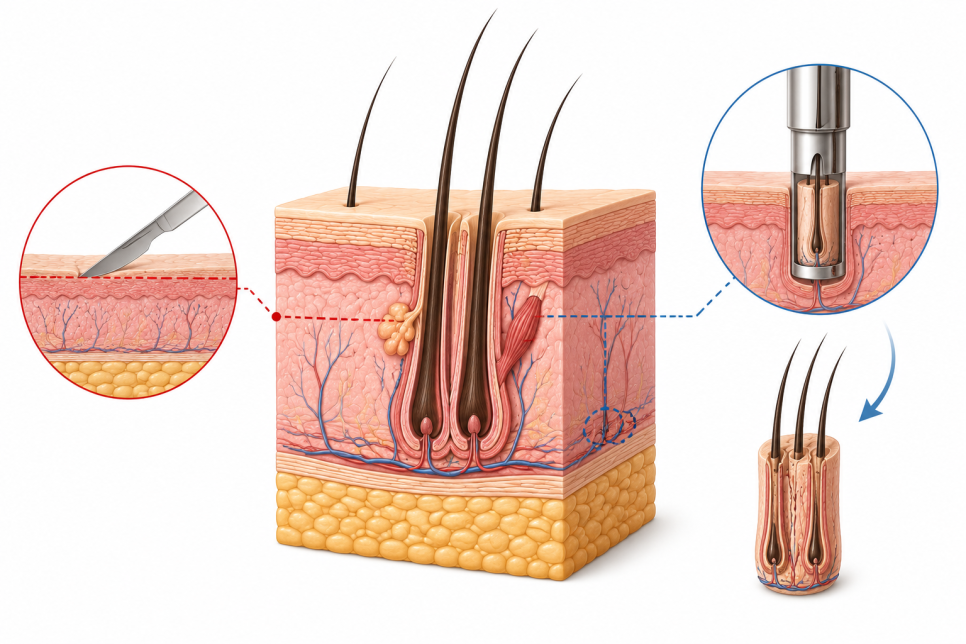
In incision hair transplantation, a section of scalp at the back of the head
is cut out, the follicles are separated,
and then transplanted.
In contrast, non-incision hair transplantation
uses a small punch instrument
to directly harvest the follicles one at a time.
In other words, the transplantation process is similar,
but the difference lies in how the follicles are obtained.
As a result, differences may also occur in the recovery process, the form of scarring,
and the procedure time.
- Differences Between Incision and Non-Incision Hair Transplantation
| Category | Incision Hair Transplantation (FUT) | Non-Incision Hair Transplantation (FUE) |
|---|
| Follicle harvesting | Follicles are harvested by making an incision in the scalp | Follicles are directly harvested one at a time |
| Suturing | Required | Not required |
| Type of scarring | A linear scar may remain | Small dot-shaped extraction marks may appear |
| Recovery process | The sutured area may require time to heal | May involve relatively less burden because there is no suturing process |
| Procedure time | May be relatively short | May take longer depending on the number of follicles harvested |
| Large-scale transplantation | May be considered when many follicles are needed | Possible, but the procedure may take longer depending on the number harvested |
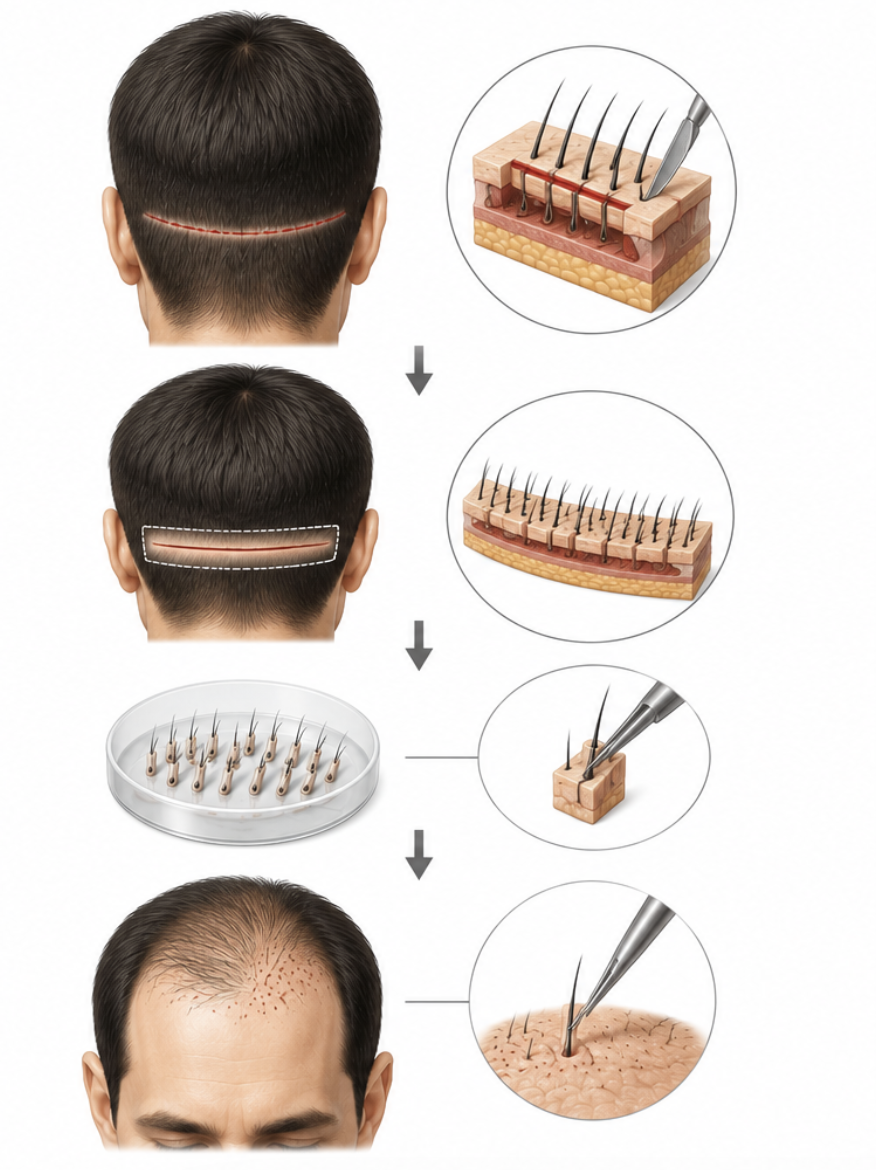
Incision Hair Transplantation (FUT)
Incision hair transplantation involves
making a thin, elongated incision in the scalp at the back of the head,
removing the strip of skin,
and separating the follicles within it one by one
for transplantation.
Procedure
-
Make an incision of a specific length in the scalp at the back of the head
-
Suture the incision
-
Separate the follicles from the harvested strip of skin
-
Transplant the follicles to the areas affected by hair loss
Characteristics
-
May be considered when many follicles need to be harvested at once.
-
A linear scar may remain at the back of the head.
-
The sutured area may require a recovery period.
-
The scar may be noticeable if you frequently maintain a short hairstyle.
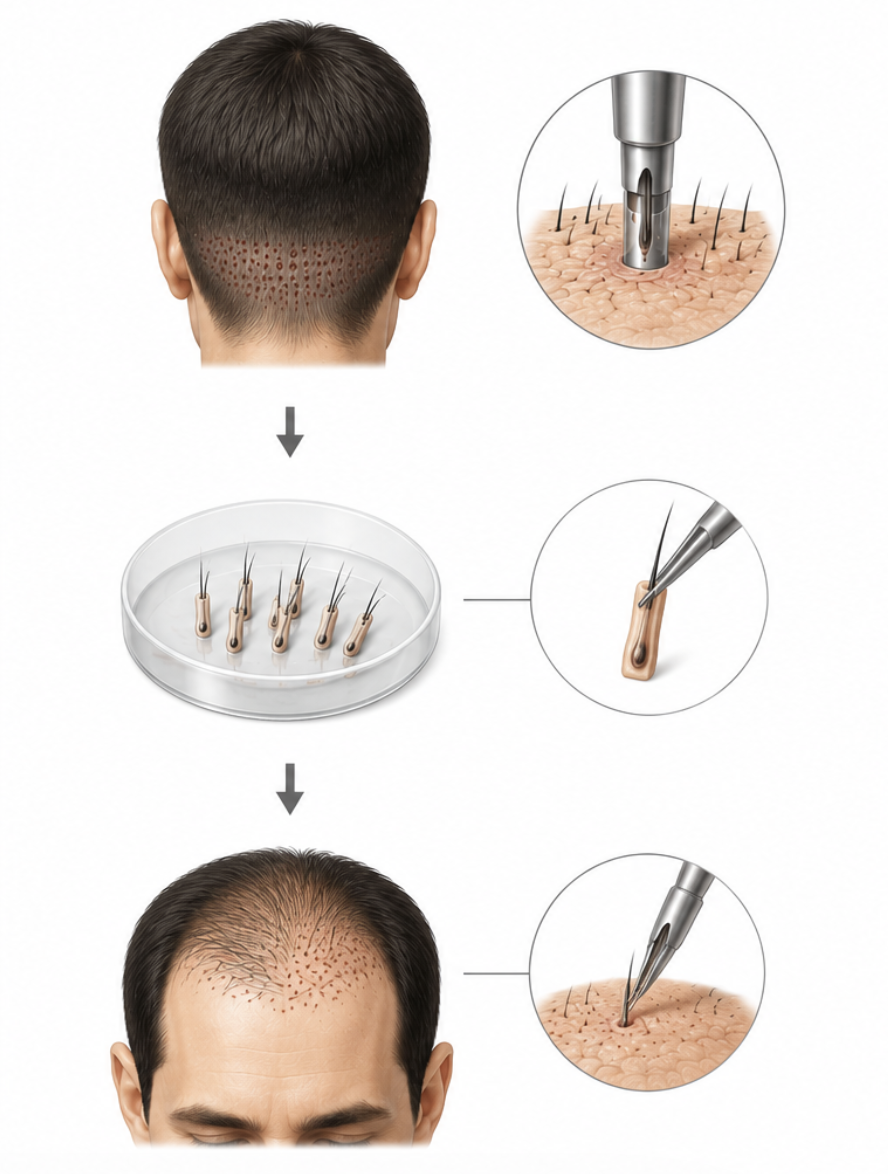
Non-Incision Hair Transplantation (FUE)
Non-incision hair transplantation does not involve making an incision at the back of the head.
Instead, a small punch instrument
is used to directly harvest the follicles one at a time.
Procedure
-
Harvest the follicles one at a time from the back of the head
-
Select the harvested follicles
-
Transplant them one at a time to the areas affected by hair loss
Characteristics
-
There is no incision or suturing process.
-
Small dot-shaped extraction marks may appear and may become less noticeable over time.
-
It is one of the methods chosen by people who prefer short hairstyles.
-
The procedure may take longer depending on the harvesting area and the number of follicles needed.
- What Are the Criteria for Choosing Between Incision and Non-Incision Hair Transplantation?
When choosing between incision and non-incision hair transplantation,
it is better to consider several factors together
rather than deciding based solely on a comparison of scars.
The main factors to examine include:
-
Extent of hair loss
-
Number of follicles needed for transplantation
-
Density of the hair at the back of the head
-
Scalp elasticity
-
Hairstyle normally maintained
-
Whether you have had a previous hair transplant
For example, the approach may differ
between cases requiring many follicles over a wide area
and cases involving the transplantation of a relatively small number of follicles.
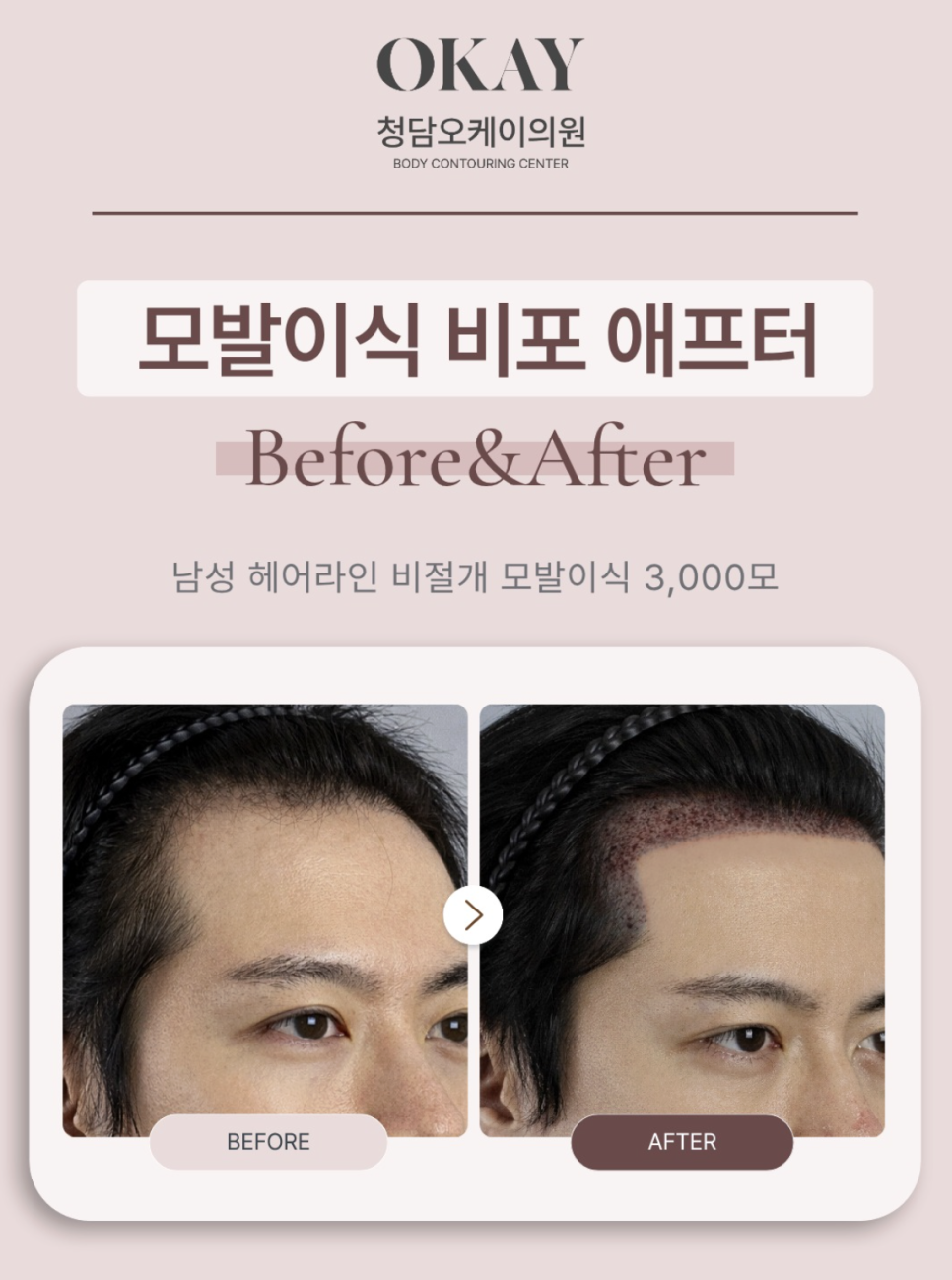
Whether you frequently maintain short hair
may also be one of the factors
that influences the choice of procedure.
Ultimately, each person has a different scalp and hair condition,
so the appropriate method may also differ.
- Design Is More Important Than the Method Itself

With incision and non-incision hair transplantation,
the differences in surgical technique are important,
but what is more important
is a design that considers a natural hairline
and the direction of the hair.
Hair transplantation is not simply a matter of filling empty areas.
The direction and angle of the existing hair,
along with its density,
must also be considered
to achieve a natural appearance.
In particular, the hairline is also connected to the proportions of the face,
so designing it too low or too high
may create an unnatural impression.
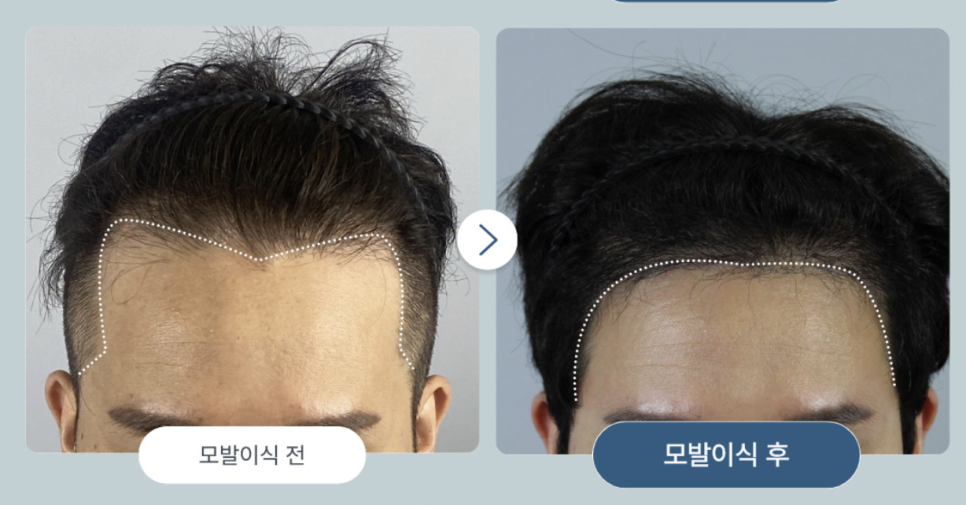
It may also be helpful to establish a plan
while considering how hair loss
may progress in the future.
↓↓↓ Related Content ↓↓↓
-Opening Hours-
| Weekdays 10:00–19:00 (last registration at 18:30) Saturdays 10:00–16:00 (last registration at 15:30) Public holidays / Wednesdays and Sundays: Closed regularly |
-Contact-
| ▶ 청담오케이의원 |
|---|
| Consultation phone: 02-3446-7588 Contact us via KakaoTalk |
-How to Get Here-