※ This post is content intended to provide medical information.
This content is not subject to review under Articles 56(2) and 57 of the Medical Service Act,
and we would like to inform you that it is not posted for advertising purposes.
Hello,
I am Seong Hyeon-ju, director of Cheongdam OK Clinic.

| ▶ Full Member of the Korean Association of Cosmetic and Plastic Surgery (KACS) |
|---|
| ▶ Full Member of the Korean Society for the Study of Obesity (KSSO) |
| ▶ Full Member of the Korean Association for the Aesthetic Management of Obesity (KAAM) |
| ▶ Full Member of the Korean Society of Liposuction Surgery (KSSL) |
| ▶ Full Member of the Korean Society of Aesthetic Surgery (KSAS) |
You exercise consistently,
and manage your diet,
but some people feel that their thighs in particular remain unchanged.
Although their weight has decreased,
their thighs feel tight when they put on pants,
and it is not uncommon for them to feel stressed because their inner thighs continue to rub together.
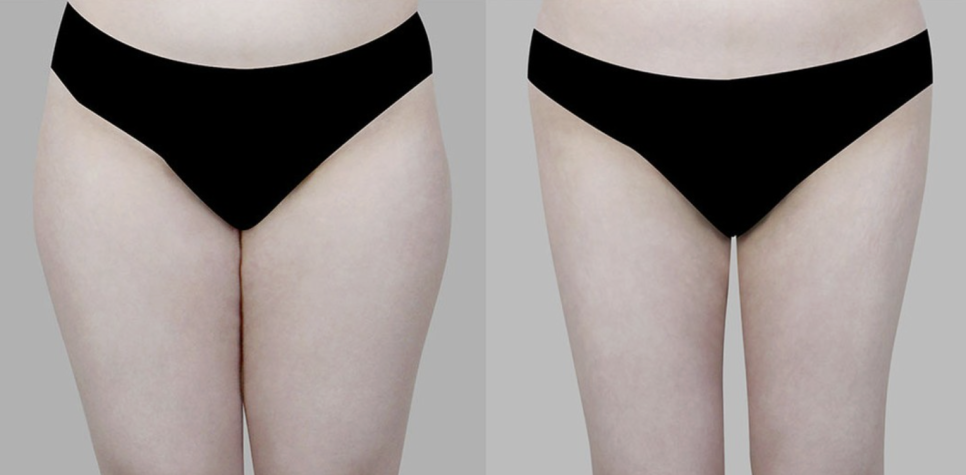
This may lead them to look into thigh liposuction for lower-body obesity,
but many also wonder,
“Why do thighs not lose fat easily through exercise?”
Today, before considering thigh liposuction for lower-body obesity,
we will look at why it can be difficult to achieve changes through exercise alone
and the factors that should be considered together.
| Table of Contents |
|---|
| 1. Why thighs may not change much even with exercise 2. When is thigh liposuction for lower-body obesity needed? 3. Design is more important than removing a large amount 4. Criteria for a natural lower-body line |
- Why thighs may not change much even with exercise
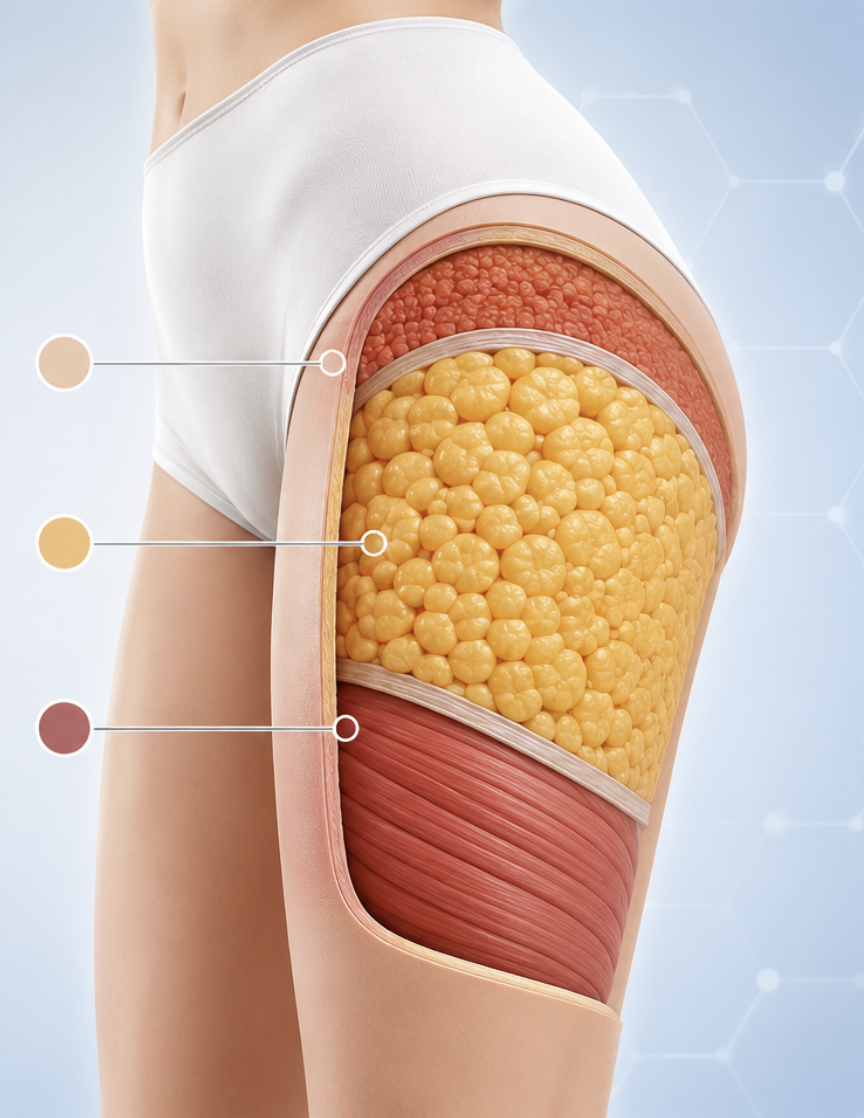
Fat tends to decrease throughout the body together.
However, the order in which fat is lost
may differ from person to person.
Due to factors such as genetic body shape,
hormones,
fat distribution,
and muscle mass,
when fat is concentrated in the thighs,
the lower body may seem to change more slowly
even when weight decreases.
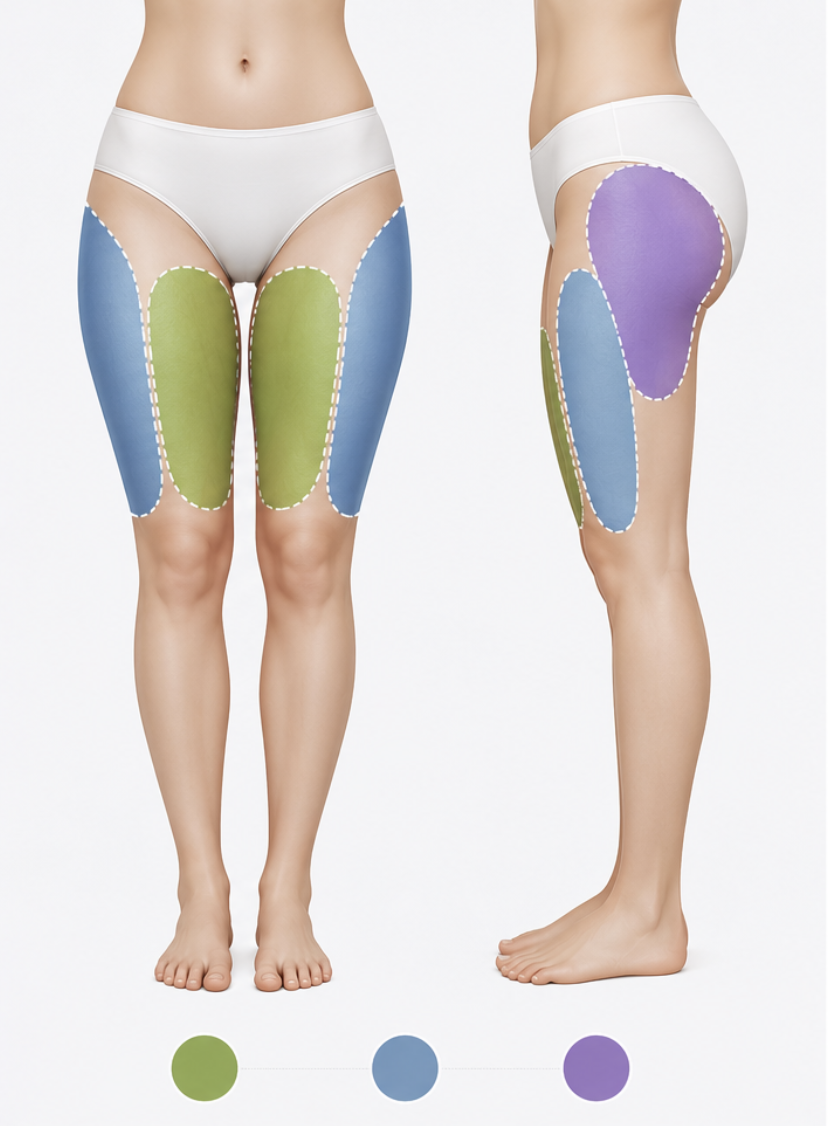
In particular, areas where fat has accumulated locally,
such as the inner thighs,
the outer thighs,
and the riding-breeches area,
may not show satisfactory changes
through exercise and diet alone.
Of course, individual differences exist,
and exercise and lifestyle improvements
play an important role in healthy weight management.
- When is thigh liposuction for lower-body obesity needed?
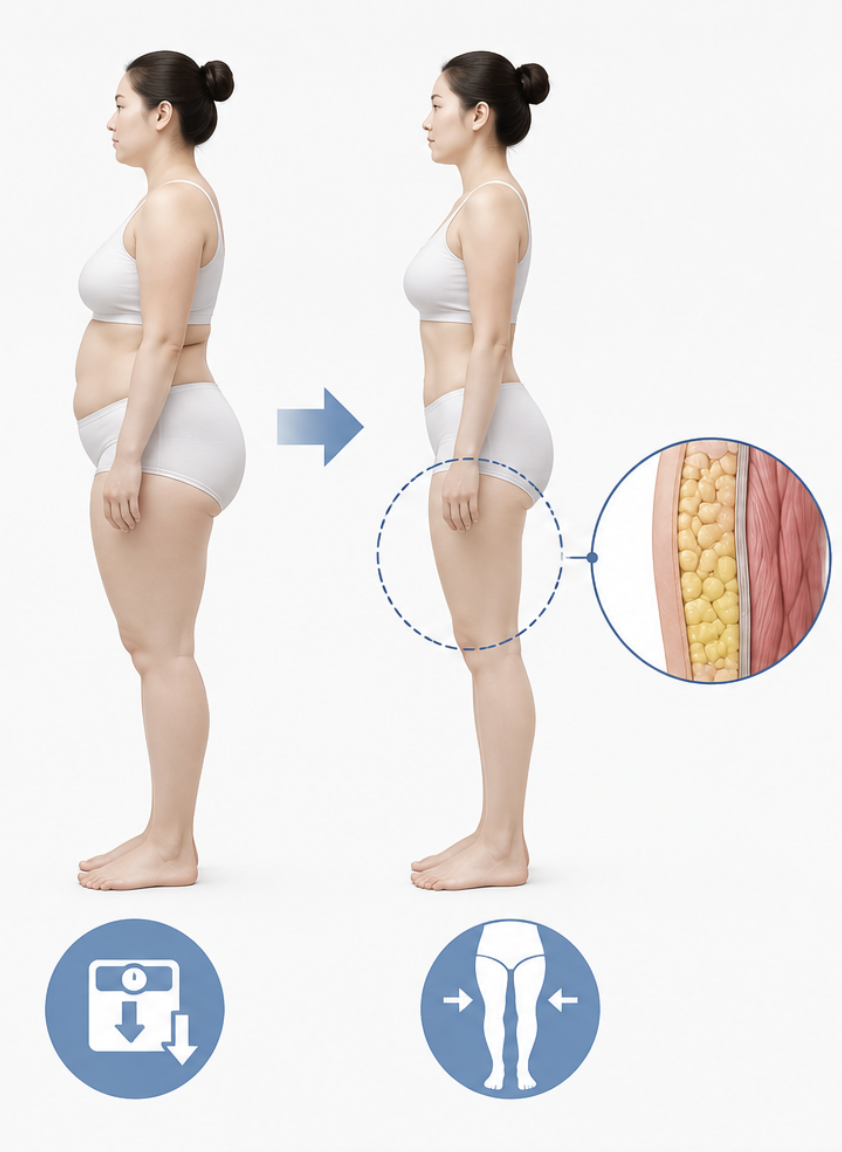
Thigh liposuction for lower-body obesity
is often considered as a process for refining the contours of a specific area,
rather than as a method for significantly reducing body weight.
For example,
someone may be within the normal weight range
but have difficulty fitting into pants because of their thighs,
experience repeated friction between the inner thighs,
or appear to have wider hips because of the riding-breeches area.
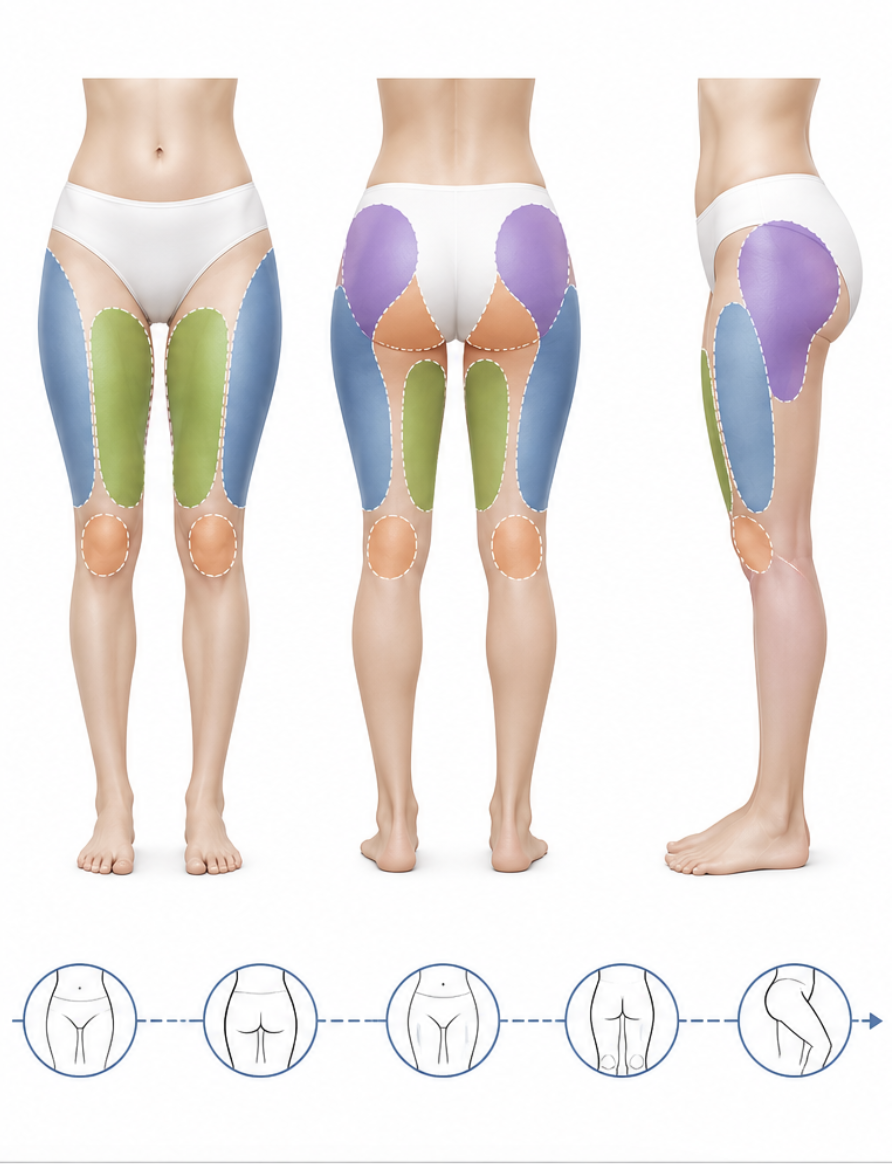
In such cases,
it is necessary to first examine the current body shape and fat distribution
before determining the appropriate approach.
Everyone has a different body shape.
Even with the same lower-body obesity,
the required design may differ.
- Design is more important than removing a large amount
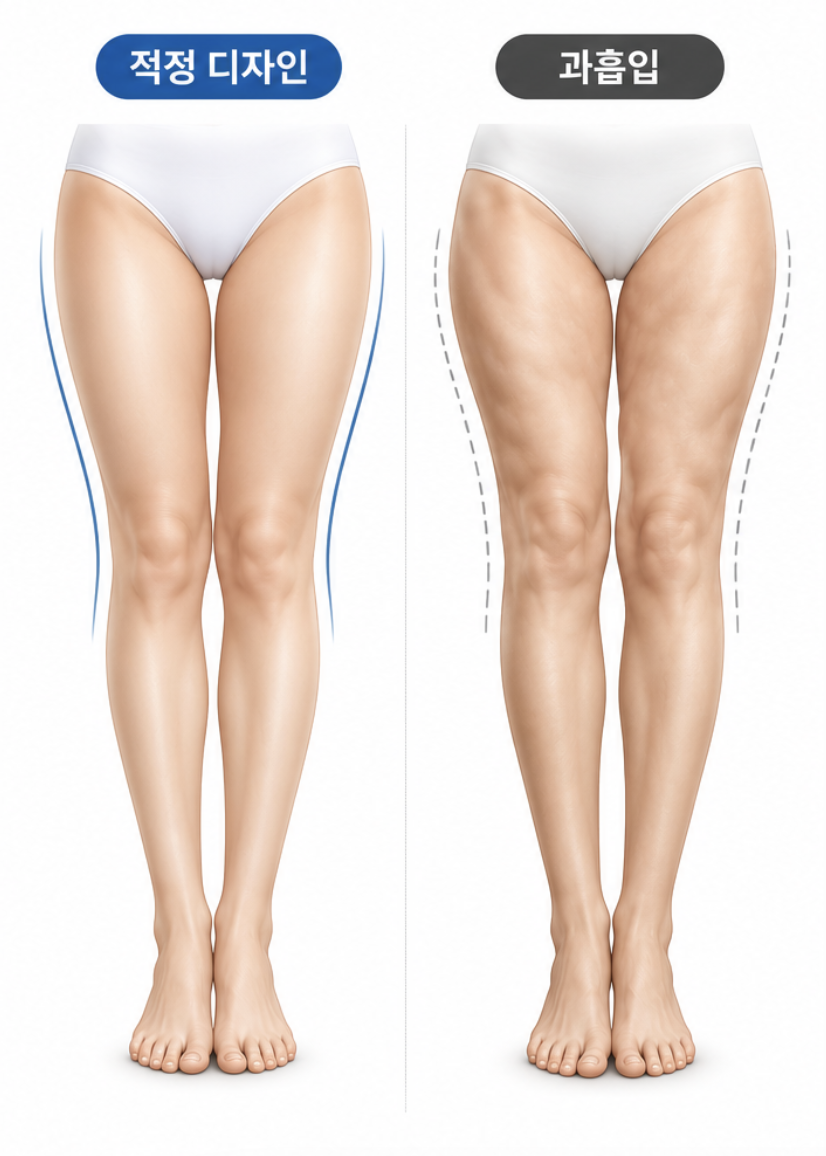
When considering thigh liposuction for lower-body obesity,
the most important factor is
the balance of the contours,
rather than the amount removed.
Removing a large amount is not necessarily the answer.
Excessive fat removal may lead to
uneven skin,
asymmetry,
or skin laxity,
and whether side effects occur and how severe they are
may vary depending on an individual’s skin elasticity, fat layer,
and recovery process.
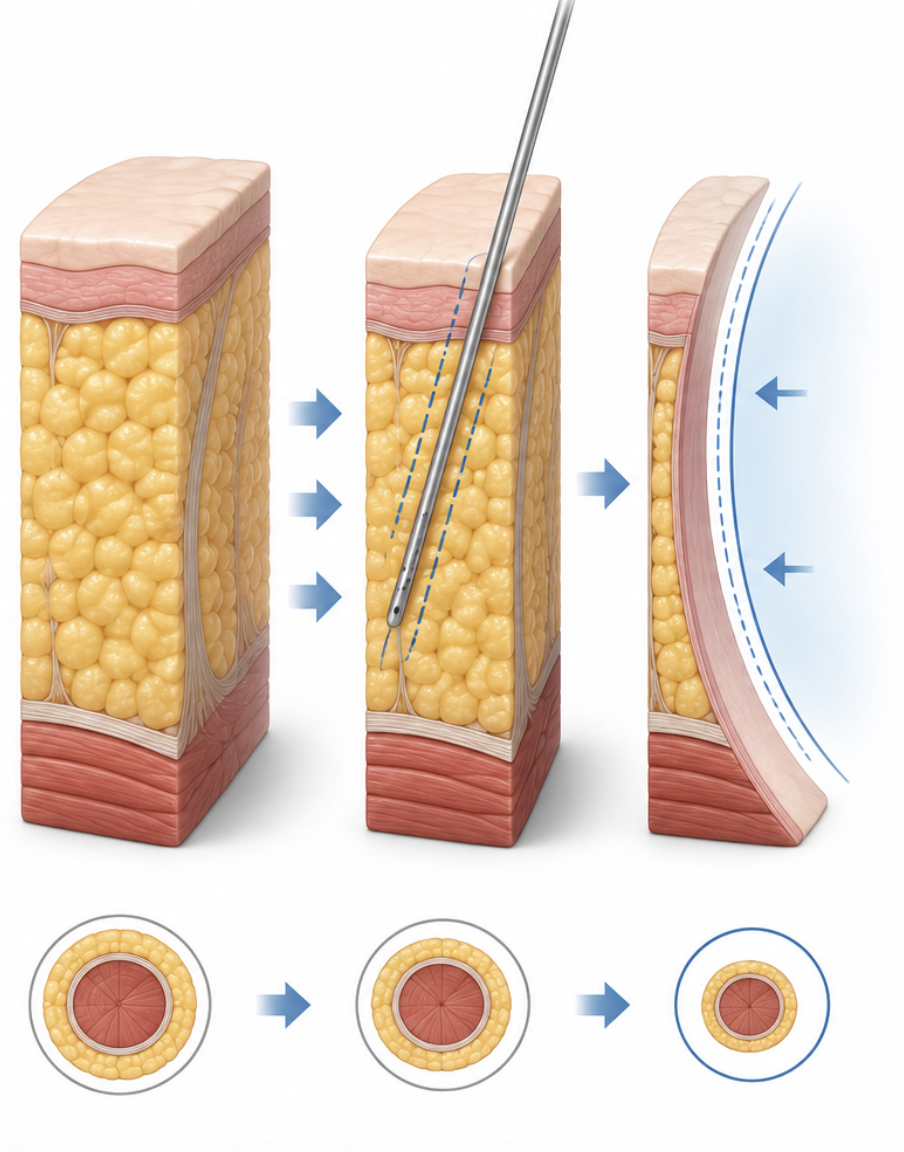
The thighs are not areas that exist separately
as only the inner thighs
or only the outer thighs.
The inner thighs, outer thighs, riding-breeches area,
hip line, and knee line
are connected as one continuous flow.
Body contouring
is not simply about removing fat;
it is the process of creating proportion.
A line that can remain satisfying over time
is more important than an excessive change.
- Criteria for a natural lower-body line
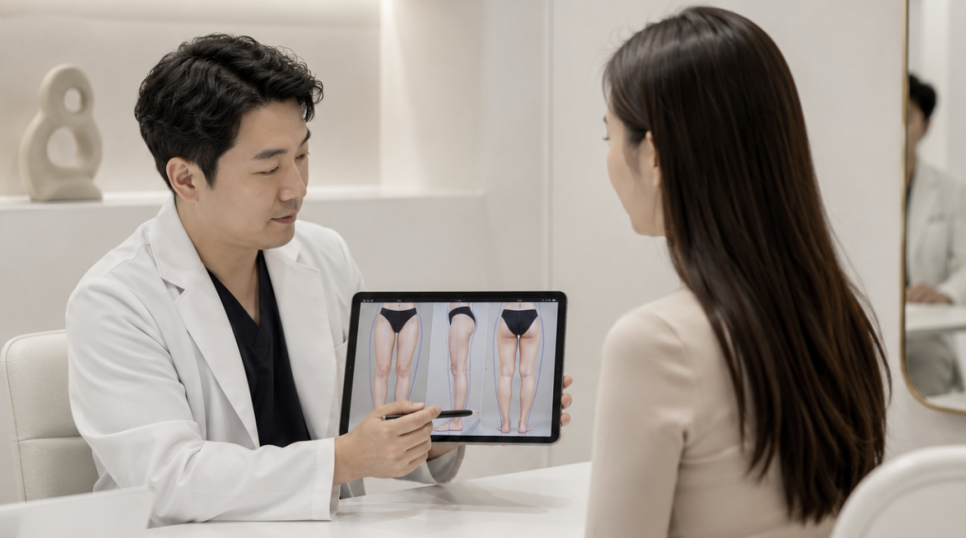
For a natural result,
looking only from the front is not sufficient.
The side and back views should also be examined,
and the curves continuing from the pelvis and hip line
to the knees
should be analyzed together.
Three-hundred-sixty-degree body-shape analysis
and design that considers proportions
can help plan
not only the thighs
but the overall lower-body silhouette.
Not everyone who wants the procedure will undergo surgery.
If the BMI is very low,
if skin elasticity is insufficient,
or if weight fluctuations are substantial,
more careful consideration may be necessary.
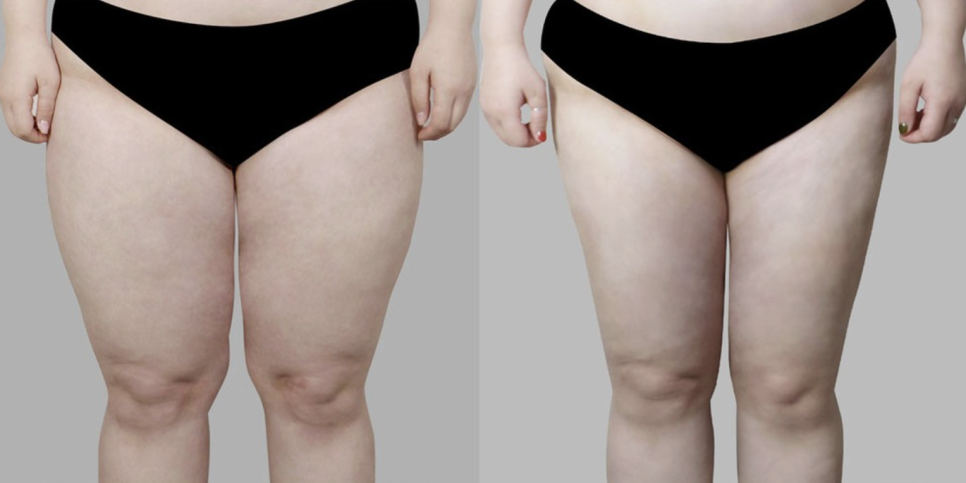
Since fat is tissue that is difficult to restore once removed,
sufficient consultation and planning are important.
Safety is a prerequisite for every surgery.
Lower-body obesity that is difficult to change through exercise
may be influenced by the location of fat distribution
and the characteristics of the body shape.
However, thigh liposuction for lower-body obesity
is not about removing as much as possible;
it is important to first understand
that it is a process of creating proportions suited to the current body shape.
Everyone has a different body shape,
so the appropriate method and design may also differ.
If you have any questions,
through a sufficient consultation,
please take the time to comfortably confirm
the approach suited to your current body shape.
↓↓↓ Content you may also find helpful ↓↓↓
-Operating Hours-
| Weekdays 10:00–19:00 (last registration at 18:30) Saturdays 10:00–16:00 (last registration at 15:30) Closed on public holidays, Wednesdays, and Sundays |
-Contact-
| ▶ Cheongdam OK Clinic |
|---|
| Consultation: 02-3446-7588 KakaoTalk inquiries available |
-Location-