Hello.
This is Apgujeong Yonsei Baro Dental Clinic.
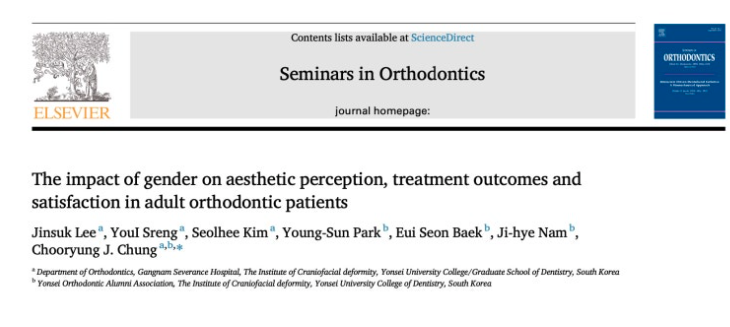
Today, we would like to introduce a research paper in which Dr. Baek Ui-seon of Apgujeong Yonsei Baro Dental Clinic participated as a co-author.
It was published in an SCIE journal in April 2025.
All analytical data in the orthodontic field tend to focus on average values without considering age- and sex-related differences.
Even when the front teeth are moved 4 mm backward through extraction orthodontic treatment, the patterns of change cannot be the same for men and women. Nevertheless, patients have traditionally been given explanations based only on average values.
The thickness and elasticity of the skin differ clearly between men and women.
Naturally, the way soft tissue changes as a result of orthodontic treatment may also differ.
This study focuses on this aspect and also addresses the perceptual region using deep-learning technology.
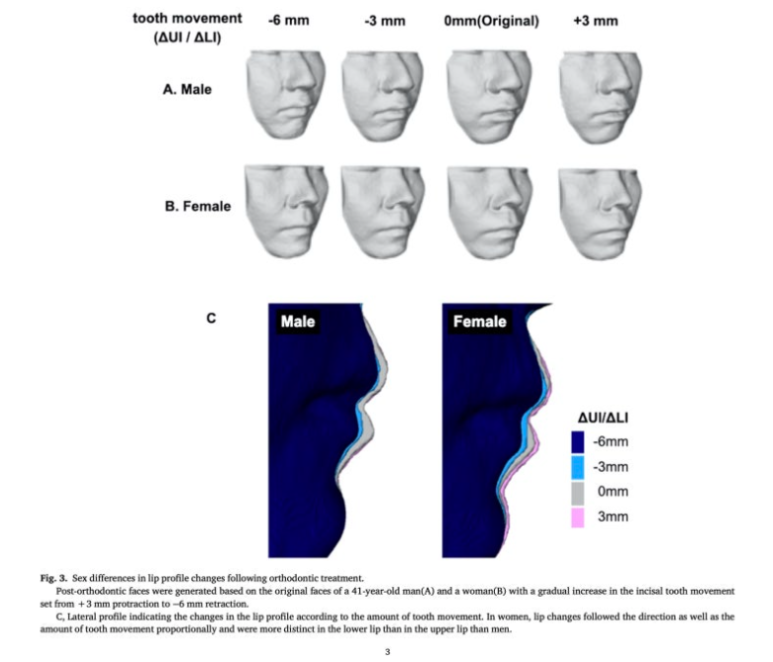
This figure shows the differences between men and women in the way the lips move inward.
Compared with the man on the left, changes in the chin area are more noticeable in the woman on the right.
These differences can be explained by fundamental sex-related differences in skeletal and soft-tissue anatomy, as well as differences in the aging process. In general, men have greater bony support, slower reductions in bone density, and thicker soft tissue around the lips and chin. Women, on the other hand, generally have thinner skin and more rapid reductions in bony support, which can lead to faster progression of facial sagging and wrinkles with age.
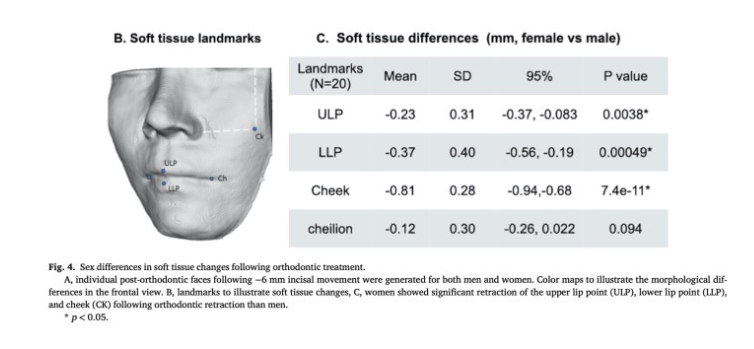
One noteworthy finding is that more extensive facial changes were observed in women than in men, not only around the lips but also in the cheeks and square-jaw areas.
In other words, the loss of facial fullness that many people worry about appears to be more pronounced in women than in men.
For the latest research on peanut-shaped faces and cheek hollowing, please refer to the blog of Dr. Baek Ui-seon, Director of Apgujeong Yonsei Baro Dental Clinic.
Similarly, it seems difficult to ignore the tendency for cheek volume to decrease, even though this is not directly related to orthodontic treatment.
This study has shown that clear gender differences also exist in this regard.
There are other interesting findings as well. When motivation for orthodontic treatment was analyzed, <improving tooth alignment> was by far the most common motivation. Among the remaining responses, women had a higher proportion citing appearance improvement (16.7%), while men had a relatively higher proportion citing improved chewing function (14.7%).
Although women's primary motivation for orthodontic treatment was improvement of tooth alignment rather than improvement of their smile, women ultimately reported the greatest satisfaction from increased confidence in their smiles after treatment.
It is also interesting that, when divided by age, satisfaction with orthodontic treatment was much higher among those in their 50s and older than among those under 50. If someone asks, "Is orthodontic treatment possible for people in their 50s and older?" we can explain, based on the findings, "Yes. In fact, you may be much more satisfied than younger people."
At Apgujeong Yonsei Baro Dental Clinic, we focus on health and function in orthodontic treatment beyond simple tooth alignment, and we provide care with an especially discerning eye for smile aesthetics.
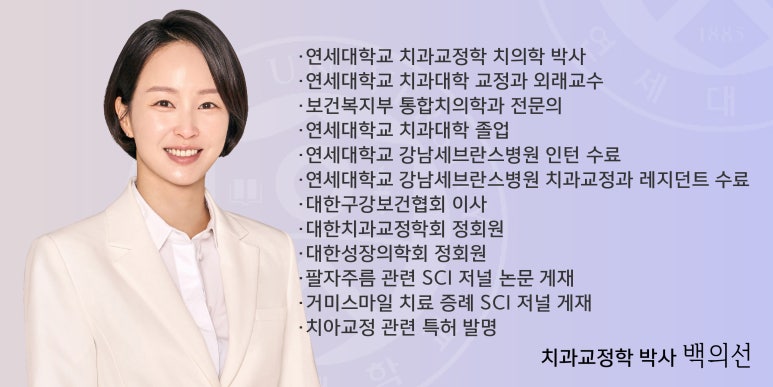
Apgujeong Yonsei Baro Dental Clinic
<Chat via Kakao>
https://pf.kakao.com/_GLucb
<Make a Naver reservation>
https://booking.naver.com/booking/13/bizes/721284