Hello,
I’d like to share a review of orthodontic treatment with Invisalign Lite for someone in their 50s.
Many middle-aged people who want orthodontic treatment worry that their gums may get worse.
Even younger people hesitate because of gum health concerns, and it is even more so for people in their 40s and 50s.
I have weak gums—can orthodontic treatment make my gums worse?
I’m asked this question quite often in practice.
If someone has thin alveolar bone and receding gums and undergoes full orthodontic treatment that takes 1 to 2 years, that can happen.
In such cases, the doctor in charge needs to examine the patient carefully.
However, in partial orthodontic treatment that only straightens the front teeth, there is not much tooth movement itself, so the chance of the gums worsening because of orthodontic treatment is almost nonexistent.
Of course, some patients misunderstand and think their gums have sunk after treatment.
When black triangles become larger after orthodontic treatment, they may interpret it that way.
If teeth have been crooked and crowded for a long time and then become straight, the areas of the alveolar bone that were originally hidden finally become visible. This does not mean the gums have receded because of orthodontic treatment.
Teeth that protrude significantly from the original alignment often have receded gums.
This is called gingival recession.
However, when they are moved back into place through treatment, the receded gums often recover as well.
Let’s focus on this point.
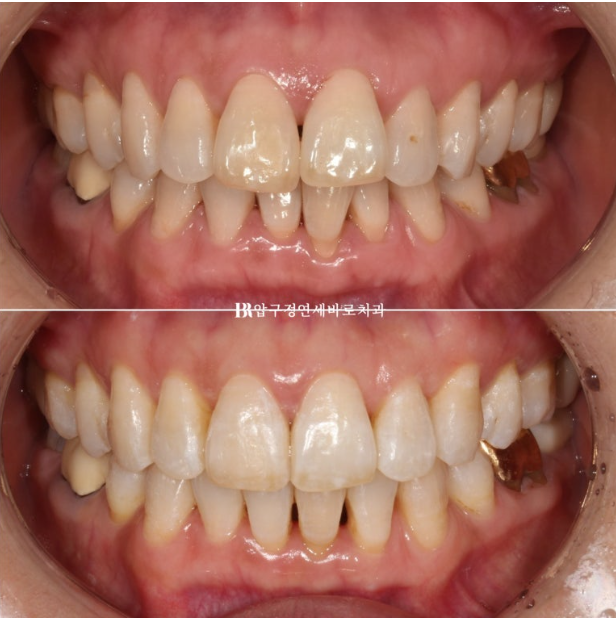
A patient in their 50s came to the clinic for orthodontic treatment because their front teeth were gradually protruding and becoming crooked.
They had already completed extraction orthodontic treatment a long time ago, but as they got older, the front teeth gradually became misaligned, so they came for partial correction of the front teeth.
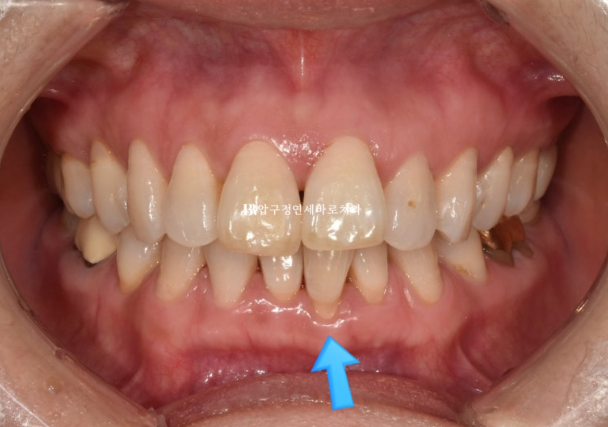
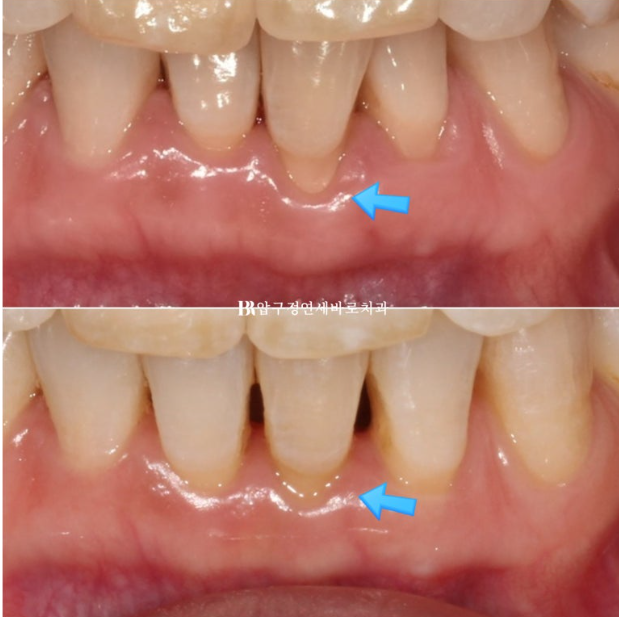
The blue arrow indicates that the gum line is lower than that of the surrounding teeth.
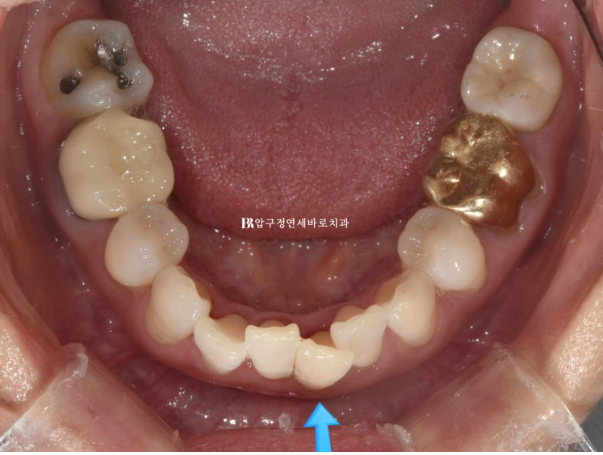
The reason is that this tooth had deviated the most from the alignment.
When it is moved back into place, the gums may recover.
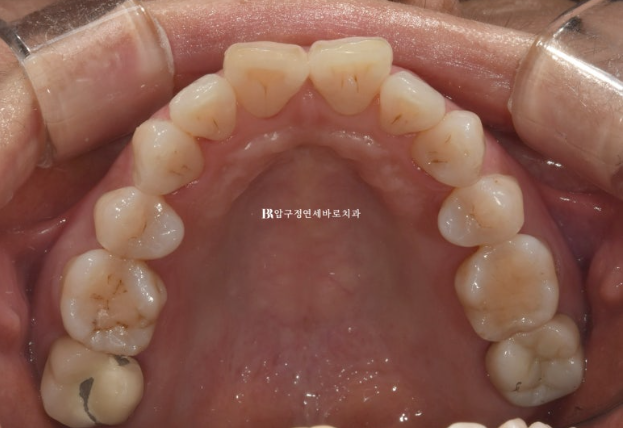
The two upper front teeth are protruding and rotated.
This is not a formal term, but teeth like this are called butterfly teeth.
This amount of correction is sufficiently manageable with Invisalign Lite.
Invisalign Lite provides up to 14 appliances per set.
Considering the patient’s age and gum condition, extending the replacement interval to 10 days instead of the usual 7 days puts less strain on the gums.
The time needed to wear all 14 appliances in one set is about 140 days.
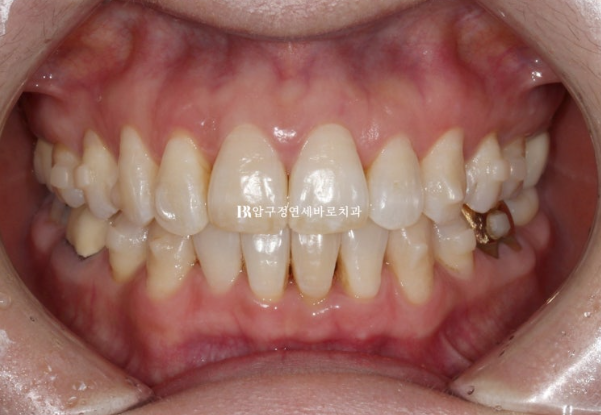
24.01
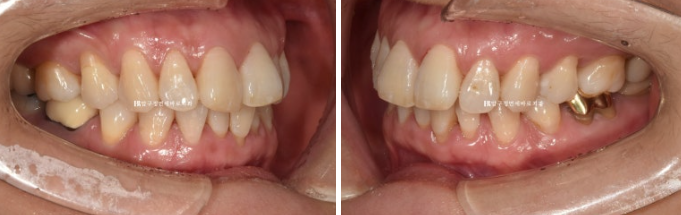
The alignment became neat, and a small amount of interproximal reduction helped reduce the black triangles.
However, there was a height difference in the upper front teeth, so we decided to address this with additional appliances.
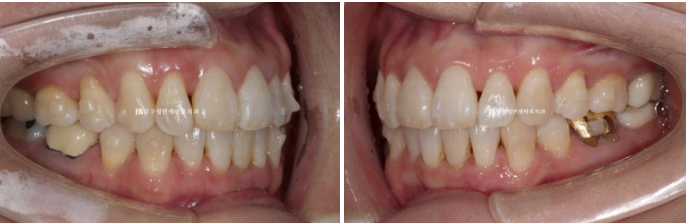
24.01
The angle of the protruding front teeth improved, and the butterfly teeth and buck teeth were aligned.
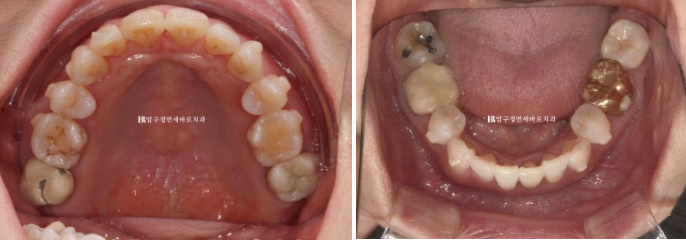
24.01
This already looks good enough, but to aim for a perfect result, additional appliances were made.
The additional appliances were worn for 10 days at a time over 3 months, from February to May, and the treatment was completed.
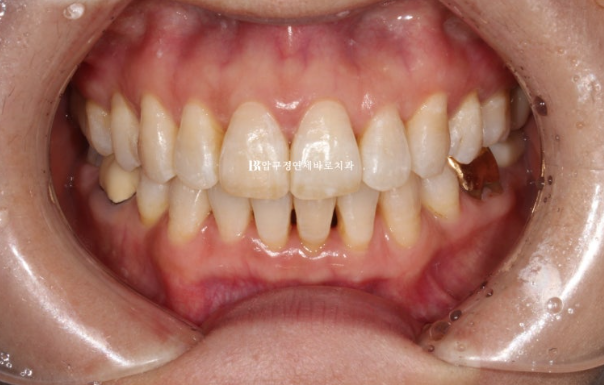
24.05
The black triangles in the upper front teeth were reduced through interproximal reduction, but as the crooked lower front teeth became aligned, black triangles appeared there.
The lower black triangle size was also reduced through interproximal reduction, but it is best to keep interproximal reduction within a range that does not burden the teeth.
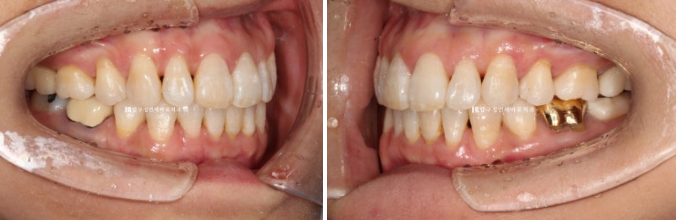
24.05
The bite that many patients worry about is also good.
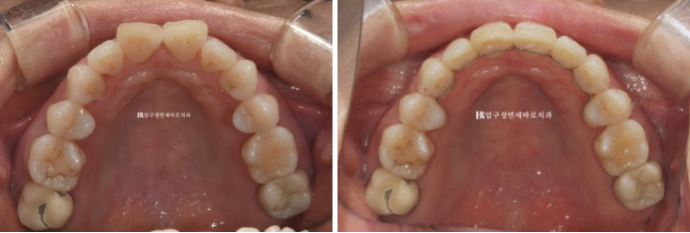
23.07~24.05
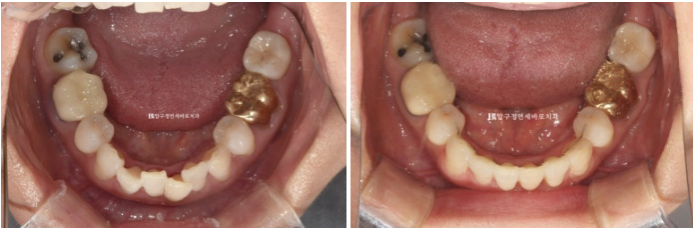
23.07~24.05
23.07~24.05
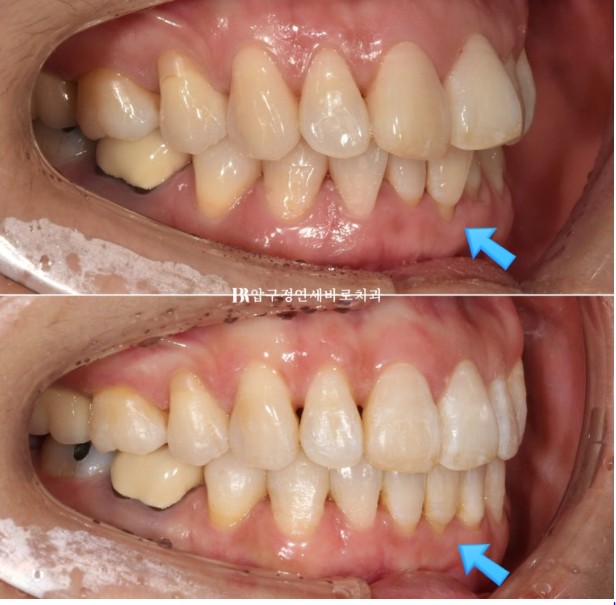
Let’s take a closer look at the tooth whose gums had receded the most because it had deviated the furthest from the alignment.
23.07~24.05
As the gingival recession recovered, root exposure decreased.
As people enter their 40s and 50s, front teeth naturally become crooked due to the direction of physiological bite forces and the natural aging process.
If left untreated, it becomes worse.
Don’t give up thinking it is already too late.
For middle-aged patients, orthodontic treatment may be a better choice for oral health.