Hello.
This is Apgujeong Yonsei Baro Dental Clinic, a Gangnam orthodontic clinic.
Many people who need orthodontic treatment worry that their gums might get worse.
Even younger adults hesitate for this reason, so this concern is understandably greater for people in their 40s and 50s.
“My gums are weak. Won’t orthodontic treatment make them worse?”
We are often asked this question.
For people with thin alveolar bone and receding gums, there could be such a possibility if they undergo comprehensive orthodontic treatment that takes one to two years.
The orthodontist needs to examine this carefully.
However, with partial orthodontic treatment to align only the front teeth, there is not much tooth movement itself, so it is highly unlikely that the gums will worsen because of the orthodontic treatment.
Of course, many patients also mistakenly believe that their gums have receded after orthodontic treatment.
This misunderstanding can occur when black triangles become larger after treatment.
When teeth that have been crooked and overlapping for a long time are straightened, areas where the alveolar bone was originally absent become visible for the first time. The gums have not receded because of the orthodontic treatment.
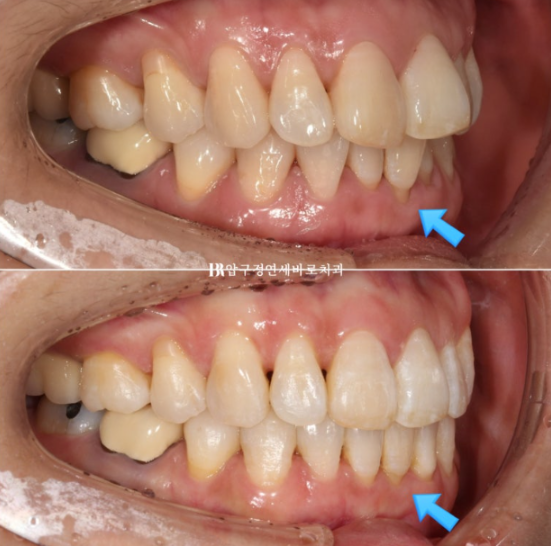
Teeth that protrude significantly from their original alignment often have receding gums.
This is called gum recession.
However, when such teeth are moved back into their proper positions through orthodontic treatment, the receded gums may sometimes recover.
Let’s focus on this aspect.
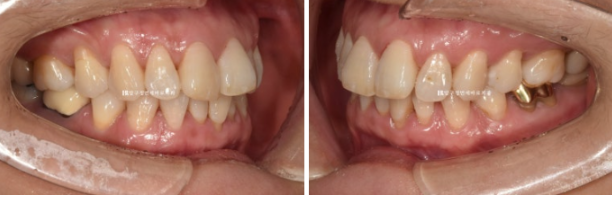
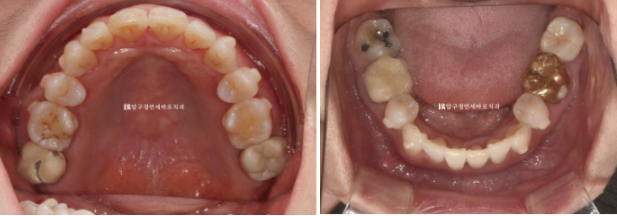
A patient in her 50s visited us for orthodontic treatment because her front teeth had gradually become more protruded and misaligned.
She had already completed extraction-based orthodontic treatment a long time ago, but as she grew older, her front teeth gradually became misaligned. She visited us for partial orthodontic treatment on the front teeth.
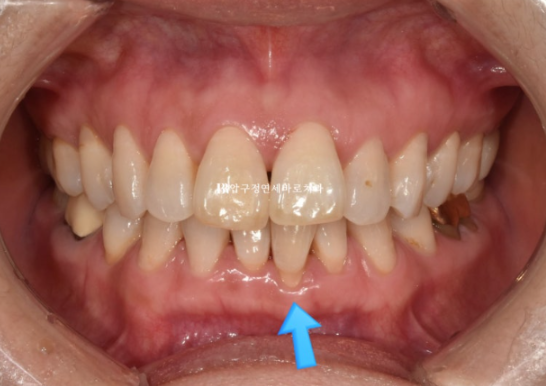
The area indicated by the blue arrow shows gum recession compared with the surrounding teeth.
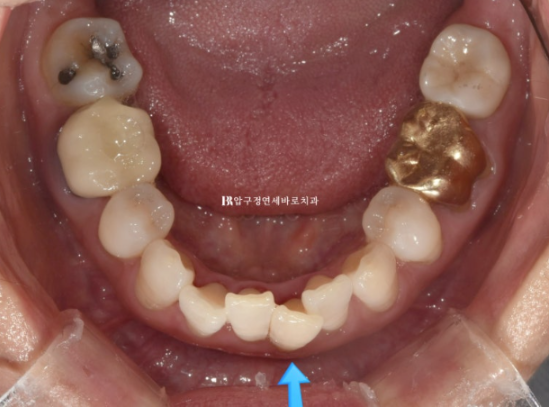
This is because it was the tooth furthest out of alignment.
When it is moved back into its proper position, the gums may recover.
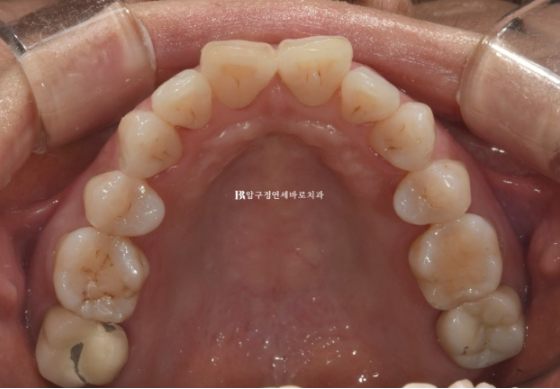
The two upper front teeth were protruded and rotated.
Although it is not an official term, this is sometimes called “butterfly teeth.”
In this case, Invisalign Lite is sufficient.
Invisalign Lite provides up to 14 aligners per set.
Considering the patient’s age and gum condition, changing the aligners every 10 days instead of every 7 days generally places less strain on the gums.
It takes approximately 140 days to wear all 14 aligners in the first set.
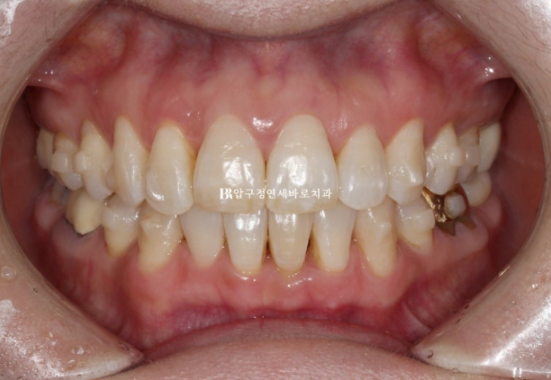
24.01
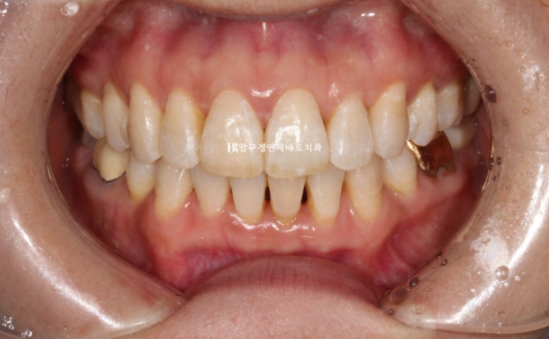
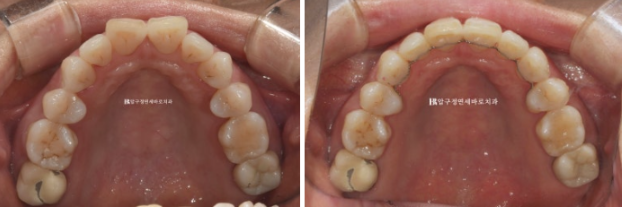
The teeth became well aligned, and the black triangles were reduced through a small amount of interproximal reduction.
However, there was a height discrepancy between the upper front teeth, so we decided to address this with additional aligners.
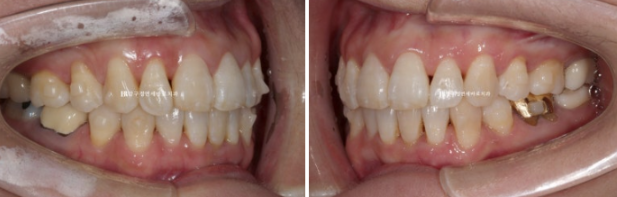
24.01
The angle of the protruded front teeth improved, and the butterfly teeth were arranged into a more rabbit-like alignment.
24.01
The result was already quite good, but we made additional aligners to aim for a perfect result.
The additional aligners were worn for 10 days each for three months, from February through May, completing the treatment.
24.05
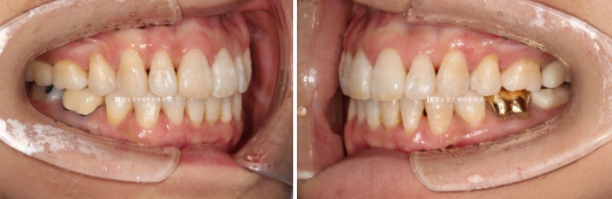
The black triangle between the upper front teeth was reduced through interproximal reduction. However, black triangles appeared as the previously crooked lower front teeth became aligned.
Q. Why do the gums look as though they have receded after orthodontic treatment?
This is the point patients misunderstand most often.
In many cases, the gums have not actually receded.
Instead, it may feel that way because the black triangles have become larger.
When crooked and overlapping teeth become aligned,
areas with insufficient alveolar bone that were not previously visible may be exposed,
making the gums appear to have receded.
In other words,
the gums did not recede because of the orthodontic treatment.
A condition that already existed has simply become visible.
The same applies to the lower teeth. Although the size of the black triangles was reduced through interproximal reduction, this procedure should be performed only to the extent that it does not place excessive strain on the teeth.
24.05
The bite you were concerned about is also good.
23.07~24.05
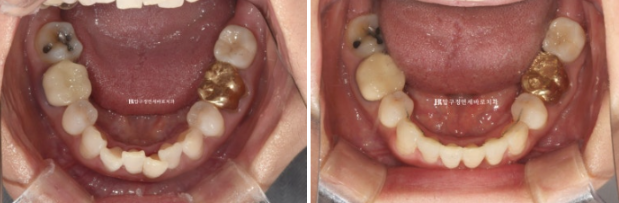
23.07~24.05
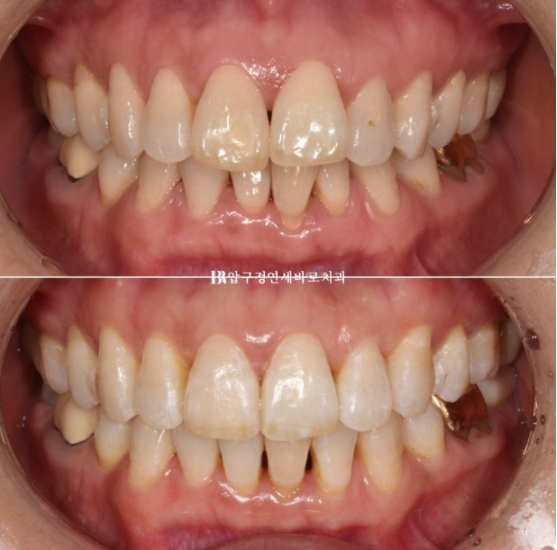
23.07~24.05
Let’s take a closer look at the tooth whose gum had receded particularly noticeably because it was the furthest out of alignment.
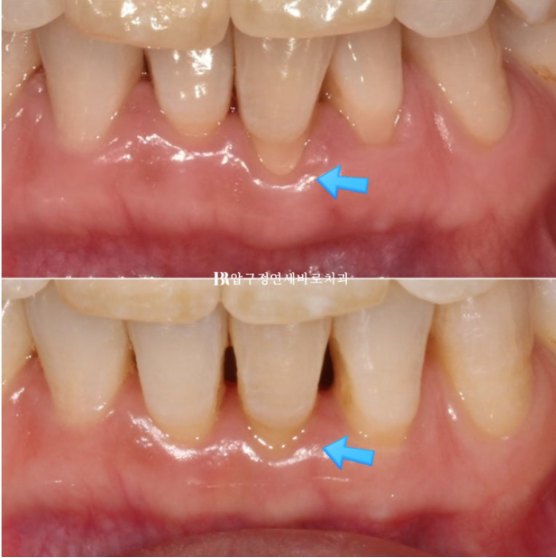
23.07~24.05
The gum recession recovered, reducing the amount of exposed tooth root.
By the time people reach their 40s and 50s, it is common for the front teeth to become crooked due to the direction of physiological bite forces and as part of the natural aging process.
If left untreated, the condition can worsen.
Please do not give up by thinking that it is already too late. Visit a nearby orthodontic clinic for a consultation.
Frequently Asked Questions About Orthodontics for Middle-Aged Adults
Q. Can people in their 40s and 50s have orthodontic treatment?
Yes, of course.
Age is not an absolute limitation for orthodontic treatment.
It is more important to accurately assess the current condition of the gums and alveolar bone.
Q. Will orthodontic treatment inevitably make the gums worse?
No.
With an appropriate diagnosis and treatment plan,
the gums are usually maintained in a stable condition,
and there are even cases in which gum recession partially recovers.
By the time people reach their 40s and 50s, it is common for the front teeth to gradually become crooked due to the natural aging process and changes in bite forces.
If this is left untreated, the teeth may become more misaligned and more difficult to maintain.
However, there is no need to give up because you think it is already too late.
With an accurate diagnosis and an orthodontic plan that takes the gum condition into account, healthy and stable orthodontic treatment is fully possible for middle-aged and older adults.
If you are concerned about the alignment of your front teeth or gum recession, please receive an accurate consultation at a nearby orthodontic clinic.
Gangnam Orthodontic Clinic for Middle-Aged Adults