Hello.
This is Yonsei Baro Dental Clinic, a Gangnam orthodontic clinic.
Today, we would like to introduce a case of Invisalign Lite treatment in a patient in their 50s.
This patient had protruding and spaced upper front teeth, while the lower front teeth were also misaligned.
In particular, the patient had both peg-shaped teeth and a deep overbite. Therefore, a treatment plan that considered not only tooth alignment but also the size and shape of the teeth after orthodontic treatment was necessary.
Ultimately, treatment was carried out in the following order:
Invisalign Lite treatment → Creating space around the peg-shaped teeth → No-prep Gelami veneers
Today, using this case, we will explain in detail how Invisalign treatment was carried out for a patient in their 50s and what should be considered when peg-shaped teeth are present.
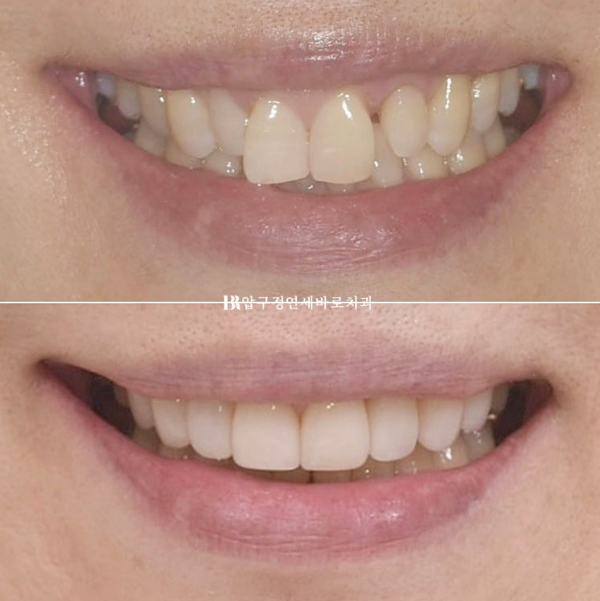
23.09~24.08
We will show how to achieve a healthy and aesthetically pleasing treatment result through a combination of limited orthodontic treatment for the front teeth and no-prep veneers.
The patient visited us for orthodontic treatment because the two upper front teeth had descended significantly and were spaced apart.
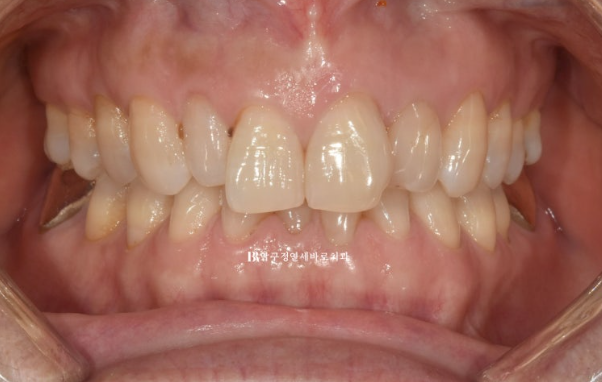
23.09
The two upper front teeth had descended considerably, resulting in a severe deep overbite.
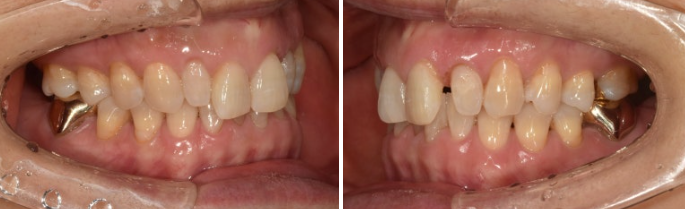
When a deep overbite is present, the lower front teeth push the upper front teeth from behind toward the front every time the mouth closes. As a result, the space between the upper front teeth gradually increases, and they become more protruded.
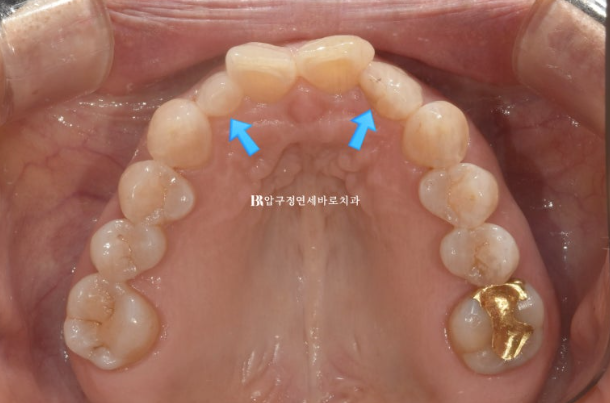
23.09
The area indicated by the blue arrow shows a peg-shaped tooth.
On one side, resin had been temporarily added to fill the space.
Since orthodontic treatment was planned, the resin used to fill the space was removed, and a scan was taken to fabricate the appliance.
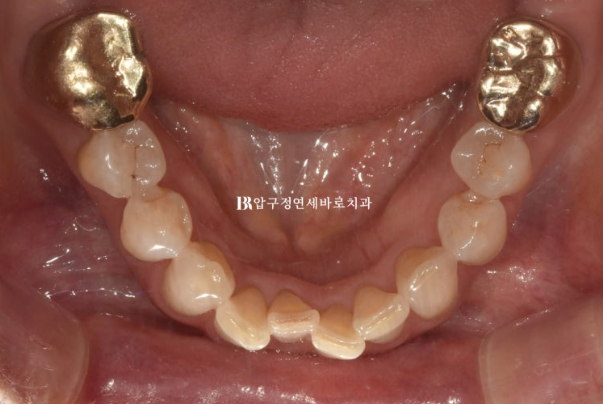
23.09
The lower teeth were also crooked.
The original plan was to restore the size of only the peg-shaped teeth with veneers after orthodontic treatment.
As with the patient discussed in an earlier post, the plan changed during treatment, and it was decided to place no-prep veneers on all eight front teeth.
For aesthetic reasons, Invisalign Lite was recommended as the orthodontic treatment method.
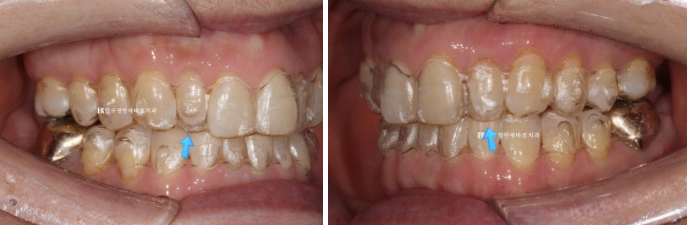
24.01
This is the patient during treatment with the first set of aligners.
Upon closer inspection, you can see that the aligners were not fully seated over the peg-shaped teeth on both sides.
The possible reasons why the aligners may not fit properly over the attachments are as follows:
-
The aligners were not worn consistently.
-
The aligners were worn consistently but were not fully seated.
-
The aligners were worn very well, but for various reasons, the force was not properly transferred to the teeth.
These are the three possible reasons.
There are several possible causes for the third reason.
One is when the tooth height is short, and another is when the tooth is narrow from side to side, as with a peg-shaped tooth or a lower front tooth.
When a tooth is flat and wide, a larger area is covered by the Invisalign aligner.
Rotation and extrusion are movements that can be difficult to achieve with Invisalign. However, when a larger area of the tooth is covered, force is transferred more effectively, making rotation and extrusion easier to achieve.
On the other hand, if the tooth is narrow and close to cylindrical, without a flat surface, rotation and extrusion are difficult.
For this reason, rotation or vertical control is often difficult with peg-shaped lateral incisors or lower front teeth.
This is why the recommended appliance may differ depending on the individual tooth shape, even when the malocclusion is similar.
In this patient’s case as well, the aligners were not able to adequately control the peg-shaped teeth.
This area was addressed again with the additional aligners.
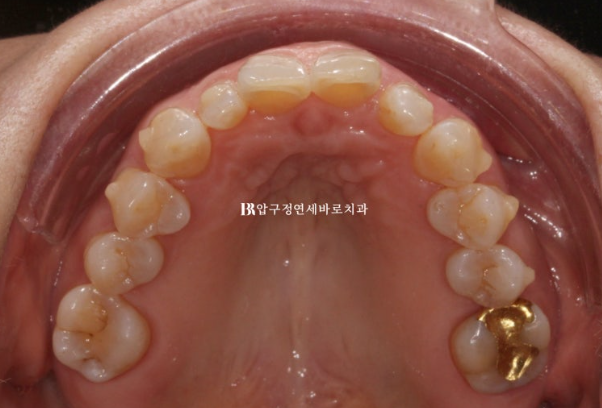
24.03
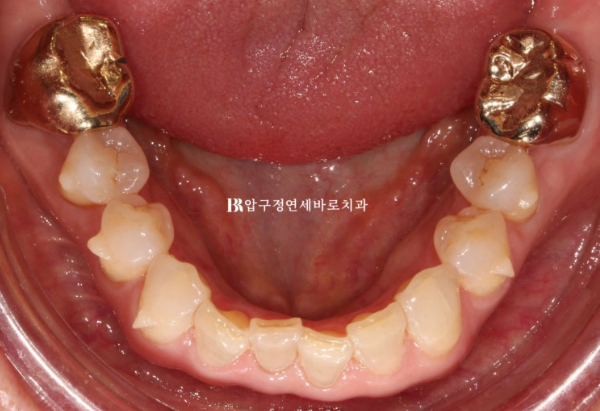
24.03
The alignment had improved by approximately 60%.
To achieve the remaining 40%, additional aligners were ordered in March 2024.
It took one month to receive the additional aligners after placing the order.
During this one-month period, the patient maintained the result by wearing the final, 14th aligner only while sleeping.
Treatment with the additional aligners began in April 2024. The patient then wore the 14 additional aligners permitted under Invisalign Lite over the following four months, finally completing orthodontic treatment in August.
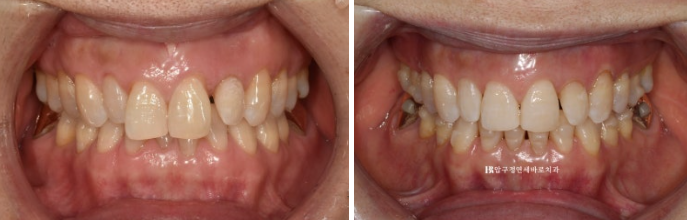
The descended front teeth had moved up into their proper positions, and the deep overbite had also improved considerably.
The attachments on the eight upper front teeth were removed first in preparation for the no-prep veneers.
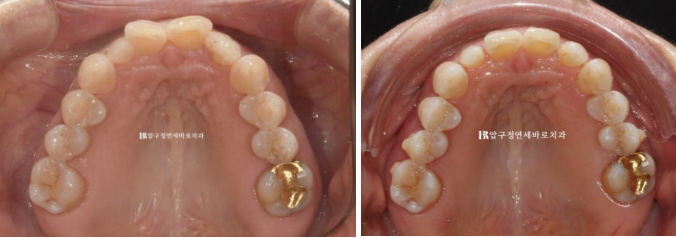
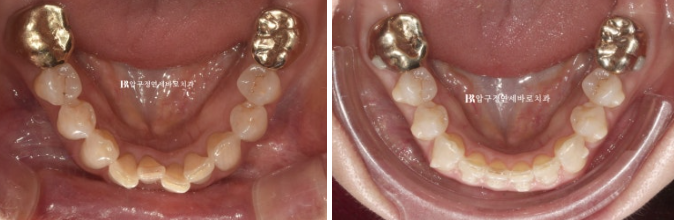
23.09-24.03
The alignment was successfully established.
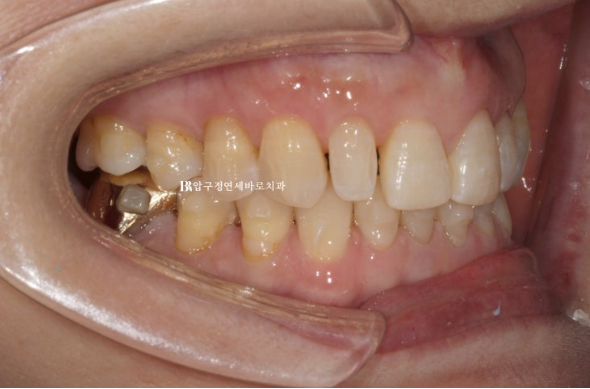
Can you see the spaces on either side of the peg-shaped teeth?
The intended spaces were successfully created to restore the size of the teeth.
We waited 10 days while the no-prep veneers were fabricated, and they were finally bonded to the eight upper front teeth.
Whitening the teeth immediately before bonding the veneers can help minimize the original yellowish tooth color showing through.
This patient also underwent tooth whitening immediately before the no-prep veneers were bonded to create a lighter underlying shade.
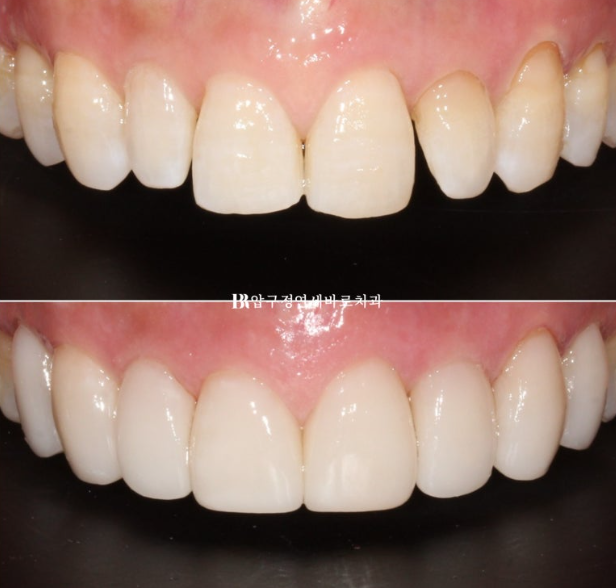
24.08
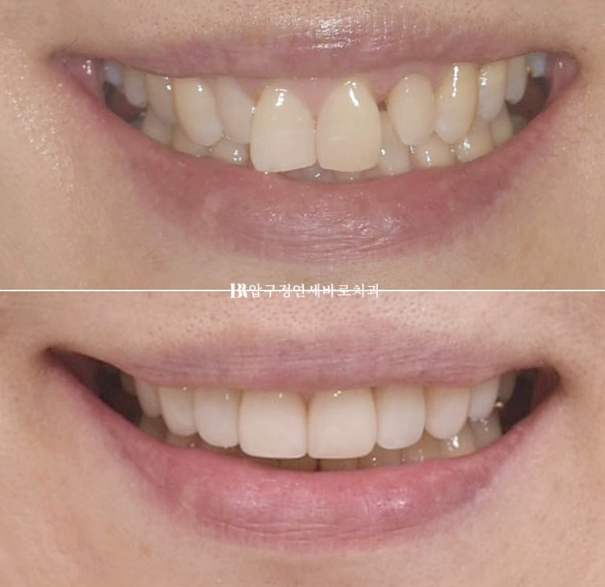
The milky-white translucency looks very natural.
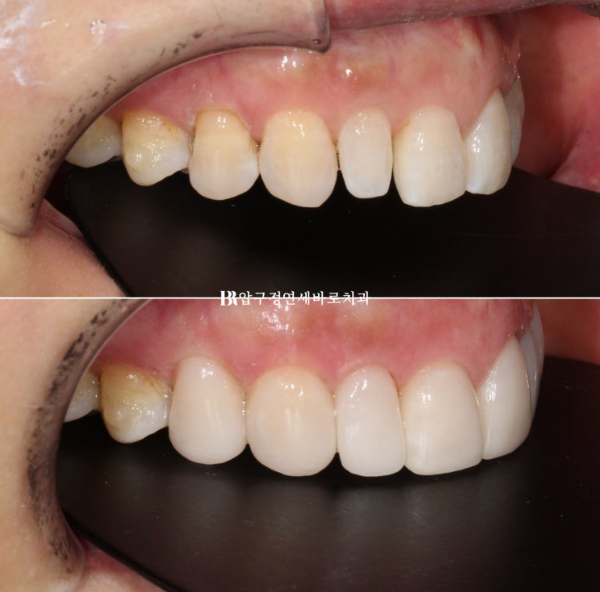
24.08
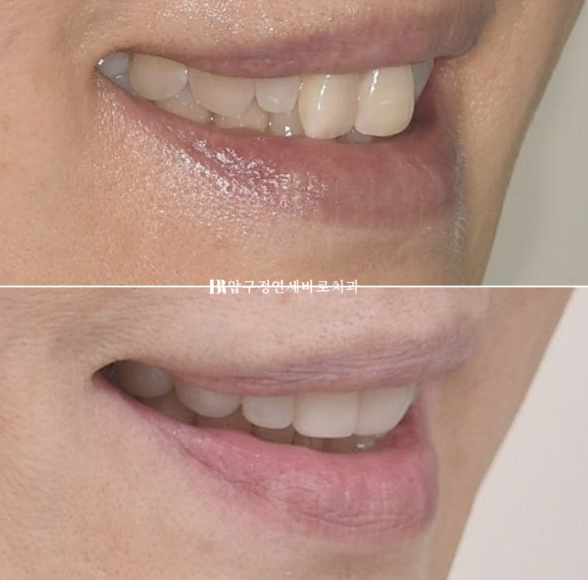
To meet the patient’s preference for a natural appearance, artificial-looking features were minimized in the shape of the teeth as much as possible.
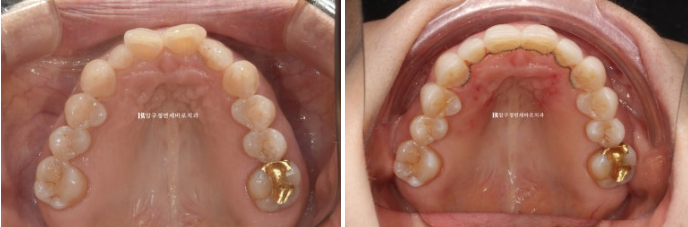
Here is a comparison between before orthodontic treatment and after completion of the no-prep veneer treatment.
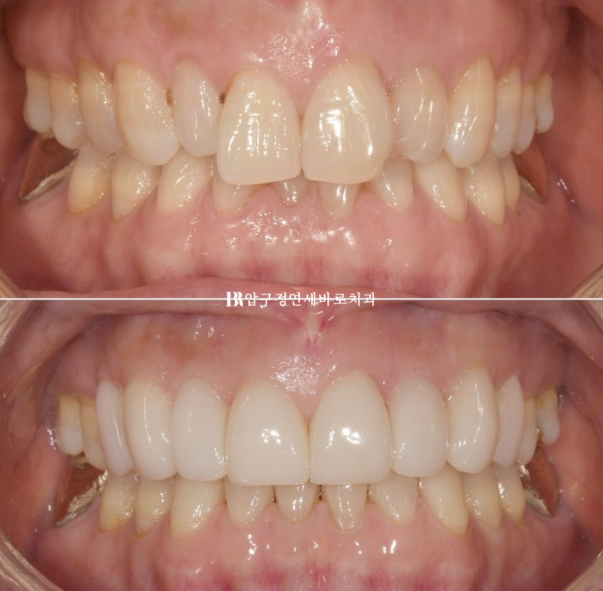
23.09~24.08
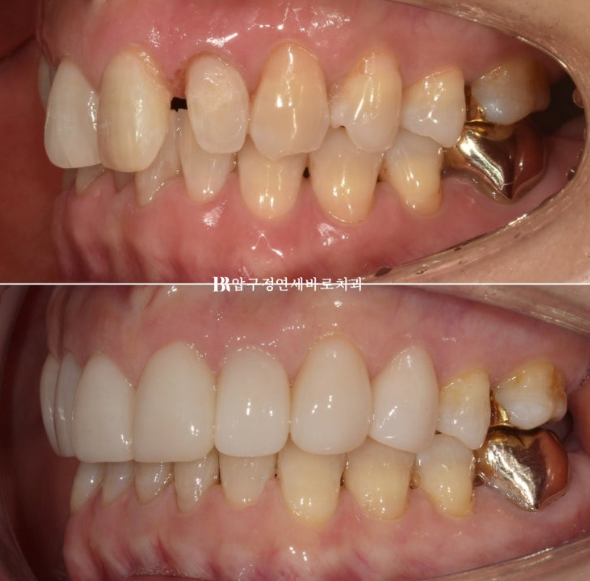
23.09~24.08
23.09~24.08
Just as wrinkles increase on the face, the signs of aging gradually become more noticeable in our teeth as we get older.
The gums may gradually recede, fine cracks may develop in the teeth, and more areas may become worn or chipped.
The color may also become darker.
Just as the skin may undergo lifting treatments, teeth may also require an anti-aging treatment such as veneers. However, this does not mean that the treatment needs to compromise dental health by cutting down the teeth.
Even if it is somewhat inconvenient and costs a little more, look for a dental clinic where no-prep veneers are available.
If You Are Considering Invisalign Treatment in Your 50s
What is important in this case is not simply that “the patient had Invisalign treatment in their 50s.”
The treatment was planned according to the patient’s dental condition in the following order:
Deep overbite improvement → Tooth alignment → Creating space around the peg-shaped teeth → No-prep veneers
In particular, when peg-shaped teeth are present, transferring force from clear aligners may be difficult because of the size and shape of the teeth. Therefore, it is important to create a treatment plan that considers both the tooth shape and the necessary tooth movements.
Also, if no-prep veneers are planned after orthodontic treatment, another option to consider is to first organize the position of the teeth and the spaces through orthodontic treatment, rather than focusing on the veneers first, and then proceed with aesthetic treatment.
Over approximately one year of treatment, this patient improved the deep overbite and tooth alignment with Invisalign Lite treatment. The size of the peg-shaped teeth and the shape of the front teeth were then restored with no-prep Gelami veneers.
Being in your 50s is not, in itself, an absolute limitation for orthodontic treatment. However, because the condition of the teeth and gums can change with age, it is important to accurately assess each individual’s dental and gum condition and the necessary tooth movements before deciding on a treatment method.
Thank you.