Hello,
This is the Seoul branch of Plan Dental Clinic.
If you have not taken good care of your teeth,
or if a tooth was lost due to an accident
and you left it that way for a long time,
you need an artificial tooth to replace the empty space.
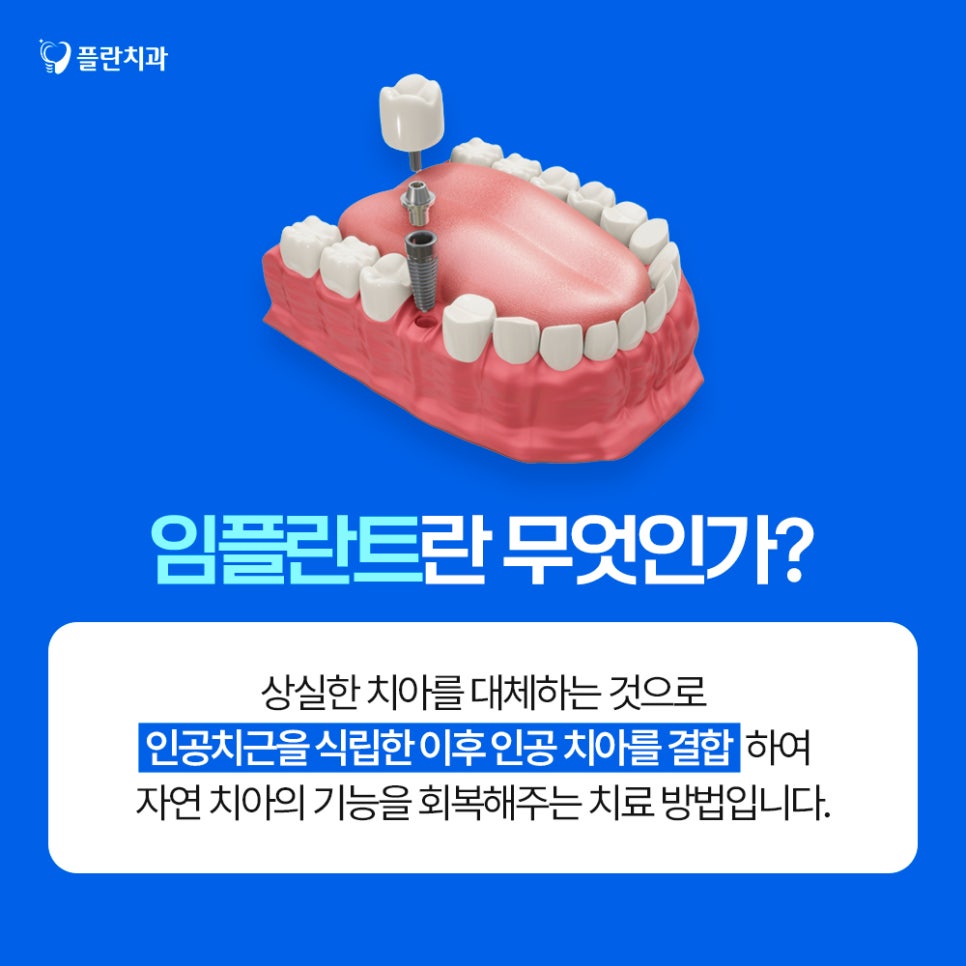
An implant is a treatment method that can replace a natural tooth
when a tooth has been lost.
By inserting an artificial root into the affected area and then attaching an artificial tooth,
it can restore the function of the tooth.
Replacing lost teeth in this way
and placing an artificial root to create an artificial tooth
that can serve as a tooth
is the core of implant treatment.
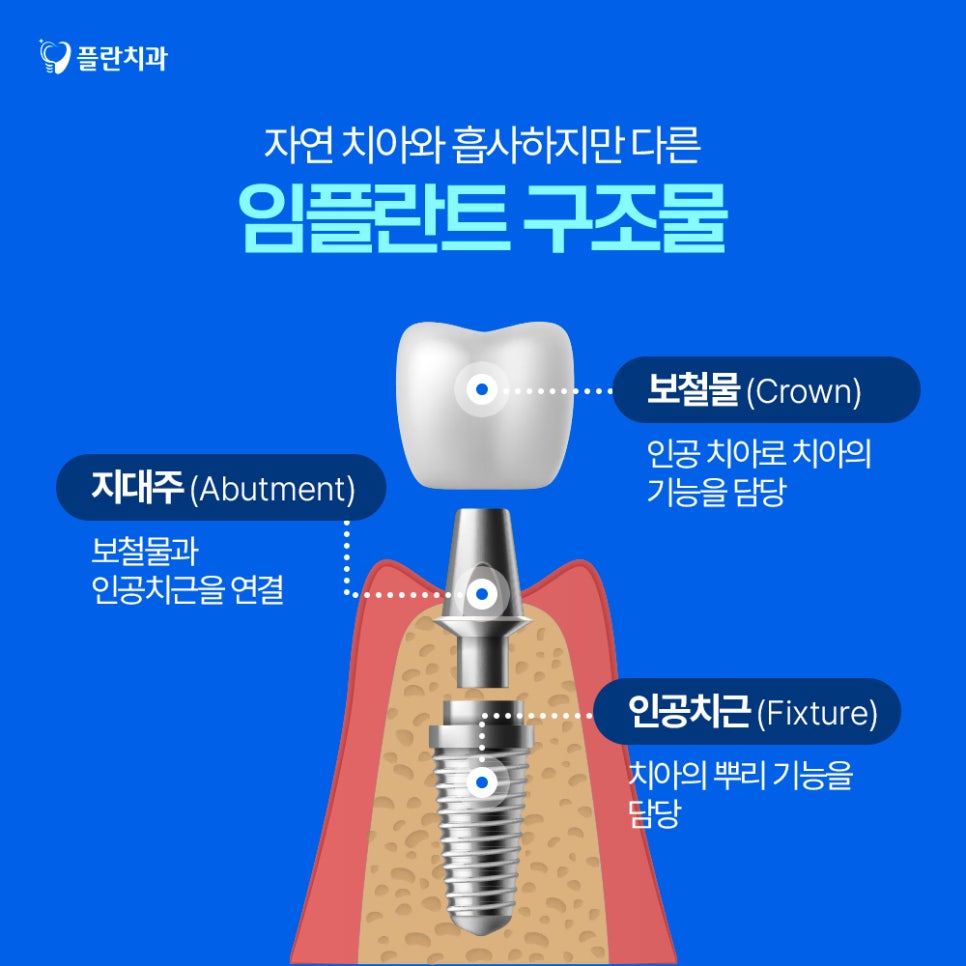
The structure of an implant has many similarities
to a natural tooth.
First, there is a structure called the artificial root, or fixture,
which performs the function of the tooth root.
Then a component called an abutment is placed on top of it,
which connects the prosthetic tooth to the abutment
that functions as the tooth.
To put it simply, you can think of it as the “pillar of the tooth”
or something that plays a role similar to bone.
Finally, a prosthetic tooth is placed on top of that,
serving to protect the abutment
and the artificial root,
so the structure is divided into these parts.
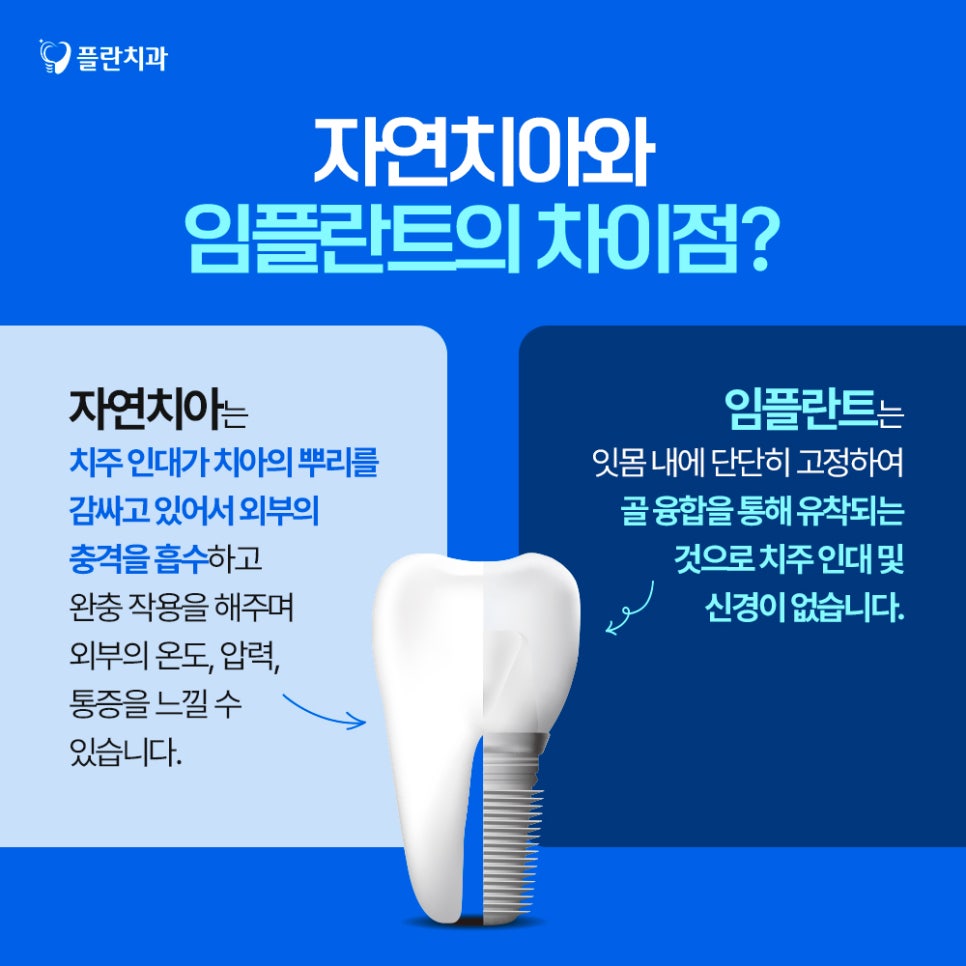
Then what is the difference between a natural tooth and an implant?
First, a natural tooth is surrounded by the periodontal ligament around the root,
which absorbs external impact and provides cushioning.
Because of this, you can feel temperature, pressure,
and pain from the outside, so if a cavity develops
or a tooth is damaged, it can be felt immediately.
This happens because the periodontal ligament and nerves
allow you to naturally sense temperature, pain, and so on.
In contrast, an implant becomes integrated through osseointegration,
and because it has no periodontal ligament or nerves, it may not feel pain
or temperature.
So unlike a natural tooth, even if it is damaged,
there are many cases where you may not notice it much.
This is also why post-treatment care after an implant is important.
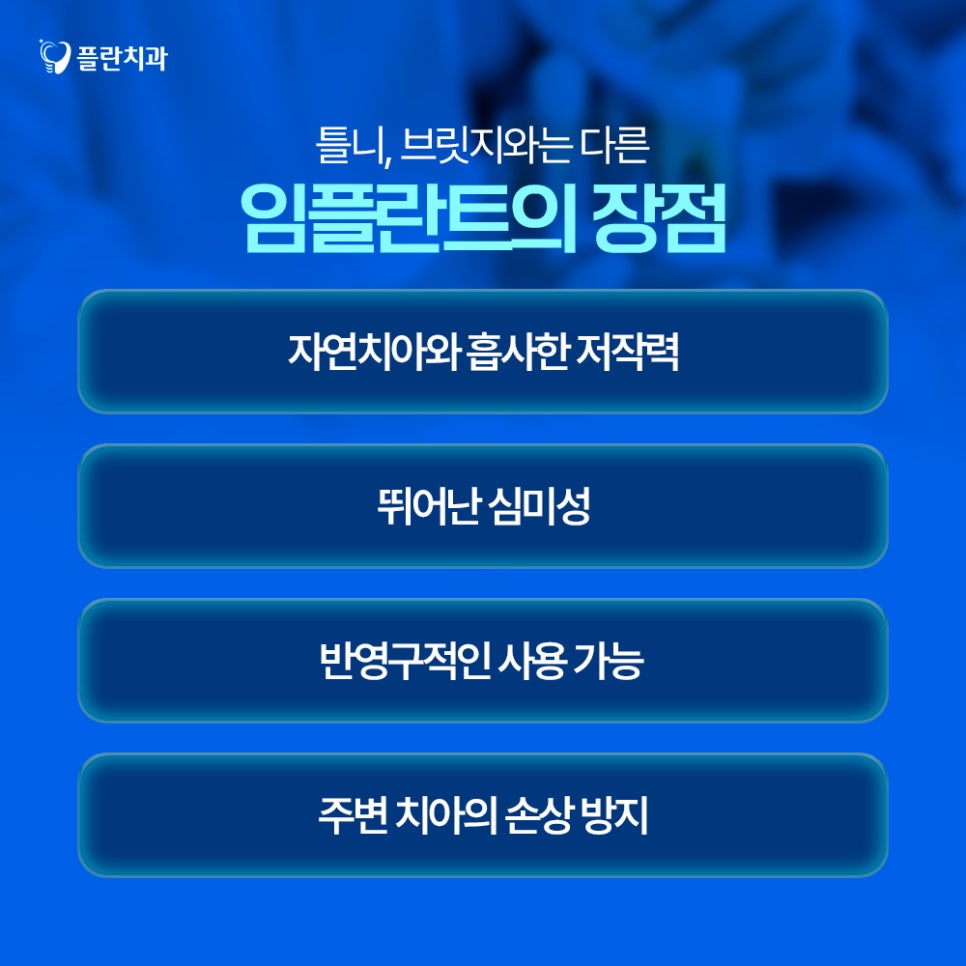
Then what differences are there compared with existing dentures and bridges?
Implants have chewing force similar to natural teeth,
so they chew food better than dentures and bridges.
In the case of dentures, chewing force is usually around 60% to 70%,
but implants are over 80%,
so they can be considered similar to natural teeth.
They are also superior aesthetically and can be used semi-permanently,
which is another advantage.
In addition, dentures can damage the gums or surrounding teeth,
but implants do not, which is why many people prefer them.

For these reasons, implants are recommended for people who were born
with a shortage of teeth, or who suddenly lost teeth due to an accident.
They can also be considered when a permanent tooth does not erupt
after a baby tooth falls out,
or when a tooth becomes a very small peg-shaped tooth.
Implants are also worth considering if you have worn dentures for a long time
and feel discomfort, or if your teeth have become loose due to cavities,
periodontal disease, or similar issues.

An implant may seem like something that is simply “placed,”
but depending on the placement site and the number of implants,
it is divided into several types.
Partial implants usually involve placing one or two,
and they are commonly performed.
Full implants are recommended for edentulous cases, meaning when there are no teeth at all,
or when only one or two teeth remain.
In particular, if you have worn dentures for a long time and the gums have weakened and collapsed,
it is advisable to consider full implants.
And when bone grafting is needed for the jawbone, a bone-graft implant is performed,
and there is also a method called sleep dentistry implants,
where the patient is guided into a light sleep-like state
before the implant is placed under conscious sedation.
Lastly, there is also reoperation, which is when a previously placed implant fails
and is placed again.

Then why do implants fail?
There is a saying that 50% of implant success depends on the clinician’s know-how,
and 50% depends on post-treatment care,
which shows how important the clinician’s skill and aftercare are.
In particular, the condition of the implant must be checked continuously after treatment,
so you should visit at least once a year for an examination.
The most common complication after an implant is;
‘peri-implantitis,’ which refers to inflammation occurring near the implant site.
It usually causes odor or bleeding,
but the problem is that because there are no periodontal ligaments or nerves,
there may be no subjective symptoms, so pain may not be felt
and treatment is often delayed.
In such cases, the existing implant must be removed
and a new one placed, so regular checkups are essential.
Also, if you smoke frequently, osseointegration may fail,
meaning the bone does not properly bond.
While some cases occur because aftercare was not properly performed,
there are also cases where the implant falls out again because there is not enough jawbone.
That is why, in the bone grafting part as well,
the practitioner’s know-how and skill are important.

Lastly, we will also explain how to properly care for an implant
that was difficult to place.
After placing an implant, you should brush thoroughly
using a soft toothbrush.
At this time, you should use oral hygiene products such as interdental brushes or floss
for more thorough care.
Also, if you frequently eat tough and hard foods in daily life,
the implant is more likely to break, so you should be careful.
And alcohol consumption and smoking, which increase inflammation and hinder blood circulation,
should also be avoided.
You should also improve habits such as teeth grinding,
and properly caring for the gums through regular checkups and scaling
is also a way to maintain the implant’s lifespan for a long time.
Because it takes an average of 3 to 6 months or more
from the time an implant is placed,
when you decide to proceed,
you should choose a place with abundant clinical experience
and good aftercare.
An implant is a decision where one choice matters.
If you would like more detailed information, please leave a comment.
This has been Plan Dental Clinic Seoul Branch.
Thank you :)
Directions
- Address: 15F, 119 Dosan-daero, Gangnam-gu, Seoul
- Located about a 10-minute drive from Gangnam Station