
A famous Apgujeong plastic surgery clinic: what should you check when getting breast augmentation?

The breast is an important area that completes a woman’s body silhouette. More than just volume, the breast symbolizes confidence, balanced beauty, and femininity. However, when volume is insufficient or sagging occurs due to congenital factors or acquired reasons such as dieting, childbirth, or aging, many people experience discomfort in daily life.
For those with such concerns, let’s talk about breast augmentation.

Scientific analysis considering the ideal line and harmony
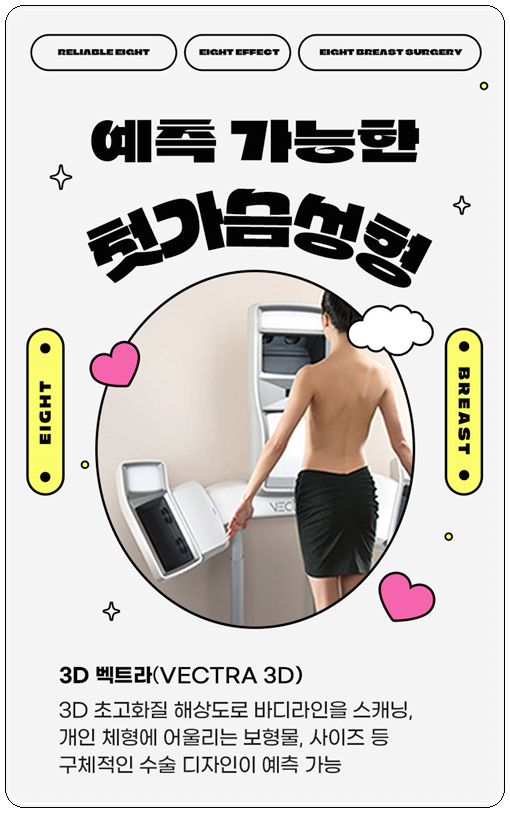
The key to breast augmentation is not simply making it “bigger,” but making it “beautiful in a balanced way.” To achieve this, it may be helpful to conduct a precise analysis of each person’s body type and anatomical structure through 3D Vectra stereoscopic analysis based on the following measurement indicators.
Nipple position: upper volume and central focus
Distance from the inframammary fold: lower curve and degree of sagging
Distance between the nipples: setting the inward/outward slope angle of the breasts
Areola diameter: incision range and whether sagging is present
Chest width/shape: determining implant width and projection limits
Tissue thickness: checking tissue quality, feel, and implant composition ratio
Presence of asymmetry: determining whether correction is needed
📌 By visualizing this data through a 3D Vectra simulation, it is possible to compare images before and after the procedure in detail, enabling a highly satisfying consultation.

Use implants optimized for your body type
Since this clinic has a variety of genuine implants, it is possible to make an appropriate choice tailored to your physical characteristics.
✅ Minimize the possibility of rippling
✅ A width-to-height ratio that suits the individual body type
✅ Natural feel & upper tension
✅ Breast insurance program in case of rupture or capsular contracture
Motiva, Sebbin, Mentor, and more detailed types are available, and customized selection is possible during consultation.

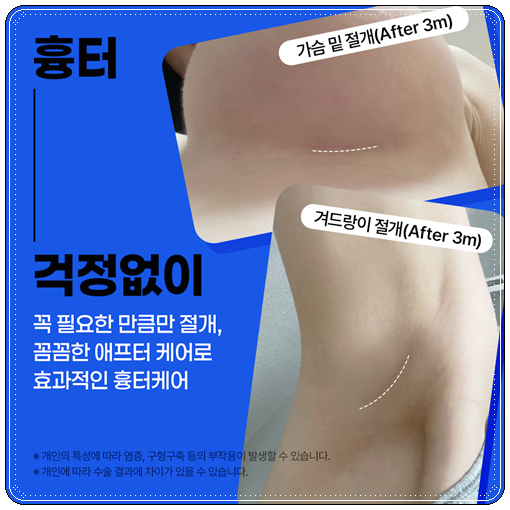
Scar management strategies according to incision location
| Incision area | Recommended cases |
|---|
| Armpit | When you are very concerned about scars, first surgery, seasons with a lot of exposure |
| Under the breast fold | When there is some under-breast volume, revision surgery, insertion of large-volume implants |
| Areola | When the areola diameter is 3 cm or more, or when correction of ptosis/sagging is performed together |
By using the Air Contact system and Full HD endoscopy,
precise dissection and stable implant placement can be achieved with minimal incisions in a short time,
helping reduce bruising and bleeding and supporting faster recovery.
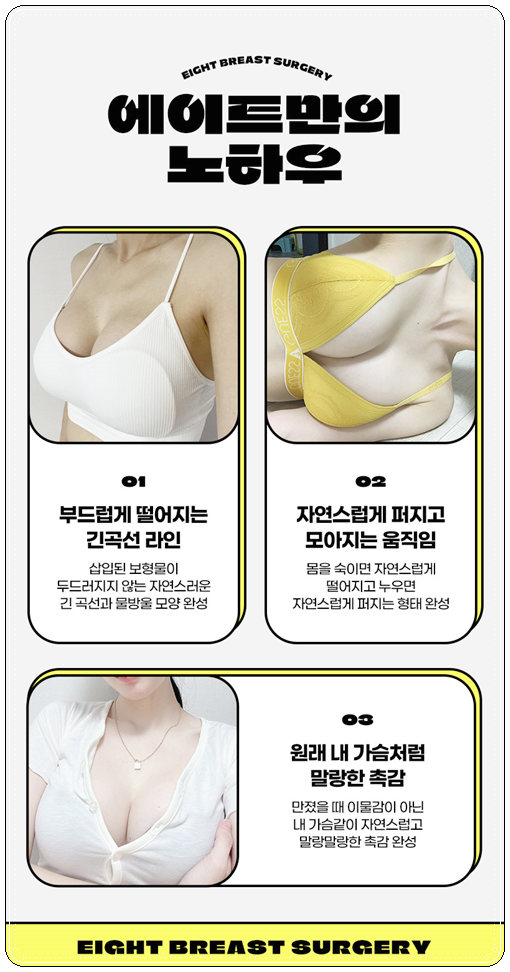

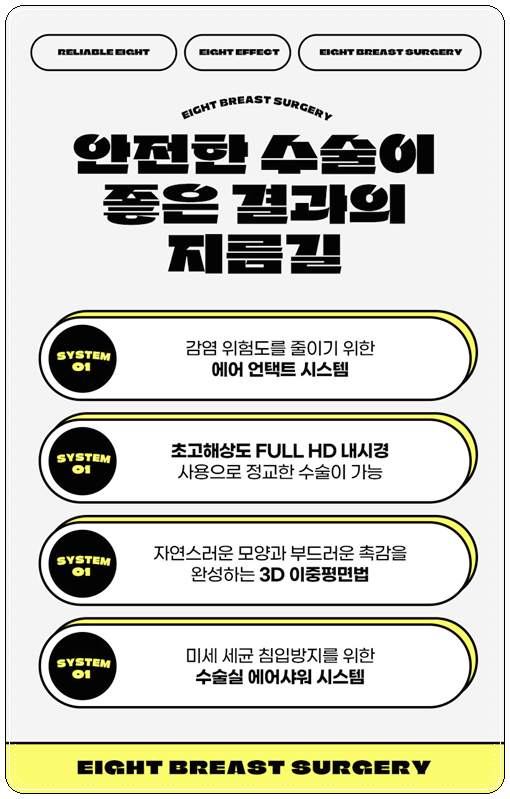
Previous image
Next image
Customized design for implant placement position as well
Submuscular: for slim body types and when a natural contour is preferred
Subfascial: for cases with abundant tissue, faster recovery and less pain
Dual Plane: the most common method, helps prevent sagging and provides a natural feel

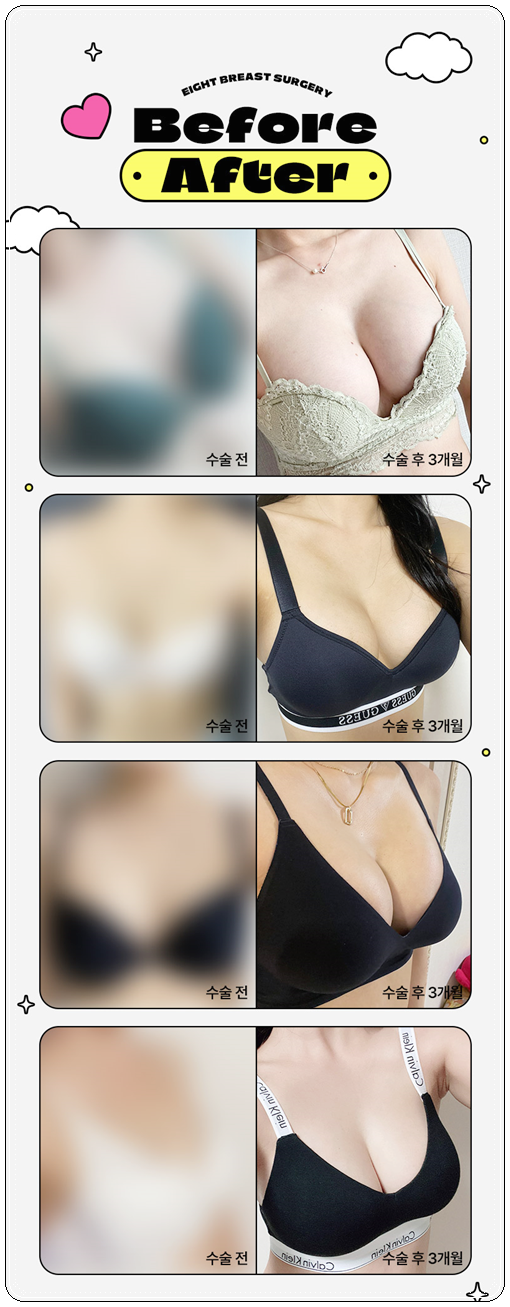
Previous image
Next image
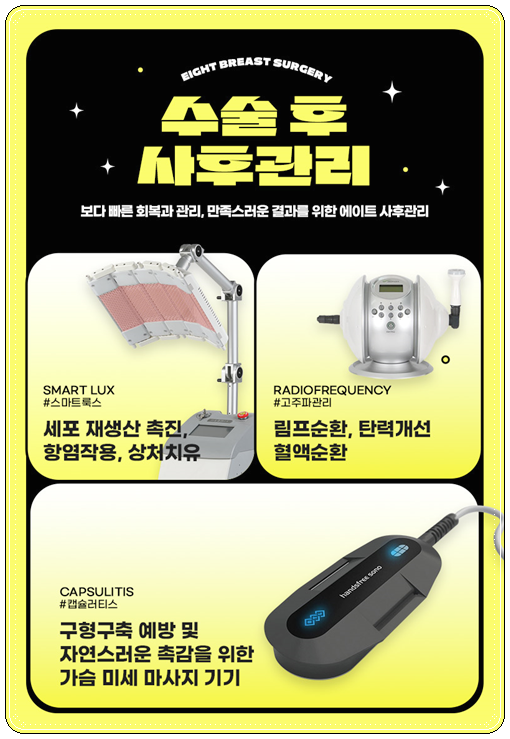
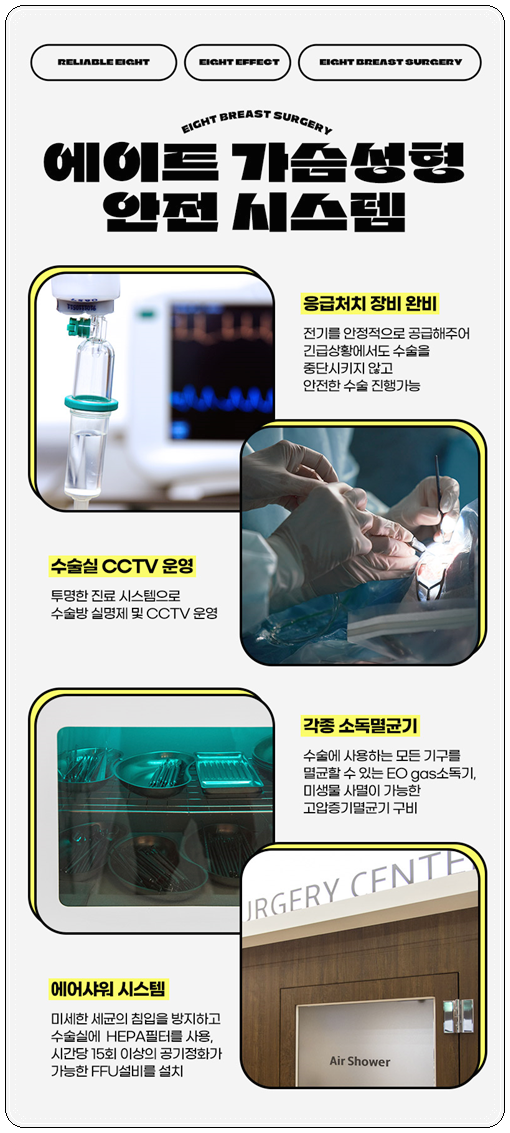
Safety systems and aftercare, too
Anesthesia management: full-time presence of a specialist in anesthesiology and pain medicine, cardiopulmonary monitoring
Aseptic surgery: operating room air shower system, hygiene system, safety system
Recovery program: Smartlux, Capsulettis, radio frequency, scar care, and more
“Breast augmentation is not a simple procedure, but a high-difficulty treatment in which anatomical design, aesthetic balance, and long-term safety are important.” To that end, EIGHT, which has professional expertise, provides a more systematic and stable medical service. This post is for medical information purposes, so if you have any further questions, please refer to the website and visit the clinic in person to speak with the director in detail and learn more about the specifics.