
How Much Does a Non-Implant Tip Rhinoplasty Cost? Types of Materials Used in Nose Surgery and How It Differs from Bridge Surgery
If nose surgery in the past focused solely on building a high bridge, today’s trend has shifted toward a natural yet refined line that looks like your original nose rather than something artificial. In particular, among people who are concerned about the rejection of artificial implants such as silicone or Gore-Tex, or about side effects such as inflammation, visibility, or contracture, non-implant tip rhinoplasty is becoming the overwhelmingly preferred choice. But once you actually decide to have nose surgery, it can be confusing to see why there are so many types of materials used in nose surgery, and why the cost of tip surgery and bridge surgery differ. Today, I’d like to talk about that.

- A complete encyclopedia of nose surgery materials: what is the best choice for me?
The first step to successful nasal contour correction is choosing the material that best suits your body. Autologous tissue has very little foreign-body reaction, so its safety is extremely high.
① Autologous septal cartilage
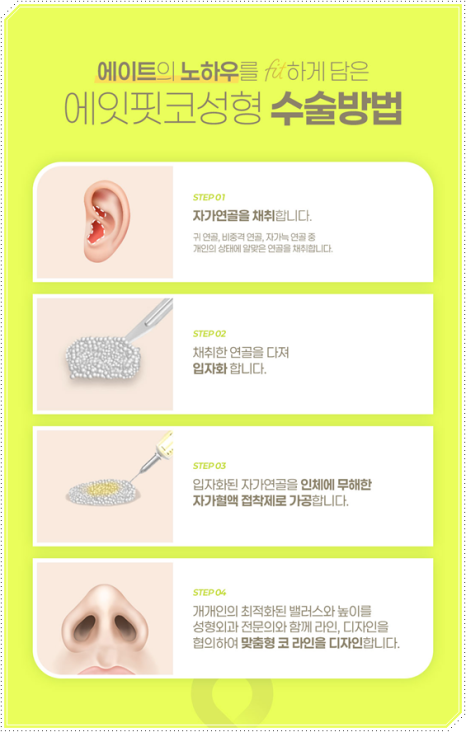
This is the partition cartilage inside the nose. It is straight and firm, making it the ideal material for building the foundation and support structure of the tip. It is relatively easy to harvest and has excellent strength, helping maintain a high, well-defined tip for a long time.
② Ear cartilage
Because it is rounded and elastic in shape, it is ideal for expressing the soft curve of the nasal tip. If you build a pillar with septal cartilage first and then add ear cartilage on top of it, you can complete a naturally soft-looking yet refined tip, even to the touch.
③ Autologous rib cartilage and donated rib cartilage
These are used when autologous cartilage is insufficient or when strong support is needed for revision surgery. Eight has micro-incision techniques that minimize scarring when harvesting rib cartilage, reducing the burden associated with rib cartilage.
④ Autologous dermis and autologous fat
These are used to add volume to the bridge without implants. They are the best alternative for people whose skin is thin and may show an implant through it, creating a soft nasal bridge with no artificial feel at all.

- Eight’s distinctive technology: What is A-Fit Nose?
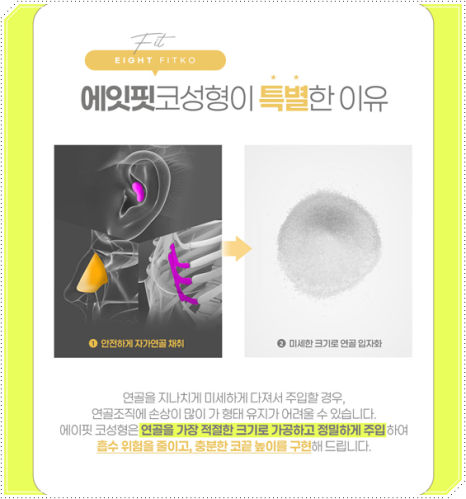
Good materials alone cannot guarantee a perfect result. A-Fit Nose is Eight’s non-implant rhinoplasty solution, which analyzes each patient’s anatomical characteristics to find the optimal fit.
-
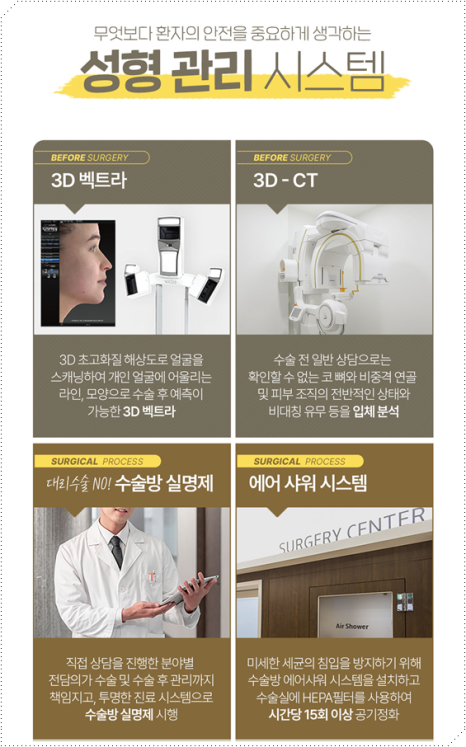
3D CT, Xu1 endoscopy, and 3D Vectra precision diagnosis: Before surgery, the degree of nasal bone deviation, the size of the septum, and skin thickness are measured to the 0.1 mm level to prevent unnecessary treatment.
-
Golden angle of the nasolabial angle: The angle formed by the nasal tip and the philtrum is precisely adjusted to between 95 and 105 degrees, creating the effect of a less prominent mouth and a smaller-looking face.
-
Combined functional nose surgery: Breathing-related issues such as rhinitis or a deviated septum are addressed at the same time, increasing satisfaction.

- Financial analysis: Non-implant tip rhinoplasty cost vs. bridge surgery cost
The cost issue that many people are most curious about depends on the scope of the surgery and the combination of materials used.
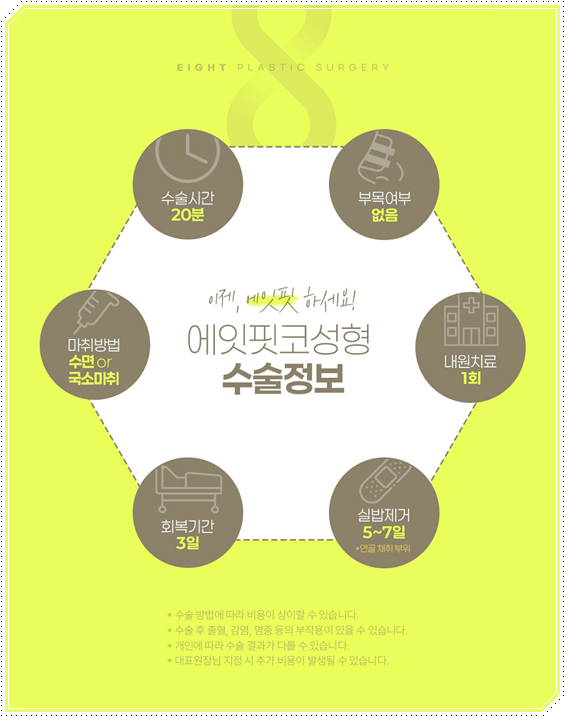
① Non-implant tip rhinoplasty cost (around the mid-1 million KRW range and up)
There is no cost for artificial implants, but the key factor is the surgeon’s skill and technical fee for harvesting and meticulously shaping the patient’s own cartilage. Eight’s A-Fit Nose system provides high-density surgery at a reasonable price, and the cost is adjusted according to the level of difficulty.
② Bridge surgery cost (around the low-1 million KRW range and up)
A procedure that simply inserts a silicone implant is relatively low in cost, but the price can rise to over 2 million KRW depending on more complex surgical methods.
③ Full nose surgery (bridge + tip) cost
In general, the most common approach is combining the bridge (implant) and the tip (autologous cartilage), and the cost is typically in the mid-2 million KRW range to around the 4 million KRW range. It may vary depending on the detailed surgical method and level of difficulty.

- Conclusion: How to find your own refined, lifelong nose
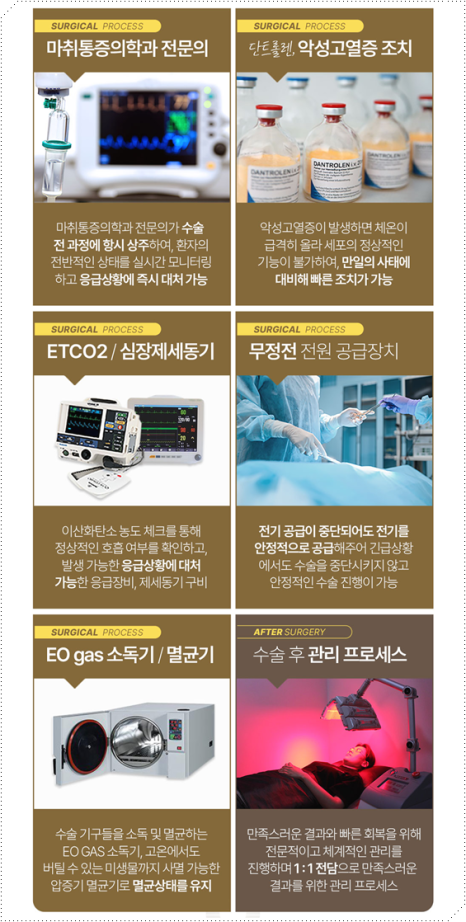
In the end, the success of non-implant tip rhinoplasty depends on a deep understanding of the materials and the medical team’s aesthetic sense. Rather than focusing only on the price, it is wise to look for a professional plastic surgery clinic that offers specialized techniques through a precise analysis system. Above all, since nose surgery must prioritize safety, I recommend carefully checking the clinic’s safety system, whether a board-certified anesthesiology specialist is on site, whether the surgery is performed under a real-name system, whether CCTV is installed in the operating room, whether an air-shower sterile treatment system is in place, and whether dermatology aftercare programs are available, so that you can make a safe plan.
I hope the guide to nose surgery that I’ve summarized today becomes a clear roadmap for your safe and beautiful transformation. For additional questions or detailed estimates, please refer to the website and visit the clinic for a one-on-one consultation with a board-certified plastic surgeon.






Previous image
Next image