Preparing for the Cost and Swelling When Combining Medial and Lateral Canthoplasty with Double-Eyelid Surgery: A Comparison
A person's eyes are not necessarily beautiful simply because they are large. Many people want clearly defined, attractive eyes, but harmony that takes into account everything from the shape of the face to the shape of the eyes, the distance between the eyes, eyelid thickness, the amount of fat, muscle strength, and even the angle of the outer corners is essential. For this reason, many people today are making plans to extend the length of their eyes and improve a stuffy appearance in order to address concerns about their eye shape. To this end, many people consider medial and lateral canthoplasty together with double-eyelid surgery. Today, we will address some common questions about these canthoplasty procedures.
- The Importance of ‘Structural Understanding’ in Eye Surgery
Although the eyes are a small area, they are a key element that determines the overall impression of the face. The eyelids are very thin, highly mobile tissues in which the skin, muscles, and fat work together to enable the eyes to open and close while also shaping their appearance.
Therefore, eye surgery is not simply about creating a crease; it requires a process of designing natural movement while taking these structures into account. Even for the same type of eye surgery, the appropriate method may vary depending on the individual's eye condition, making a personalized approach very important.
- Comparison and Meaning of Medial and Lateral Canthoplasty
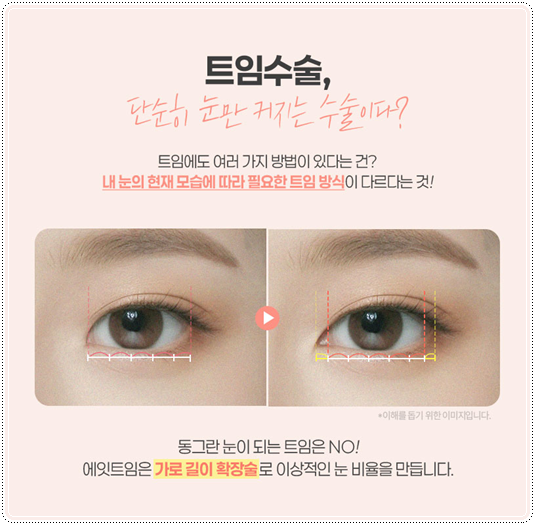
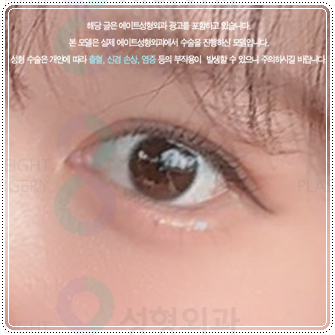
Canthoplasty is a procedure that opens the inner, outer, upper, or lower areas of the eyes to expand their horizontal and vertical dimensions and gently adjust the overall angle of the eye shape.
-
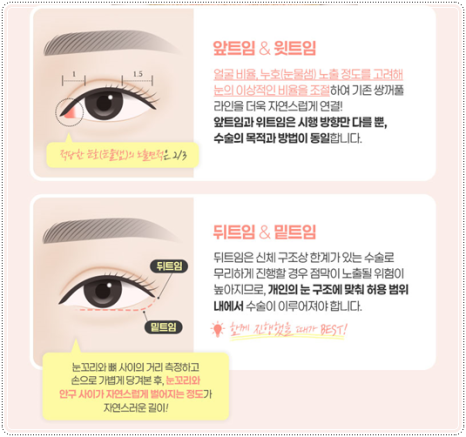
Meaning of medial canthoplasty: This involves creating an incision horizontally, following a curved line from the inner eyelashes in accordance with the shape of the epicanthal fold. It is suitable when the distance between the eyes appears wide or the lacrimal lake is covered.
-
Meaning of lateral canthoplasty: This is performed to open the outer canthus, the outermost point of the eye, outward. It effectively lengthens the horizontal dimension of the eye and creates a more open appearance.
Because medial and lateral canthoplasty target different areas, they may be performed selectively or together depending on whether the individual's eye shape is affected by an epicanthal fold or by a narrow horizontal width.
- Synergy When Medial and Lateral Canthoplasty Are Performed Together with Double-Eyelid Surgery
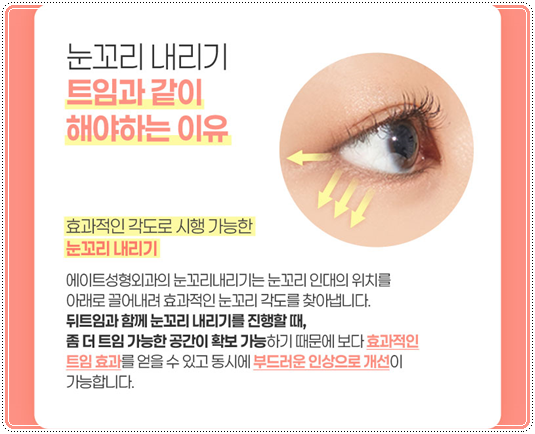
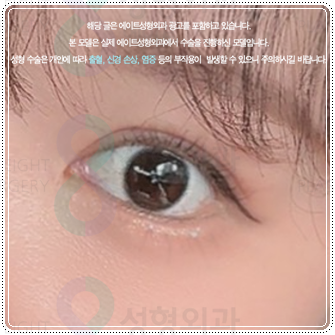
First, double-eyelid surgery is a process that induces adhesion between the levator palpebrae superioris muscle, which opens the eye, and the skin or conjunctiva so that the skin folds when the eye opens. It involves fixing the anatomical structures through the buried-suture, partial-incision, or incisional method. Medial canthoplasty performed alongside it involves incising and removing the epicanthal fold at the inner corner of the eye to expose the previously covered medial canthus, thereby extending the horizontal length and creating a more open appearance. Lateral canthoplasty involves incising the conjunctiva near the outer corner and reattaching the lateral canthal ligament to the periosteum, which can extend the horizontal length of the eye outward and adjust the angle of the outer corner.
Because these procedures affect one another's results, the scope of surgery must be determined by comprehensively considering the horizontal and vertical dimensions of the eyes, the degree of ocular protrusion, the tension of the epicanthal fold, and the presence or absence of ptosis. Excessive canthoplasty may cause side effects such as mucosal exposure, dry eye, or scarring, so the key is to apply precise techniques within the tissue's limitations.
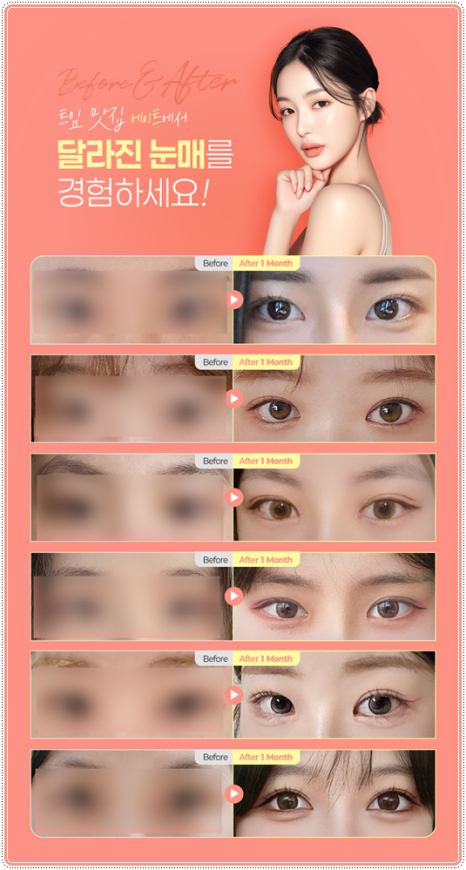
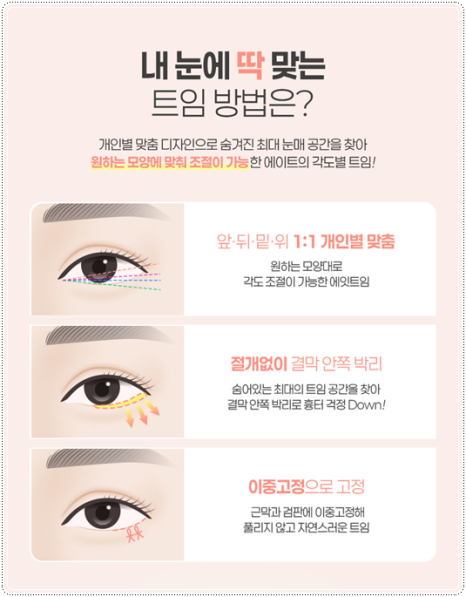
Combining double-eyelid surgery with canthoplasty in this way can maximize the three-dimensional quality of the eye shape. In particular, Eight Plastic Surgery's ‘Eight Trim’ technique minimizes visible scarring through micro-incisions and precise suturing, while precisely measuring each individual's degree of lacrimal lake (red tissue) exposure to prevent side effects caused by excessive canthoplasty. In addition, during lateral and lower canthoplasty, rather than simply incising the skin, the tissue at the outer corner of the eye is firmly fixed to the orbital periosteum, helping maintain an open-looking eye shape over time.
- Cost and Swelling Management for Medial and Lateral Canthoplasty
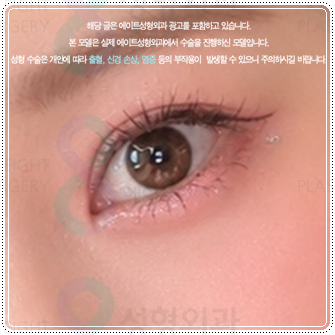
The cost and swelling associated with medial and lateral canthoplasty, which many people are especially curious about, may vary depending on individual anatomical conditions.
-
Cost information: Medial canthoplasty generally costs between KRW 500,000 and KRW 1,000,000, while lateral canthoplasty also typically costs between KRW 500,000 and KRW 1,000,000. Double-eyelid surgery may cost anywhere from KRW 600,000 to KRW 2,000,000, so rather than setting a standard based solely on the price, it is advisable to undergo a detailed evaluation, determine the scope of surgery you need, and then receive a consultation.
-
Swelling and recovery: It is important to develop a plan suited to the individual's eye condition through thorough consultation with a board-certified plastic surgeon. At facilities such as Eight Plastic Surgery that operate systematic post-operative care programs, combining swelling laser treatments and scar care can be highly helpful for a prompt return to daily life and for preventing complications.
Usually, during the first 1–3 days after double-eyelid surgery and medial and lateral canthoplasty, swelling and bruising are concentrated around the surgical area. It is important to keep the head elevated and apply cold compresses consistently to constrict the blood vessels and reduce the inflammatory response. Afterward, switch to warm compresses to promote blood circulation and remove residual swelling.
In general, substantial swelling subsides considerably within 2–4 weeks, allowing patients to resume daily activities. However, it typically takes approximately 3–6 months for the tissues to fully settle, scars to fade, and the eye shape to appear natural, depending on the individual's healing rate and the surgical technique used.
During this recovery period, avoid vigorously rubbing or irritating the surgical area. Alcohol and smoking can interfere with blood flow, delay recovery, and cause inflammation, so it is advisable to strictly limit them for at least one month.
- Special Features of Eight Trim
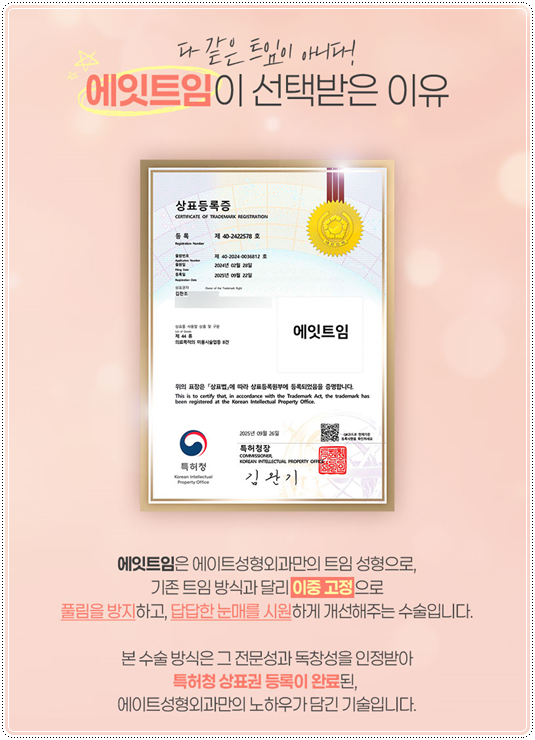
Eight Plastic Surgery's ‘Eight Trim’ goes beyond simply opening the eyes by applying precise techniques that take safety and lasting results into account.
-
Minimizing scarring: Visible scarring is minimized through micro-incisions and precise suturing.
-
Preventing complications: The degree of lacrimal lake (red tissue) exposure is precisely measured for each individual to prevent complications caused by excessive canthoplasty.
-
Adhesion-prevention technique: During lateral and lower canthoplasty, the procedure does not simply involve incising the skin; the tissue at the outer corner of the eye is firmly fixed to the orbital periosteum. This helps prevent the tissues from adhering again after surgery and helps maintain an open-looking eye shape over time.


- Safety Checklist for the Medical System
For eye surgery, the safety system supporting the procedure is just as important as precise surgical techniques. Be sure to check the following when choosing a medical institution.
-
Ensuring transparency: Check whether CCTV cameras that comply with legal standards are installed and operating in the operating room.
-
Dedicated medical staff: Check whether a board-certified anesthesiologist is present and monitors the entire surgical process in real time.
-
Infection prevention: Be sure to check whether the facility maintains a sterile environment that fundamentally blocks the entry of external fine dust and bacteria through an air-shower system in the operating room.
-
Precise sterilization: For safety, check whether all medical instruments are managed through a double sterilization system—high-pressure steam and EO gas.
-
Emergency preparedness: It is advisable to check whether emergency equipment is fully available, including an uninterruptible power supply (UPS), dantrolene for malignant hyperthermia, and syringe pumps.
This has been an overview of double-eyelid surgery and medial and lateral canthoplasty. These eye procedures are not simply about making the eyes larger; it is important to accurately identify each individual's anatomical concerns and pursue their natural beauty. Therefore, if you are planning surgery, be sure to have a thorough consultation with a board-certified plastic surgeon and establish a surgical plan that is most appropriate and safe for your condition.
[Medical Law Compliance Notice] This post was prepared in compliance with medical law for the purpose of providing medical information and includes advertising for Eight Plastic Surgery. All plastic surgeries may cause side effects such as inflammation, bleeding, or nerve damage depending on the individual's condition. Be sure to decide whether to undergo surgery only after a detailed consultation with a board-certified plastic surgeon.