For Revision Double-Eyelid Surgery Without Failure: From the Features and Cost of the Non-Incisional Method to Swelling Recovery by Stage
Many people consider revision surgery after experiencing unexpected results from double-eyelid surgery. Since the eyes are an important area that determines the overall impression of the face, revision double-eyelid surgery requires a much higher level of sophistication and precise analysis than the initial procedure. Today, we will discuss the essential information you need to know for revision double-eyelid surgery without failure.
- Learn About the Main Types of Cases Requiring Revision Surgery and Directions for Improvement
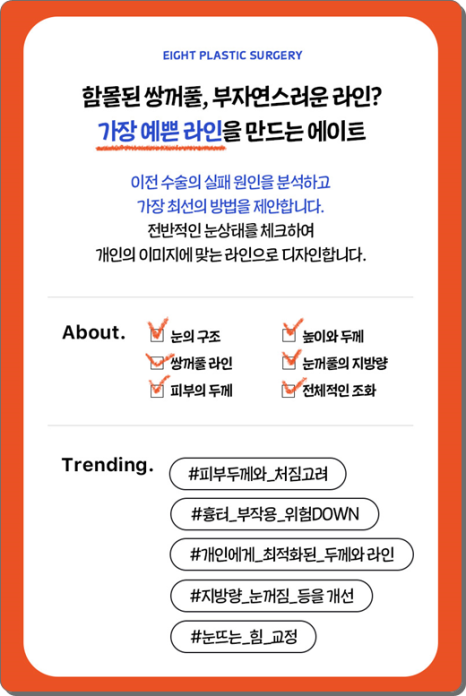
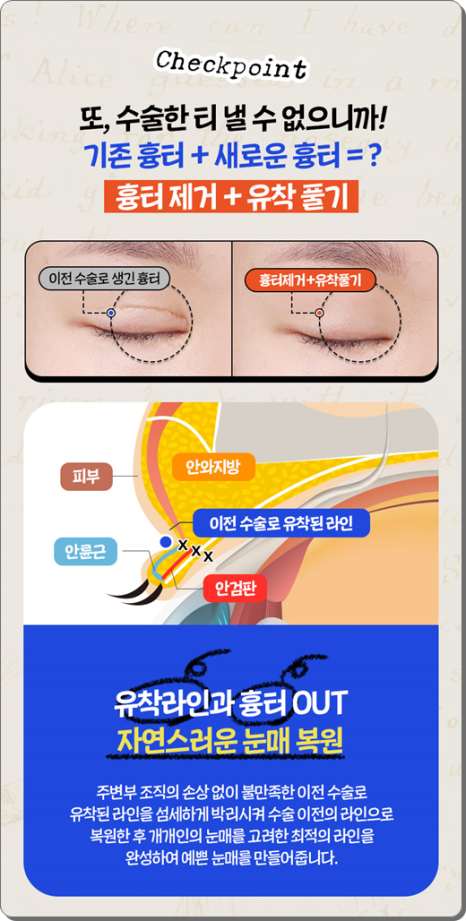
Revision double-eyelid surgery is not simply a process of creating the crease again; it involves clearly identifying the cause of the unsatisfactory result and organizing the existing tissue. Accordingly, it is important to apply an appropriate method tailored to each individual case.
-
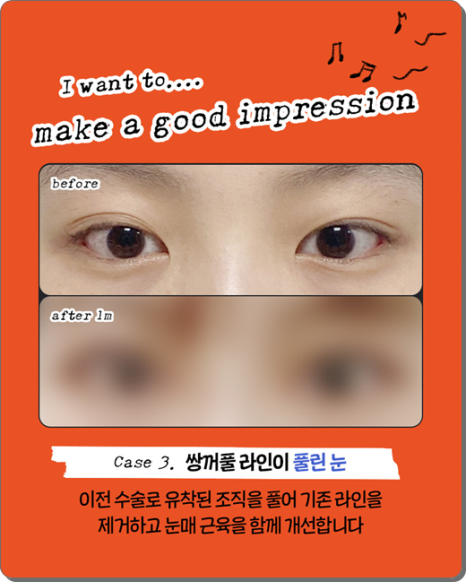
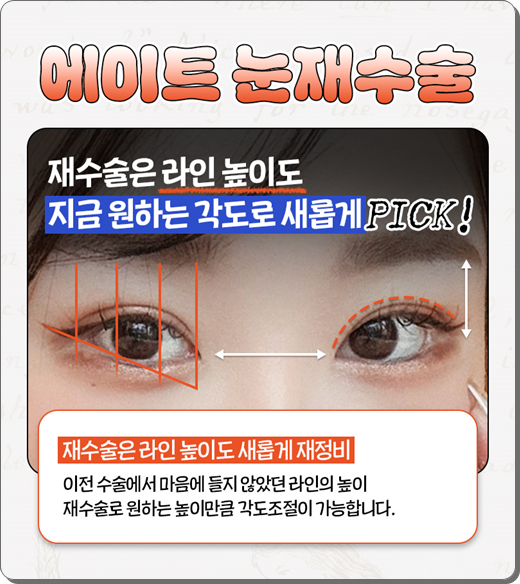
Sausage eyes (high crease): To lower an excessively high crease, hardened scar tissue is removed and, when necessary, the crease is adjusted downward using the “double-line” technique.
-
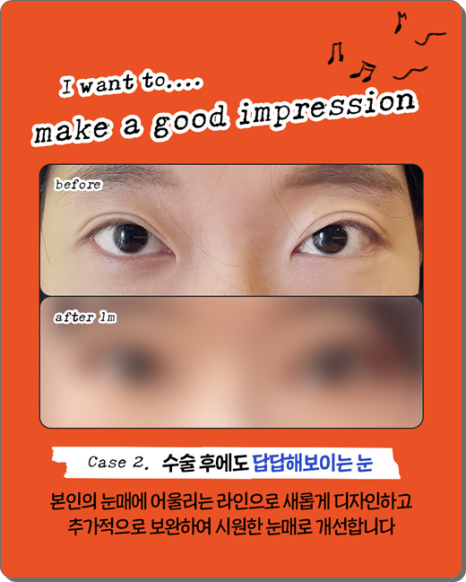
Loss of the crease and a faint crease: If the strength needed to open the eyes is insufficient, ptosis correction may be performed at the same time to strengthen fixation.
-
Severe scarring and asymmetry: Existing scar tissue is precisely dissected and removed, while the anatomical structures and eye-opening strength of both eyes are balanced.
-
Hollowness above the eyes and multiple creases: This is often caused by excessive fat removal during the previous surgery. A smooth eye contour can be restored through autologous fat grafting or fat repositioning.
- Features and Advantages of Non-Incisional Revision Double-Eyelid Surgery
Many people prefer non-incisional revision surgery because they are concerned about an incision.
-
Natural appearance: Since no incision scar remains, there are few visible signs of surgery.
-
Faster recovery: Because there is less tissue damage, patients can generally return to daily activities relatively quickly.
-
Easy correction: This method is advantageous for making subtle adjustments to the height and shape of the crease. In particular, satisfaction with non-incisional correction tends to be high when the eyelid skin is thin and there is little sagging. In rare cases where the difference between the eyes is not significant, revision surgery may be performed on only one side to achieve overall balance.
However, depending on the individual, it may be difficult to perform revision double-eyelid surgery using the non-incisional method. The appropriate approach may vary according to the different cases described above. Generally, when a previous non-incisional double-eyelid procedure has loosened, non-incisional revision may be considered if the case is suitable for it. Therefore, when making a plan, it is important to discuss it thoroughly with a board-certified plastic surgeon and prepare accordingly.
- When Is the Best Time for Revision Double-Eyelid Surgery? (Timing)
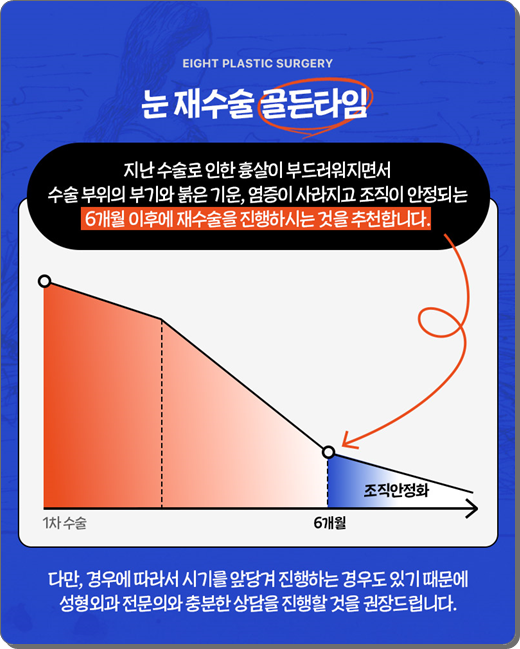
In general, an appropriate time for revision double-eyelid surgery is considered to be at least 6 months to 1 year later, after the tissue has softened and the scars have stabilized. However, if a functional problem occurs, such as an inability to fully close the eyes, or if the result is abnormal immediately after the initial double-eyelid surgery, early correction may be considered before adhesions progress. A thorough consultation with a board-certified plastic surgeon is therefore essential.
- What Is the Average Price and Cost of Revision Double-Eyelid Surgery?
So, approximately how much does revision double-eyelid surgery cost? On average, the procedure may cost between KRW 1.5 million and KRW 2.5 million. However, the price can vary depending on the difficulty of the revision, the method used for the previous surgery, the scope of correction required, and the combination of surgical techniques applied. An accurate diagnosis based on the condition of your eyes should therefore come first.
- Swelling Recovery After Revision Double-Eyelid Surgery: What Is the Recovery Process and How Should It Be Managed?
Managing swelling after revision double-eyelid surgery is also an important part of the recovery process.
-
Early recovery (1–2 weeks): Significant swelling gradually subsides, and consistent cold compresses can be very helpful during this period.
-
Intermediate recovery (1 month): This is generally a time when normal social and outside activities are possible.
-
Stabilization period (2 months): By two months after revision double-eyelid surgery, most residual swelling has subsided and the final crease has taken shape. At this point, before-and-after photos can be used to check the improvement in the appearance of the eyes.
Of course, revision surgery addresses problems caused by complex factors in different ways for each individual, so recovery times can vary considerably from person to person. It is also advisable to consider the medical institution’s post-operative care program.
- Comprehensive post-operative care: Aite Plastic Surgery provides a professional post-operative care program tailored to each individual’s recovery speed, including swelling laser treatments and scar care performed at a dermatology clinic, to help patients return to daily life quickly.

- What Is Aite Plastic Surgery’s Strategy for Successful Revision Double-Eyelid Surgery?
Aite Plastic Surgery analyzes the causes of unsatisfactory results from multiple perspectives to reduce the possibility of recurrence.
-
Precise dissection: Only the necessary areas are carefully dissected to reduce unnecessary bleeding and swelling.
-
Anatomically customized solutions: The safest medical solution suited to each individual’s available skin and current tissue condition is applied.
-
Safety systems: The clinic is equipped with professional safety facilities, including an anesthesiologist on-site, an air-shower system and sterile clean room in the operating room, a dual sterilization system, and emergency medications such as dantrolene.
In Closing
When looking at actual reviews of revision double-eyelid surgery, you will often find comments focused less on whether “the crease is pretty” and more on whether the eyes were improved with “a natural crease that suits my eyes,” according to each person’s concerns. This is because the surgical method was selected based on a precise diagnosis. Therefore, before undergoing revision surgery, the key to success is to review the clinic’s range of cases and precisely analyze the condition of your eyes.
In particular, revision double-eyelid surgery is a highly complex procedure that must take both the structural and functional aspects of the eyes into account. It is also important to carefully consider that it should ideally be the final surgery, preventing adhesions caused by repeated procedures and preserving the tissue. We recommend making a careful decision through a clinic with an experienced board-certified plastic surgeon, precise anatomical diagnosis, a safe system, and a structured recovery program, while determining the scope of surgery you truly need through thorough consultation.
(※ This post was written for the purpose of providing medical information and includes medical advertising for Aite Plastic Surgery. All surgeries may result in side effects such as bruising, swelling, infection, or asymmetry depending on the individual’s condition. Before surgery, please prepare carefully through a precise diagnosis and thorough consultation with a board-certified plastic surgeon.)