What Types of Rhinoplasty Are Available in Apgujeong? A Look at Bridge and Tip Surgery Prices and Recovery Times
As the center of the face, the nose is an important feature that influences overall facial dimension and impression. Many people visit plastic surgery clinics in Apgujeong to make their facial features look more refined or to improve the shape of the nasal bridge and tip. In particular, many people are curious about which type of rhinoplasty would be suitable for them and how long the recovery period may be after surgery, including when swelling may subside and when they may return to their daily activities. Today, for those considering rhinoplasty, we will explain the various types of surgery for the nasal bridge and tip.

- Types and Features of Nasal Bridge Surgery
Since the overall dimension of the face can change significantly depending on the height and shape of the nasal bridge, it is important to select an implant or material appropriate for the individual’s skin thickness and anatomical structure.
-
Silicone: One of the most commonly used implants in rhinoplasty, silicone allows for precise design in the desired shape and height. It is less likely to deform over time and is effective for creating a defined nasal bridge.
-
Gore-Tex: Since the implant itself becomes microscopically adhered to the surrounding tissue, it can reduce implant movement. It is used when a soft feel and natural-looking contour are preferred.
-
Autologous tissue (autologous dermis, autologous rib cartilage, etc.): For those with significant concerns about a foreign-body sensation or very thin skin, tissue from their own body can be used to augment the nasal bridge. Its advantages include a lower concern about foreign-body reactions and high biocompatibility.

- Types of Nasal Tip Surgery and Open vs. Closed Rhinoplasty
The nasal tip is a key area that completes facial proportions and dimension. Unlike the nasal bridge, it requires consideration of soft curves and movement, so autologous cartilage that is generally well tolerated by the body is primarily used.
-
Septal cartilage: Cartilage is harvested from the nasal septum, which supports the inside of the nose, and used to create a firm column supporting the nasal tip. Because it has moderate strength, it is mainly used to support and define the nasal tip.
-
Ear cartilage: Cartilage is harvested from the rounded part of the ear. This method is advantageous when creating a soft-feeling, natural-looking nasal tip.
-
Autologous rib cartilage: When the nasal tip needs to be extended more firmly or in revision surgery, cartilage may be harvested from between the ribs or from the chest area to provide strong support.
-
Surgical approaches (open vs. closed):
-
Open rhinoplasty: A small incision is made in the columella, the area between the nostrils, to obtain a wider surgical view and precisely correct the structure.
-
Closed rhinoplasty (incisions inside the nose): Incisions are made only inside the nostrils, so there is little to no visible external scarring.
Rhinoplasty involves various materials, implant types, and surgical methods. In general, the appropriate approach differs depending on the individual’s nasal type and condition, as well as the degree of improvement desired. Therefore, when making a plan, it is important to receive a thorough consultation with a board-certified plastic surgeon and review the details based on an accurate assessment.

- Information on Average Rhinoplasty Costs (Nasal Bridge and Tip Surgery)
There is no fixed price range established specifically for plastic surgery clinics in Seoul’s Apgujeong area. In addition to whether the nasal bridge and tip are treated together, the cost of rhinoplasty varies depending on the specific condition of the nose, whether it is primary or revision surgery, the type of implant and autologous cartilage used, the scope and extent of combined procedures, and the level of difficulty.
-
Rhinoplasty (nasal bridge and tip surgery) price: Approximately 2 to 4 million won.
-
Factors affecting the price: The cost may vary depending on various factors, including whether only the bridge or only the tip is treated, the implants and materials used, whether autologous cartilage can be used, and whether the procedure is primary surgery or involves correction and combined procedures. (※ The exact cost can be confirmed most accurately through a detailed examination during an in-person consultation.)

- Average Rhinoplasty Recovery Period and Typical Swelling Timeline
For people preparing for rhinoplasty, the most important considerations are when they can return to their daily activities and how swelling and scars recover over time. The specific recovery timeline when the nasal bridge and tip are treated together is as follows.
- Immediately after surgery to day 3
This is when considerable swelling and bruising may appear around the nose and eyes. A splint is fixed over the nasal bridge to maintain its shape, and breathing may feel somewhat uncomfortable because of cotton packing or bandages inside the nose. During this period, it is important to take the prescribed medication as directed and regularly apply cold compresses to help reduce swelling.
Patients generally return to the clinic around postoperative day 7 to have the splint removed from the nasal bridge and the stitches removed from the skin and nasal tip. Some residual swelling remains immediately after the splint is removed, but this is when it becomes possible to return to daily activities such as light outings or office work. After postoperative days 3–4, warm compresses are used instead to help reduce residual swelling.
- Two weeks to one month after surgery
Significant bruising and major swelling have mostly subsided, and the firm feeling at the nasal tip gradually becomes softer. From two weeks after surgery, light base makeup or makeup for going out can be used to cover any remaining redness. With closed rhinoplasty, there is little visible external scarring, while scars at the incision site from open rhinoplasty also gradually fade over time.
- Two to three months or more after surgery
Most residual swelling has subsided, sensation at the nasal tip returns to normal, and the final contours of the designed nasal bridge and tip begin to settle into a natural appearance.
However, this is only a typical timeline, and individual results may vary.



Previous image
Next image
- Points to Check for Successful Rhinoplasty
Rhinoplasty is not simply a procedure to increase the height of the nose. It is a high-level procedure that must also take into account the harmony of the entire face and the functional structure of the nose, such as a deviated septum and breathing function.
-
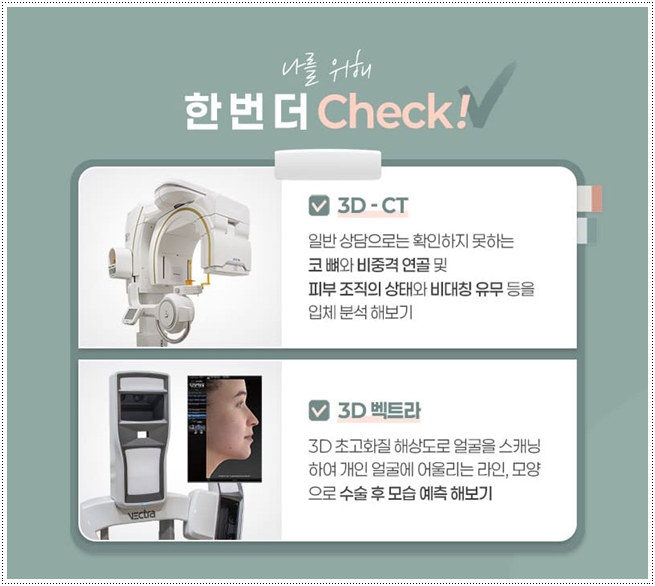
Personalized diagnosis: Because everyone has a different skin thickness, cartilage strength, and internal nasal structure, a detailed one-on-one assessment with a board-certified plastic surgeon is essential rather than a standardized design. 3D CT and 3D Vectra imaging may be helpful.
-
Systematic safety systems and postoperative care: For safety, check whether the clinic has an emergency power supply system, an operating-room air-shower system and sterile clean room, and an anesthesiologist on site. It is also advisable to choose a facility that provides thorough dermatology aftercare, such as radiofrequency care or swelling-reduction programs after surgery.
Conclusion
We have discussed the basic information above. If you are planning rhinoplasty, refer to the information provided and carefully consider the operating physician’s clinical experience, safety systems, and a personalized surgical plan suited to the condition of your nose before making a cautious decision.
※ This post was written for informational purposes in compliance with Article 56 of the Medical Service Act and its Enforcement Decree. Since all plastic surgery procedures may cause side effects such as inflammation, swelling, or scarring after surgery depending on an individual’s constitution or anatomical structure, a thorough consultation with a plastic surgeon with extensive clinical experience is essential.