Incisional double eyelid surgery near Nonhyeon Station,
Who is it recommended for?
Hello. This is Luho Plastic Surgery.
As the importance of first impressions has grown,
more and more people have wanted an appearance that looks a little more beautiful.
For those who prefer an appearance in which
the eyes, nose, and mouth are all clearly visible,
clear eyes were an essential element.
There were two methods for double eyelid surgery to improve this:
the incisional method and the non-incisional method.
Depending on your natural eye structure and goals,
the appropriate method differs,
so incisional double eyelid surgery was sometimes used.
So let’s look at what conditions call for
the incisional method.
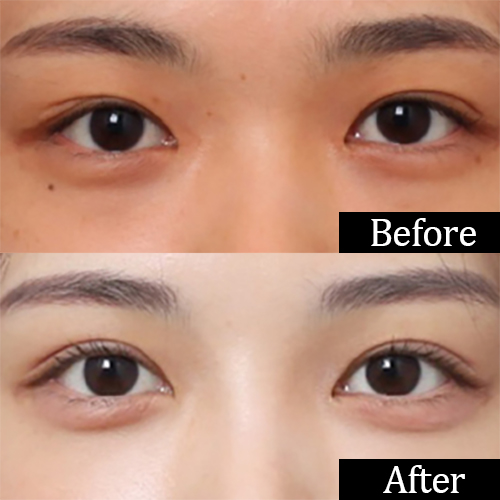
Eyes for which the incisional method is recommended
The incisional method is not about making a “strongly pinched” double eyelid.
It corrects the fundamental structure of the eyes,
creating a firm line and a neat impression.
The types that need this method are as follows.
☺️ Eyes with a lot of eyelid fat and thickness
The more fat there is, the less likely the line is to settle well,
so a non-incisional method may loosen again quickly.
☺️ Eyes where the double eyelid can easily come undone or is asymmetrical
If one side comes undone or the lines look different,
the incisional method, which allows for careful adjustment of muscle strength and fixation position,
may be more stable.
☺️ Droopy eyes, an appearance that looks sleepy
If done together with eye correction surgery,
the eyes can look clearer and the pupils can appear more open.
☺️ Eyes that previously had a non-incisional procedure
If a previous line has loosened
or a scar remains, the incisional method can be used for revision
to neatly refine the result.
☺️ Eyes with ptosis symptoms
If the strength to open the eyes is weak and the eyes are covered,
the incisional method can make the pupils look clearer.
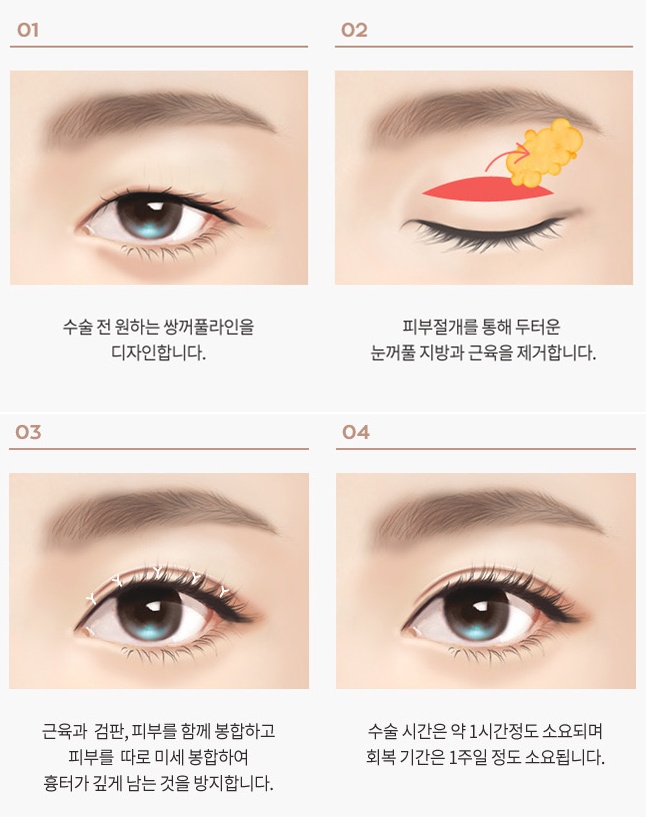
Luho Plastic Surgery’s incisional method
The incisional method is a procedure in which a certain length of eyelid skin is cut,
then the skin and muscle are tied together
to create a double eyelid artificially.
After deciding on double eyelid surgery,
most people tend to prefer the non-incisional method.
The reason is “pain and scarring.”
At Luho Plastic Surgery, incisional double eyelid surgery near Nonhyeon Station
does not differ greatly from the non-incisional method in the recovery process.
The skin is separately and finely sutured
to prevent a deep scar from remaining.
It also has the advantage of
high stability and long-lasting results.

Step-by-step changes after the incisional method
Because there is an incision and suturing process,
the recovery period is longer than with the non-incisional method,
but
if you know what changes happen at each stage and manage it properly,
the recovery becomes much easier.
✅ Right after surgery ~ Day 3: Swelling and bruising begin
-
Condition
-
The eyes are very swollen, and bruising may spread around the incision area.
-
It may feel difficult to open the eyes,
and the line may look unnatural.
-
Care
-
Cold compresses are essential (4–5 times a day, 10–15 minutes each time)
-
Do not bend your head down; keep the upper body slightly elevated when lying down
-
Avoid spicy foods and foods high in sodium
-
Do not wash the face; gently wipe only the surrounding area with a damp towel
✅ Day 4–7: Before stitch removal
-
Condition
-
The swelling goes down a little, and bruising fades to a yellowish tone.
-
Before the stitches are removed, the line may look thick,
and the feeling of opening the eyes may seem awkward.
-
Care
-
Use cold compresses and warm compresses together (to promote blood circulation)
-
Be careful when washing your face so that water does not touch the stitched area
-
Do not sleep on your side
-
The swelling decreases quickly after the stitches are removed
(stitches are usually removed on day 7)
✅ 7 days to 1 month: Line stabilization
gradually stabilizes
- The tight feeling in the eyelids almost disappears,
and the line becomes softer
-
In some cases, minor swelling and redness may continue
-
Care
-
Sun protection is essential (to prevent scar pigmentation)
-
Manage moisture with eye cream and ointment
-
Avoid intense exercise (swelling may return due to increased blood pressure)
✅ 6 weeks to 3 months
-
Condition
-
Swelling, bruising, and scars are almost gone, leaving a natural line
-
It settles into the originally planned design
-
Depending on constitutional factors and skin characteristics, scars may remain,
but if you do not have that type of constitution,
they will look like a very fine line and fade to the point of being barely noticeable
The step-by-step changes that occur after incisional surgery
may vary from person to person.

Incisional vs. non-incisional: which is right for me?
“There are people who wonder
about the exact differences between incisional and non-incisional double eyelid surgery.”
So we organized them as follows.
| Incisional method | Non-incisional method |
|---|
| Durability | High | Moderate (2–5 years) |
| Scarring | Gradually fades with a micro-incision | Almost not visible |
| Swelling period | 2–3 weeks | 5–7 days |
| Recommended for | Thick eyelids, revision surgery | Thin, elastic eyes |
However, in the end, what matters is not the “procedure” but
the “condition of my eyes.”
After comprehensively considering the anatomical structure, skin thickness, muscles,
fat, and the direction of the eyes,
you should choose the method that matches your face in a “harmonious” way
so that you can change to a more natural and clearer appearance.
If your skin is thin, the non-incisional method may be sufficient,
but if it is thick or has a lot of fat,
the incisional method can be much more natural and last longer.
How to determine harmony with your impression
The “eyes” that determine facial features
are a part of the face where a single surgery
can create a meaningful change.
In particular, the incisional method for double eyelids
does not end with simply making a line;
it is a process of achieving harmony with your overall impression.
You can expect good results
by consulting at a clinic that carefully diagnoses
skin thickness, muscle structure, and the direction of the eyes.
Why not receive a recommendation for the right surgical method
from experienced medical staff who design delicately down to 1 mm,
while considering the harmony of the patient’s facial features?