Hello, this is Ruho Plastic Surgery.
The nostrils look large from the front.
Being told that the nose looks like a pig nose or a dragon nose
can be stressful.
If your nostrils look overly exposed every time you take a front-facing photo,
it may not be only because the tip is turned up.

The customized procedure that corrects overly exposed nostrils
is alar base lowering.
Today, we will explain in detail why nostrils become exposed,
the Sinsa Station alar base lowering method performed at our clinic,
and the expected effects.

Why do the nostrils become exposed?
There are several reasons why the nostrils are highly visible from the front.
-
The alar base is excessively recessed upward
-
The nose tip is short and turned upward
-
A short columella
-
The alar bases are positioned high overall
In addition to these, there are also issues such as narrow nostrils.
But in the end, the key factors are the position of the alar base
and insufficient support.
Direct correction is possible with alar base lowering.

The shapes of pig nose and dragon nose
If you are wondering, “Could I have this too?” and want to check whether you have
a pig nose or dragon nose shape, look at the following:
✅ Pig nose: when the columella is short or the cartilage is angled upward
✅ Dragon nose: when the nostrils are long and the amount of exposure is small,
but the bridge and tip are strongly curved upward

Both create an unnatural frontal view
and disrupt the balance of the face as a whole.
Sinsa Station alar base lowering surgery
can alleviate the nostril exposure problems
that occur in these two forms.
Ruho Plastic Surgery’s alar base lowering method
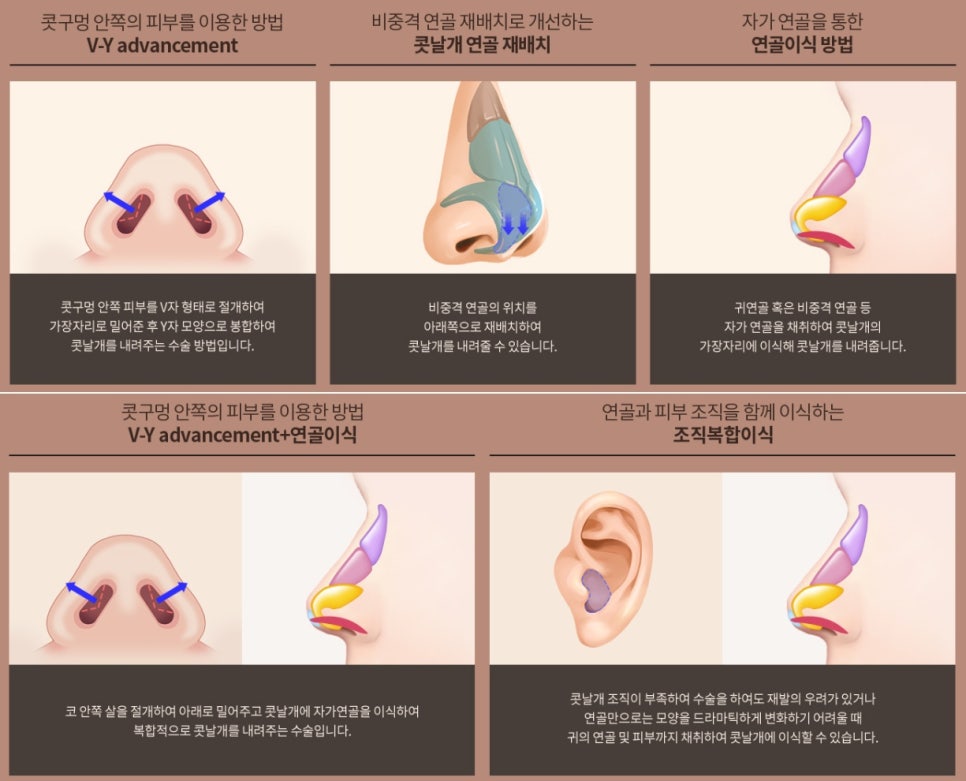
At our clinic, alar base lowering is performed
using a total of five surgical methods.
| 1) V-Y advancement | The skin inside the nostril is incised in a V shape, pushed toward the edge, and then sutured in a Y shape. |
|---|
| 2) Alar cartilage repositioning | The septal cartilage position is repositioned downward. |
| 3) Cartilage grafting | Autologous cartilage such as ear cartilage or septal cartilage is harvested and grafted to the edge of the alar base. |
| 4) V-Y advancement + cartilage grafting | After incising the soft tissue inside the nose, it is pushed downward, and autologous cartilage is grafted to the alar base. |
| 5) Composite tissue grafting | When there is insufficient alar tissue, there is concern about recurrence after surgery, or it is difficult to achieve shape changes with cartilage alone, ear cartilage and skin are harvested and grafted. |
We carefully analyze each person’s nasal structure
and design the procedure using the most suitable method.

Expected effects of Sinsa Station alar base lowering
❇️ First, improvement of the central area of the face
The nostril exposure visible from the front is reduced,
and the center of the face appears more stable.
❇️ Second, a change in impression
The outline of the nose is refined downward,
which can create a more harmonious impression.
❇️ Third, improvement in the frontal image
The feeling of looking like a pig nose or dragon nose is eased,
and there is an effect of changing the front view,
which can be difficult to resolve with tip surgery alone.
Rather than hearing, “You had nose surgery,”
we help you regain a balanced nose line
that suits your face,
so that people can say,
“I’m not sure what changed, but you look prettier.”








Previous image
Next image
In closing
Sinsa Station alar base lowering
If you have been worried because your nostrils show every time you take a photo,
alar base lowering may be a solution.
However, based on structural analysis,
you need to find a clinic that can choose
the most natural and harmonious direction.
Find a place that suggests the method
that each individual can be satisfied with,
and look for the ideal nose shape.