Upper Eyelid Fat Grafting
Does it deflate after 1 month?
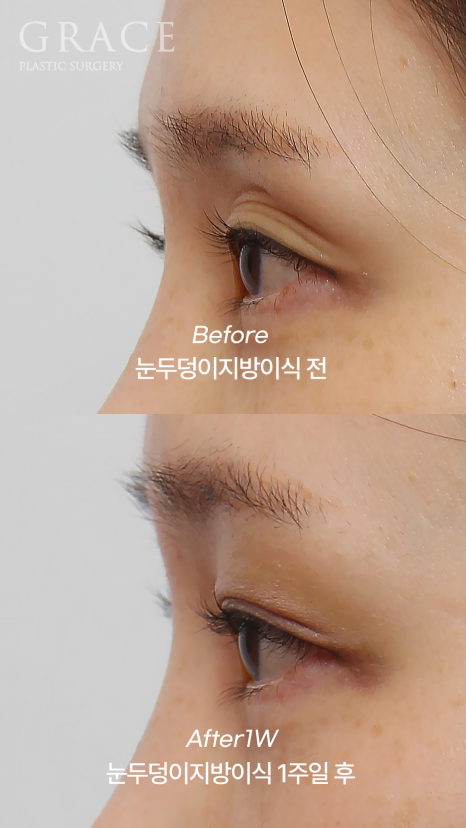
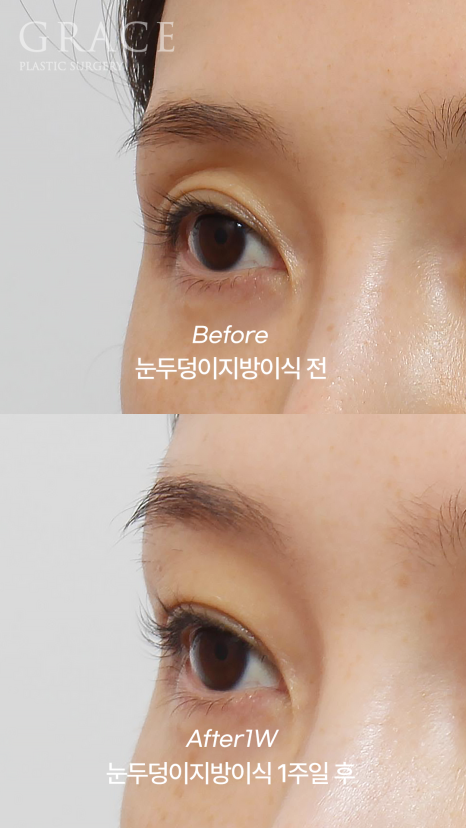
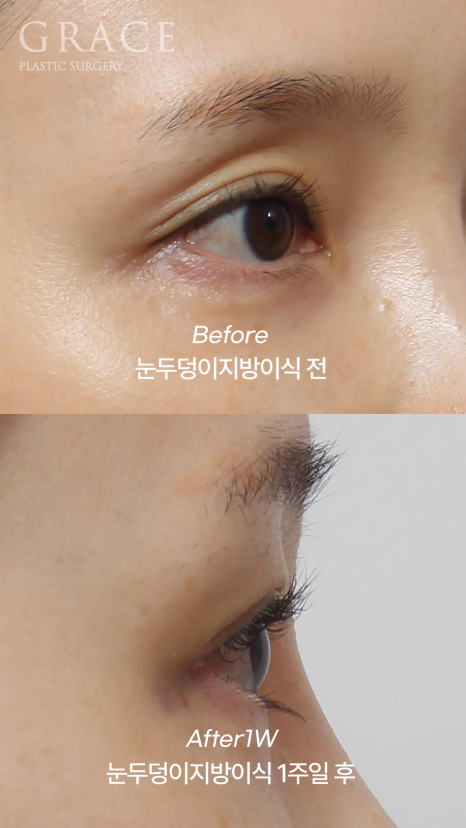
A comparison of actual 1-week and 2-month before-and-after survival rates. Among those considering upper eyelid fat grafting, many ask, "I heard it deflates quickly after 1 month."
To begin with, the survival rate varies depending on the individual’s condition, the surgical method, and the quality and amount of fat injected, but it is not true that everything will definitely deflate.
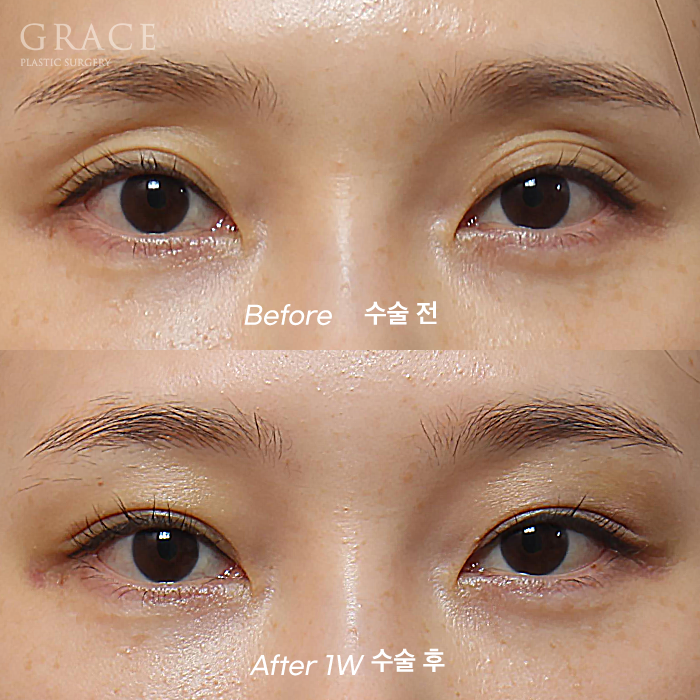
Initial changes at 1 week after
At 1 week after surgery, a slight amount of swelling is still present. However, as the hollow eye area is filled in, a clearer impression is restored, and the tired-looking eyes can be seen improving quickly.
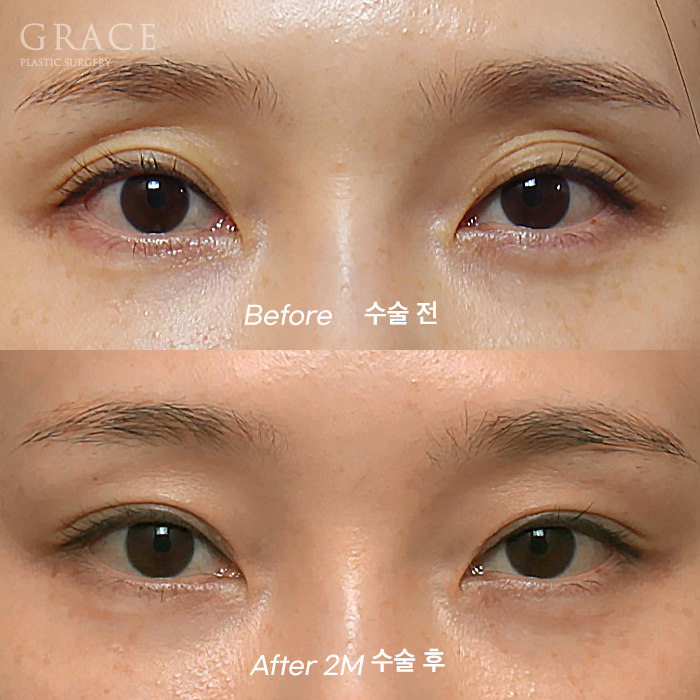
Survival rate stabilizes at 2 months after
By the 2-month mark, the fat has settled and the survival rate stabilizes. Some of the initially injected fat is absorbed, but if purified fat is injected in the right location and in the proper amount, the sunken upper eyelid can be maintained naturally without becoming overly hollow. The appearance seen at this point is closest to the final result that will be maintained long term.
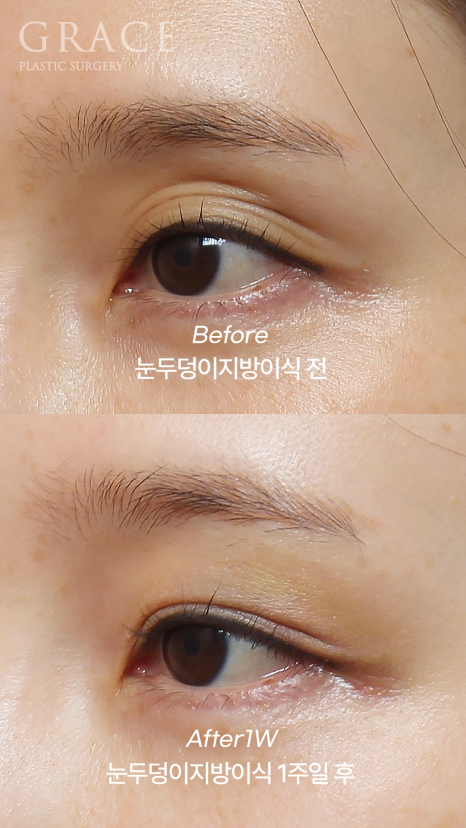
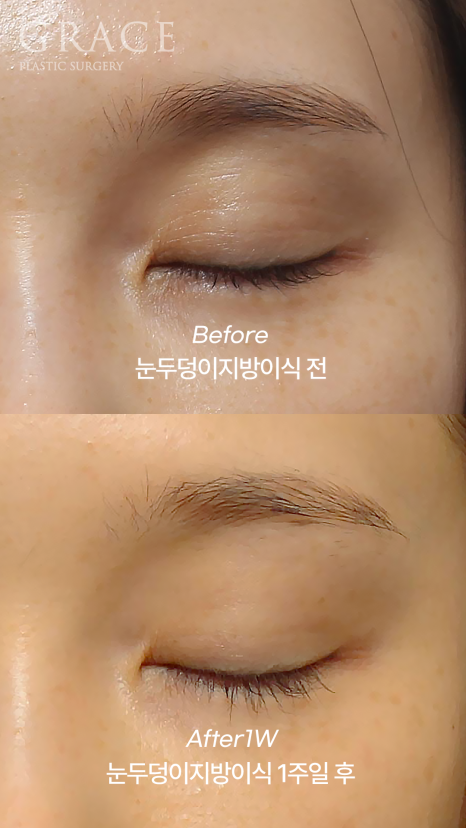
To explain the side effects of eye hollow fat grafting, every procedure has the possibility of side effects. Eye hollow filler is simple but has a short duration, while fat grafting has the strength of lasting longer, but there can be risks such as partial fat absorption, temporary bruising, and swelling. However, if an experienced specialist injects purified fat according to the proper principles, a much more stable and natural result can be expected.
Upper eyelid fat grafting is not simply a surgery that fills in volume. To see real results, a comprehensive diagnosis is needed, including eyelid skin thickness, blood flow condition, fat metabolism speed, previous surgical history, and whether ptosis or brow elevation is present. The essence of fat grafting is survival. Because the surviving fat becomes your own fat, it can be maintained for a semi-permanent period, but some of it is absorbed along with the initial swelling, so the final result stabilizes about 3 to 6 months after the procedure. You can think of this period as the "settling-in" phase. Then why do some people feel that it quickly deflated? It is due to differences in individual constitution and skin condition. In addition, if tissue damage is severe from previous surgery, survival may be lower. Finally, the eyes are a highly mobile area with frequent blinking, so fat absorption may occur faster. Because of these factors, the experience can feel different, but that does not mean the procedure itself is ineffective. Also, because the upper eyelid is a delicate area, using fresh fat is recommended. Fresh fat, not frozen fat, should be harvested and injected thinly in multiple layers so that it can settle stably in areas with good blood flow. Rather than putting in a large amount at once, layering it thinly across multiple planes is the key point for improving retention. After surgery, avoid pressure massage or excessive stimulation, and refrain from smoking or intense exercise for about a month so that survival can occur stably. The difference compared with fillers is also clear. Fillers are convenient and provide immediate effects, but in a thin-skinned area like the upper eyelid, issues such as light scattering or a foreign-body sensation may occur. On the other hand, once fat grafting survives, it can be maintained semi-permanently and the texture is much more natural. In the end, the reasons people say upper eyelid fat grafting is ineffective can be divided into three categories. First, cases where the initial absorption rate was high. Second, cases where only volume was added without correcting the underlying cause, such as ptosis or brow elevation. Third, a gap between expectations and the actual result. The goal of upper eyelid fat grafting is not simply to make the area thicker, but to correct the hollow shadow and restore a lively eye appearance. Therefore, even if some people feel it is ineffective, this is closer to a difference in diagnosis and approach rather than a problem with the fat grafting itself. If needed, improvement is possible through reevaluation and a touch-up or eye correction procedure. In conclusion, the fat that survives remains as your own tissue and is maintained semi-permanently, and if the right diagnosis and upper eyelid fat grafting procedure are performed, a satisfying result can be expected.
𝙋𝙝𝙤𝙣𝙚 02-555-8558
𝙬𝙚𝙗 http://www.graceps.kr
𝙆𝙖𝙠𝙖𝙤 http://pf.kakao.com/_xjAgxoxh/chat
𝘼𝙙𝙙𝙧𝙚𝙨𝙨 5th Floor, 623 Gangnam-daero, Seocho-gu, Seoul
Grace Plastic Surgery Upper Eyelid Fat Grafting 890,000 KRW 𝑃𝑙𝑎𝑠𝑡𝑖𝑐𝑆𝑢𝑟𝑔𝑒𝑜𝑛 𝖣𝗋. 𝑀𝑜𝑜𝑛𝑠𝑒𝑜𝑝,𝐶ℎ𝑜𝑖 #MiddleAgedEyeSurgery #UpperEyelidFatGrafting #SunkenEyeSurgery #SunkenEyeFatGrafting #UnderEyeFatRepositioning #EyeHollowFiller #UpperEyelidFiller #EyelidFatGrafting #DoubleEyelids #EyeHollowFatGrafting #UpperBlepharoplasty #LowerBlepharoplasty #UnderEyeSurgery #UpperEyeFatGrafting #UpperEyelidSwelling #UpperEyelidFatSwelling #EyeHollowSwelling #EyeHollowDeflation #UnderEyeFiller #UpperEyeFiller #UpperEyelidSideEffects #LyiEye #UnderEyeFatRemoval #UnderEyeFat #EyelidFiller Surgical results may vary depending on the individual’s condition, and we would like to inform you that some side effects such as bleeding, inflammation, and scarring may occur.