Many people think that fat grafting to the upper eyelids is a procedure similar to lower eyelid fat grafting. Although both may appear similar in that they restore volume by filling hollow areas, the actual approaches are quite different. In particular, the upper eyelid is an area with very thin skin and frequent movement. Because the fat layer moves whenever the eyes open and close, it is difficult to achieve a natural result by simply filling the deficient volume. In contrast, the lower eyelid often involves a relatively wider space, with more room for the fat to settle. The upper eyelid, however, has such a delicate structure that even a difference of just a few millimeters can change the result.
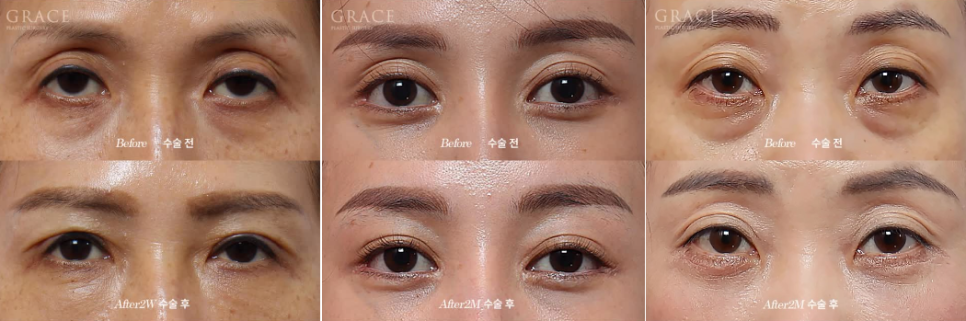
Upper eyelid fat grafting can lead to an unnatural result, such as visible fat or a thick-looking upper eyelid, if the anatomical structures, including the orbital fat layer, are not accurately understood. For this reason, Grace Plastic Surgery approaches upper eyelid fat grafting not as simple volume supplementation but as a form of structural restoration. The goal is to analyze the orbital fat space responsible for the hollow appearance of the upper eyelid and place fat in the deep layer within the orbital septum to create a more natural and stable result.
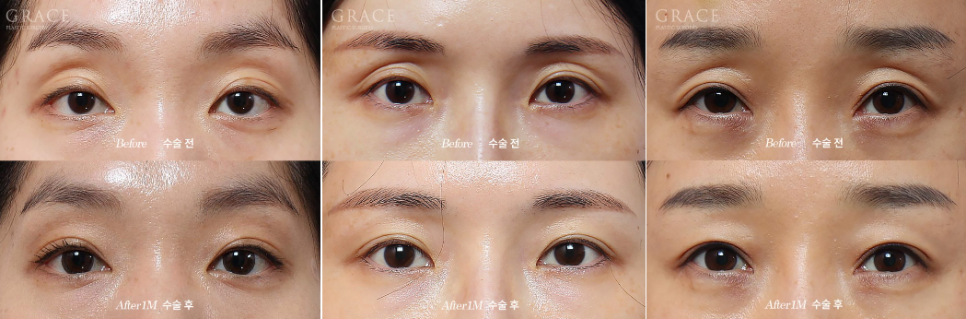
In general, upper eyelid fat grafting is often performed by injecting fat just beneath the skin or in the layer below the orbicularis oculi muscle. However, because the eyelid skin is extremely thin, injecting fat too superficially may cause it to become visible or appear lumpy. Over time, it may also create an uneven texture or make the eyelids look heavy. To reduce these issues, Grace Plastic Surgery uses a technique that grafts fat into the deep layer within the orbital septum (Fascial Plane). Rather than simply filling a hollow area, this approach is closer to restoring the structural space where volume has actually been lost. The orbital septum is an important structure that supports the orbital fat within the eyelid.
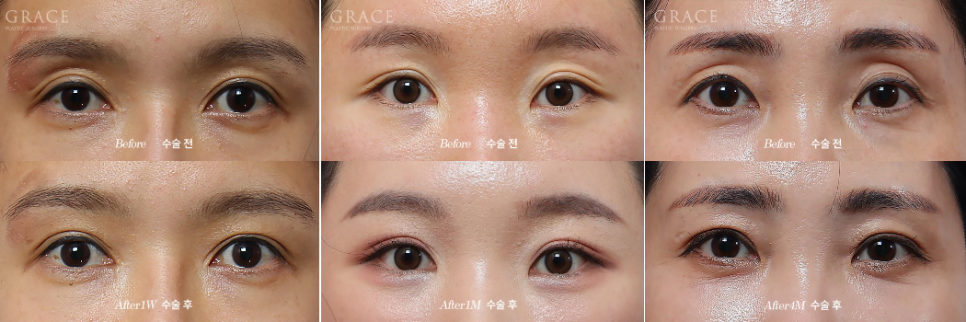
When purified raw fat is finely divided and injected into the deep inner space in 0.1 cc increments, the area over which the fat can stably contact the surrounding tissue becomes larger. This creates an environment favorable for vascular remodeling around the fat cells and may improve fat graft survival. In addition, because the fat settles within the deep structure rather than remaining directly beneath the skin, bulging on the surface and visible fat can be minimized. More natural movement can also be maintained when opening and closing the eyes, preserving the thin and delicate curve characteristic of the eyelid.
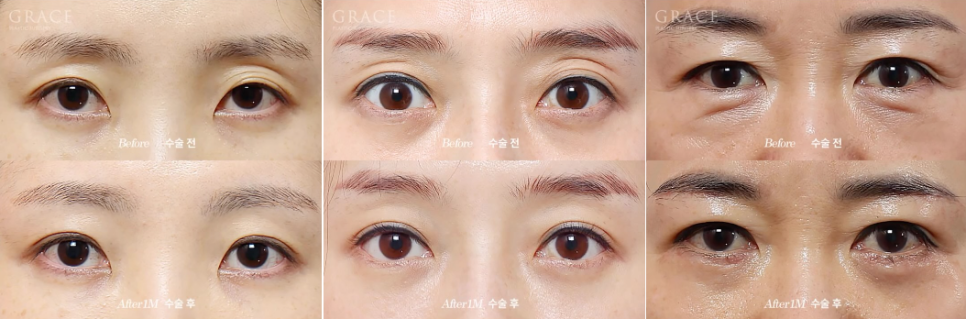
One particularly interesting aspect is the functional change. Beyond the cosmetic purpose of filling hollow upper eyelids, cases have been observed in which, when the upper eyelid depression is severe, the structures used to open the eyes receive more stable support, resulting in improved eye-opening function. In the clinical data of Grace Plastic Surgery, 94.5% of patients reported experiencing improved eye-opening function.
These findings were also introduced in the 2025 PRS Korea academic presentation given by Dr. Moonseop Choi, director of Grace Plastic Surgery. The presentation emphasized that upper eyelid fat grafting should be approached not as simple volume augmentation but from the perspective of restoring anatomical structure.
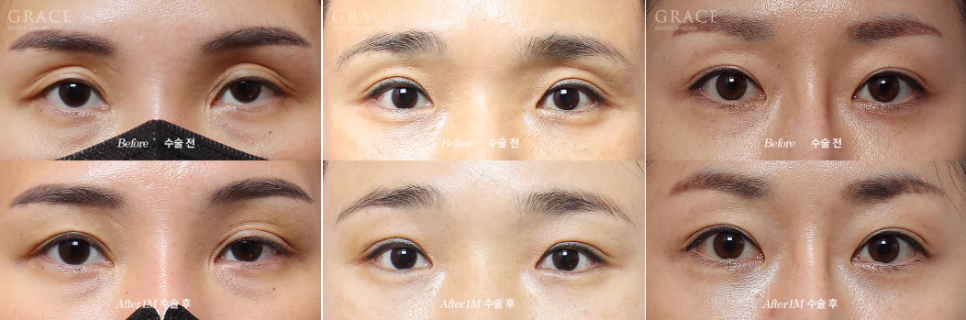
Ultimately, with upper eyelid fat grafting, where and how the fat is positioned is more important than how much fat is injected. Even with the same amount of fat, the result may vary depending on which layer within the orbital septum it is injected into and how precisely it is placed at the appropriate depth. Rather than focusing solely on filling hollow areas, Grace Plastic Surgery also considers the eyelid’s anatomical structure and movement. The procedure is performed according to each individual’s eye structure, taking into account a natural eye shape, stable fat graft survival, and more comfortable eye movement.
𝙋𝙝𝙤𝙣𝙚 02-555-8558
𝙒𝙚𝙗 https://www.graceps.kr
𝙆𝙖𝙠𝙖𝙤 http://pf.kakao.com/_xjAgxoxh/chat
𝘼𝙙𝙙𝙧𝙚𝙨𝙨 5th Floor, 623 Gangnam-daero, Seocho-gu, Seoul
Performed by Dr. Moonseop Choi, Chief Director of Grace Plastic Surgery, Plastic Surgeon Dr. Moonseop Choi #UpperEyelidFatGrafting #LowerEyelidFatRepositioning #EyeShapeCorrection #RevisionDoubleEyelidSurgery #LowerEyelidNanoFatGrafting #AntiAgingEyeSurgery #RevisionEyeSurgery #Ptosis #OrbicularisOculi #OrbitalSeptum #OrbitalFat #LevatorAponeurosis #OrbicularisOculi #OrbitalSeptum #OrbitalFat #EyelidAnatomy ※ Surgical results may vary depending on the individual’s condition, and some side effects, including bleeding, inflammation, and scarring, may occur.