160 cm · 55 kg body type
Mentor Extra SMPX 325 cc│325 cc
This was a case of breast augmentation for sagging breasts in a woman in her 50s, performed using the dual-plane (below-the-muscle) technique.
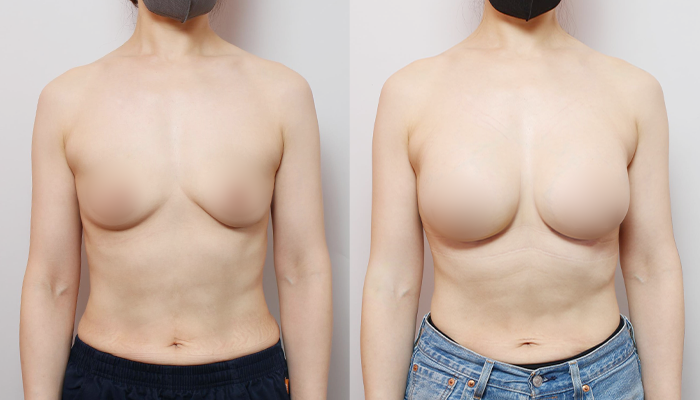
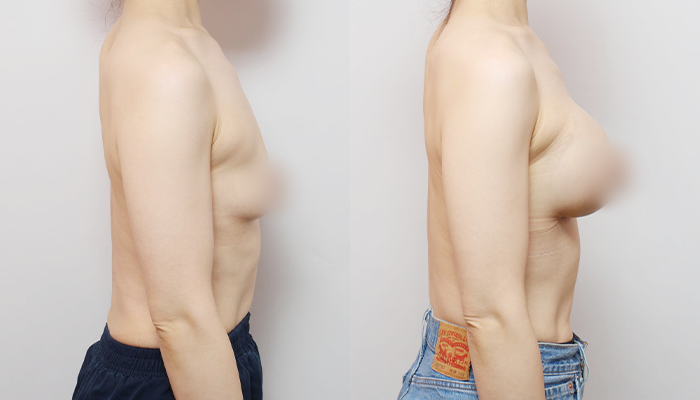
As we age, breast volume decreases and skin elasticity declines, naturally leading to sagging. This is especially common after childbirth and breastfeeding or significant weight changes, when the upper breast becomes hollow and the nipples sit lower, often creating an overall impression of loss of firmness. This case involved a patient in her 50s with a body type measuring 160 cm and weighing 55 kg, who underwent breast augmentation to improve sagging breasts. The surgery was performed using the dual-plane technique, with Mentor Extra SMPX 325 cc implants placed equally on both sides in the space beneath the muscles. Many people believe that sagging breasts always require a breast lift, but this is not necessarily the case. When nipple position, skin elasticity, and the degree of sagging are accurately assessed, implants alone may provide sufficient improvement. In this case as well, sagging was improved and volume restored using implants alone, without a lift. Before surgery, the upper-breast volume was lacking and the breasts appeared to sag overall. After surgery, the central breast volume was restored, creating a firmer-looking silhouette. Rather than using unnecessarily large implants, the focus was on creating a natural and balanced result by selecting 325 cc to suit the patient’s body type. The key consideration in breast augmentation for women in their 50s is not simply increasing size. How the sagging tissue is repositioned and where the implants are placed determine the result. Grace Plastic Surgery performs surgery using the dual-plane technique and Vertical Redraping, with the goal of creating a natural UU line from the front and a teardrop contour from the side without excessive upper fullness.
156 cm · 45 kg body type
Motiva 260 cc│260 cc
This was a case of breast augmentation performed using the tissue-preserving augmentation (partial subfascial) technique.
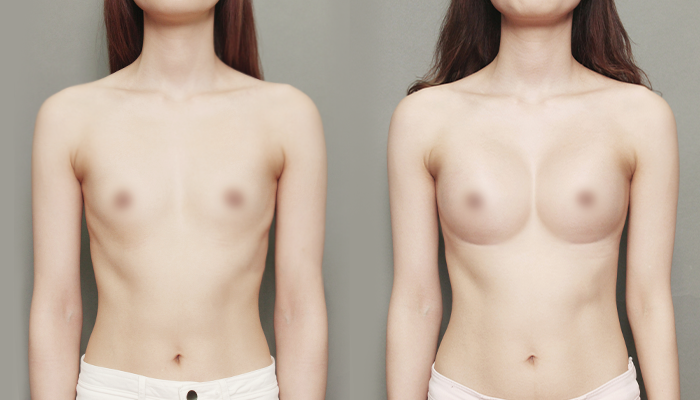
The biggest concern for people with slim body types considering breast augmentation is often whether the result will look noticeable. Because they often have little body fat and thin skin, many worry that the implant outline may show or look unnatural. This case involved a patient with a 156 cm, 45 kg body type—commonly described as an extremely slim, bony body type—with surgery performed to improve upper-body volume and create a natural change in contour. The surgery used the partial subfascial technique as part of tissue-preserving augmentation, with Motiva 260 cc implants used equally on both sides. Partial subfascial augmentation uses the fascial layer without extensive muscle dissection, reducing tissue damage and potentially allowing a faster recovery. It may be selected especially by people who exercise frequently or are concerned about changes in appearance caused by muscle movement. Before surgery, the upper body appeared generally flat and lacked volume. After surgery, natural curves were created, resulting in proportions that further emphasized the waistline.
Rather than automatically choosing a larger size, the focus was on creating moderate volume and a natural silhouette by selecting 300 cc to suit the patient’s body type.
𝙋𝙝𝙤𝙣𝙚 02-555-8558
𝙒𝙚𝙗 https://graceps.kr/breast.php
𝙆𝙖𝙠𝙖𝙤 http://pf.kakao.com/_xjAgxoxh/chat
𝙄𝙣𝙨𝙩 https://www.instagram.com/drchoi_gracebreast
𝘼𝙙𝙙𝙧𝙚𝙨𝙨 5th Floor, 623 Gangnam-daero, Seocho-gu, Seoul
Grace Plastic Surgery #breastaugmentationreview #breastaugmentationclinic #breastaugmentationsurgerycost #breastaugmentationprice #breastaugmentationclinicrecommendation #SinsaStationplastic surgery #teardropbreastaugmentation #UUbreastaugmentation #breastaugmentationcomplications #breastfatgrafting #MentorBoost #MentorExtraSmooth #partials ubfascial #tissue-preservingbreastaugmentation #subfascialsurgery #Motivacost #Mentorcost #Bounceimplant #Motivaimplant