As we gradually get older, skin aging is one aspect that no one wants to experience.
For that reason, people try to prevent skin aging and treat existing skin aging through various methods and care.
Although it may seem that “skin aging” only applies to older people,
skin aging actually begins in your 20s.
However, in your younger years, it does not really show on the surface of the skin, so you may not realize how important care is.
Starting in your 30s, when aging begins to set in more noticeably, signs of aging gradually appear on the outside,
and people manage skin aging through various methods.
In particular, for those in their late 30s to 40s, the degree of aging symptoms is not severe and appears only in certain areas,
so compared with anti-aging procedures for middle-aged patients, they may choose relatively simple thread lifting or mini facelift procedures.


Depending on the skin condition, thread lifting may be the right choice in some cases, but if you want longer-lasting results
and a higher level of satisfaction with sagging improvement, a mini facelift can be recommended.
[For a more detailed diagnosis based on your skin condition, consultation with a board-certified plastic surgeon specializing in lifting is necessary.]
When looking at reviews of mini facelifts, you can see that the age range of those who undergo the procedure is broad, from the late 20s to the early 40s on average,
but compared with middle-aged patients, younger people tend to prefer mini facelifts.
A mini facelift involves making a minimal skin incision and using a support band to lift the SMAS layer, which is the main cause of skin aging,
helping improve skin elasticity and wrinkles.
When the support band is inserted into the face and jawline, it bonds with the existing tissue and acts like an artificial ligament,
helping create a more natural and firm facial line.

A mini facelift can help with areas that need partial improvement, such as crow’s feet, nasolabial folds, sagging mouth corners, and sagging cheeks.
Elastique, used in mini facelift procedures,
maintains its elastic tension over time without cutting tissue once inserted into the body, and the polyester surrounding the elastic material is filled in by connective cells,
leading to stable results. In addition, each Elastique inserted into the body has a softness similar to subcutaneous fat tissue,
and by forming a ligament-like suspended structure, it allows for less foreign-body sensation even in highly mobile areas such as the nasolabial folds and mouth corners,
so natural movement can be expected.

A mini facelift is performed with a minimal incision inside the scalp, so scar exposure is low.
It also pulls the SMAS layer over a wide area, providing lifting effects in multiple areas and increasing satisfaction with the mini facelift.
Compared with a full facelift, a mini facelift has a shorter procedure time and minimal incisions, resulting in less bruising and swelling and faster recovery,
which helps busy office workers feel more satisfied with lifting procedures.
The Sinsa Station mini facelift clinic supports faster recovery for patients by providing continuous communication,
along with swelling laser treatment and various recovery care systems.
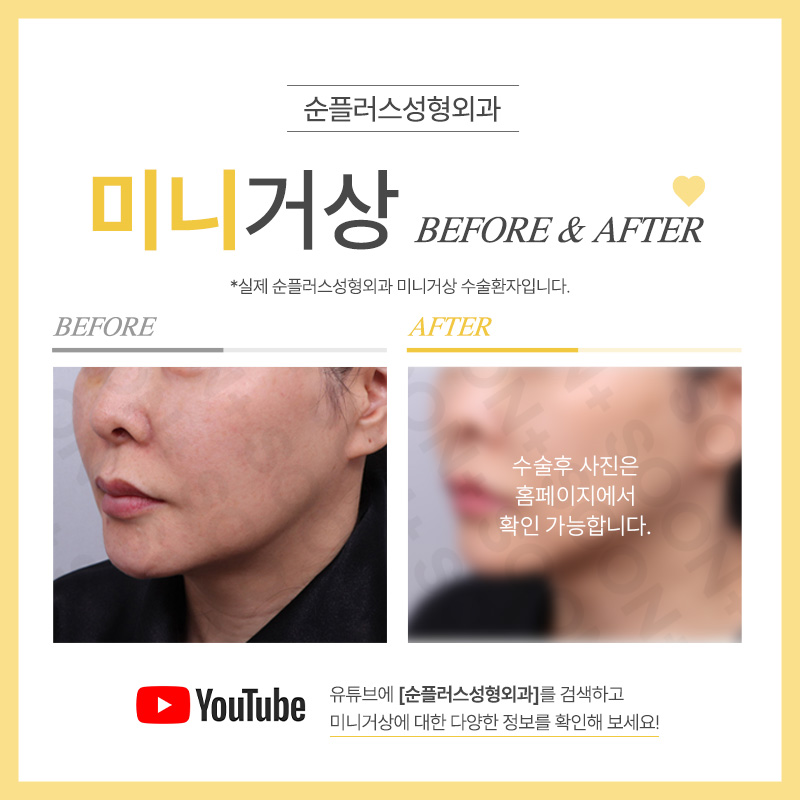
With sufficient consultation time with a plastic surgery specialist dedicated to lifting,
careful pre-procedure consultation and design are carried out, and the patient’s needs are comprehensively considered to proceed with a one-to-one customized plan,
while delicate aftercare is also provided, accompanying the patient from start to finish.
Through the Sinsa Station mini facelift clinic website and official YouTube channel,
you can also find information about various lifting procedures besides the mini facelift.
If you would like a thorough and detailed consultation with the medical team, please make an appointment and receive guidance.