Lateral canthoplasty (outer corner surgery): Expanding the horizontal length while lowering the outer eye corner for a more open look


If you want a change with bigger, clearer-looking eyes,
the first improvement method that comes to mind is likely double eyelid surgery.
Of course, double eyelid surgery can make small, tight-looking eyes appear larger,
but if the eyes are short in both horizontal and vertical length,
they can end up looking unbalanced
and even unnatural.
For that reason, to balance the eye shape
and create a more open, refreshed look,
it is sometimes performed together with procedures such as epicanthoplasty or lateral canthoplasty.
A typical lateral canthoplasty procedure
extends the horizontal length of the eyes,
while our lateral canthoplasty procedure extends the horizontal length through the outer corner surgery and at the same time lowers the outer eye corner,
allowing the effects of lower outer corner surgery as well,
so the expansion of both the horizontal and vertical eye dimensions
creates a more open and defined eye shape.
In addition, the angle of the outer eye corner and the degree of widening are
delicately adjusted according to the patient’s eye shape and desired image.


Lateral canthoplasty or lower outer corner surgery can extend the horizontal and vertical dimensions of the eyes,
making the eyes appear larger
and lowering a raised outer corner to improve a fierce, strong impression
into a softer-looking eye shape, but
because the outer corner can reattach after surgery
or leave a scar,
it must be performed carefully and by a medical team with specialized experience in canthoplasty procedures.
Our canthoplasty procedures
are performed with the expertise and extensive experience of our eye surgery specialists,
with the goal of reducing the likelihood of revision surgery,
and we do our best to help patients achieve the eye shape they want.
Even if you have double eyelids, if the horizontal length of your eyes is short
and your eyes feel tight or do not look large, lateral canthoplasty can make the eyes appear bigger
and produce a softer impression.
The results of lateral canthoplasty can vary depending on the surgeon’s skill
and the surgical method used by the clinic.
There may be cases where no improvement is seen,
and in some cases scars may remain,
causing the appearance to be less attractive than before surgery.
To avoid the need for further revision surgery,
we carefully and delicately perform lateral canthoplasty while considering each patient’s individual eye condition and goals.
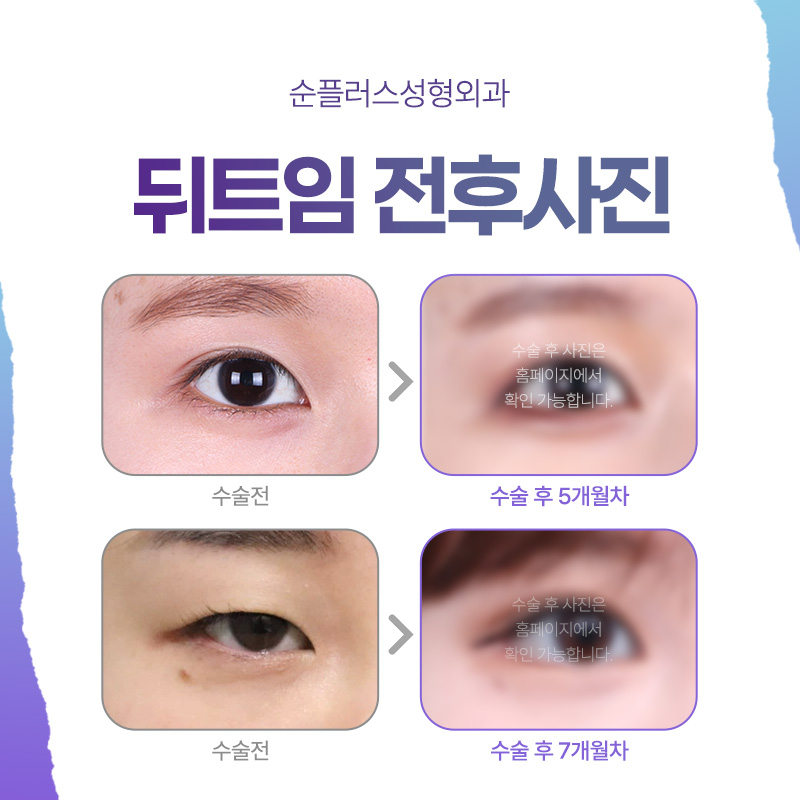
Lateral canthoplasty that does not reattach
The biggest side effect of lateral canthoplasty is
that the area may reattach after surgery.
In the case of a simple-incision lateral canthoplasty at another clinic,
the area is horizontally incised and the skin that has opened upward and downward is sutured.
Because the sutured skin above and below comes into contact,
the reattachment phenomenon occurs.
To prevent reattachment,
after making an incision according to the degree of lowering of the outer eye corner,
the outer corner is fixed in the desired position.
The sutured area for the opened skin is the upper part,
and the lower part is originally firm tissue,
so the upper and lower parts do not reattach.

Depending on the eye shape, the degree to which the effects of lateral canthoplasty appear may vary.
Therefore, before surgery, it may be necessary to carefully design the procedure after assessing the patient’s eye shape.
In general, eye shapes that tend to respond well are: if the outer corner is high / if the eyeball is large / if the eyes are protruding
On the other hand, eye shapes that tend to respond less well are: if the outer corner is not high / if the eyeball is small / if the eyes are deeply set
While a basic classification can help predict the effect of lateral canthoplasty,
a more accurate prediction requires a medical professional to move the outer eye corner with their own hands
to see how much the eyes can be enlarged,
how much the outer corner can be lowered,
and this makes an in-person visit and detailed consultation with a specialist necessary.