
A photo of Brad Pitt appearing at an event a few years ago became a big topic.
Even in his 60s, he appeared noticeably younger, drawing a lot of attention.
In the past, he had appeared at official events with skin sagging that can come with age and wrinkles across his face,
but he suddenly appeared with a smooth skin texture and a face line without sagging.
Because of this, some people suspected that he had undergone a lifting procedure such as a facelift.
Of course, even now there is no clear statement about whether he had a facelift or other lifting procedure, or not, but with changes such as clearly improved skin elasticity and reduced wrinkles,
many people think he received help from lifting.
In relation to this, many middle-aged people in a similar age group have also become more interested in facelift procedures to improve sagging facial contours and deep wrinkles,
and to achieve a youthful, younger-looking image like Brad Pitt.
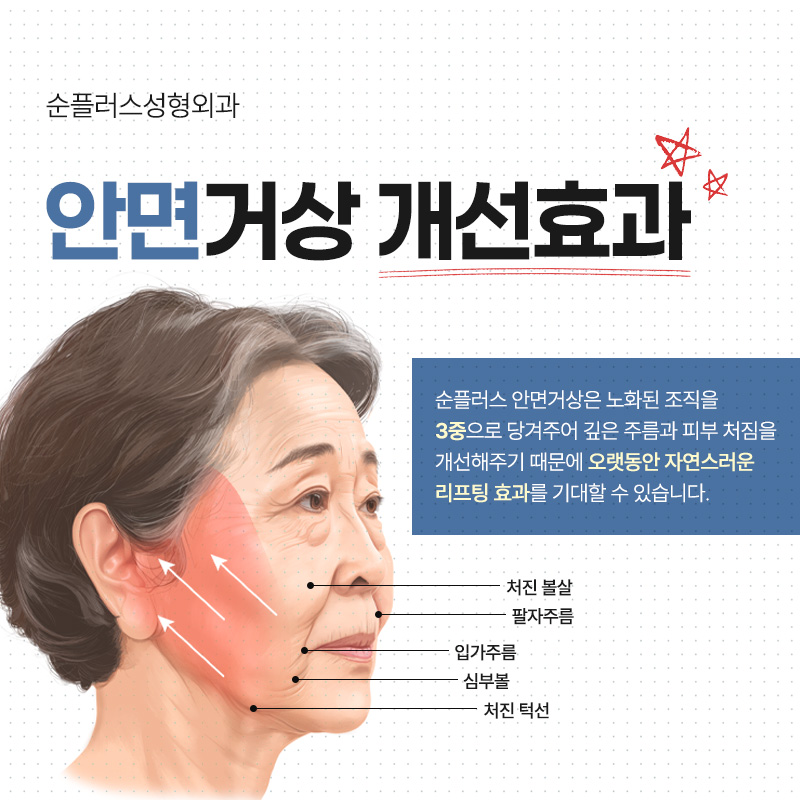
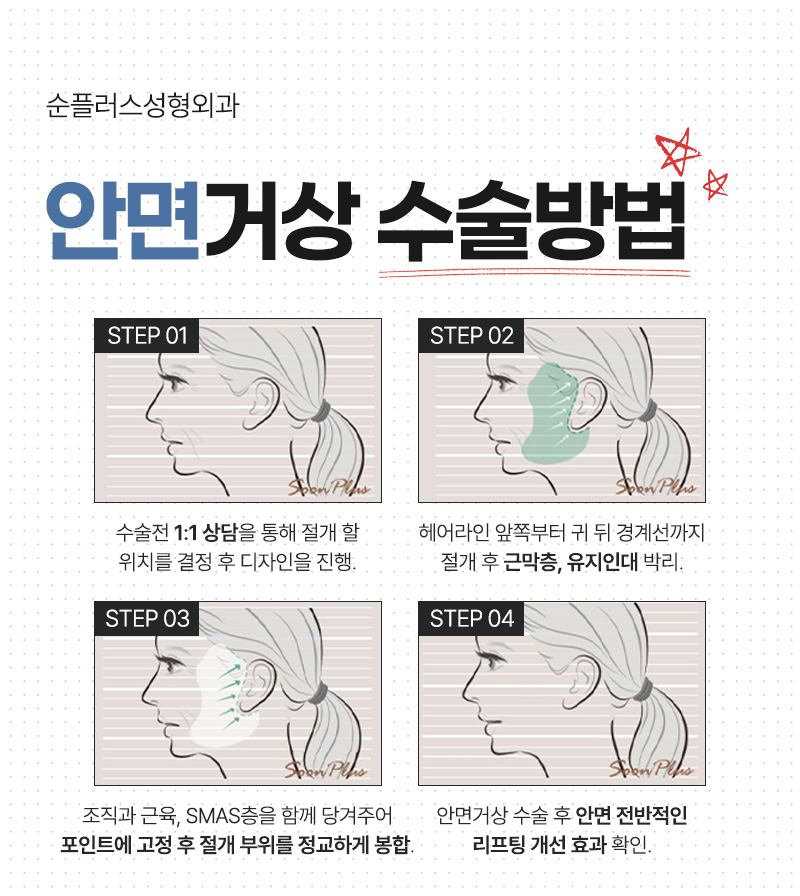
A facelift is a lifting surgery that improves facial elasticity by pulling sagging skin and tissue upward and securing them in place.
It is generally performed not by simply pulling the skin, but by also pulling and fixing the SMAS layer (the fascia layer) beneath the skin,
and because this method aims to improve structural sagging of the face, it can be expected to help improve the midface, jawline, and neck area at the same time.
Representative effects that can be expected from a facelift include helping improve a collapsed jawline, sagging cheeks, marionette-like sagging, deep nasolabial folds, and neck wrinkles and neck sagging.
A facelift is not necessary for every middle-aged person just because they are getting older.
If skin elasticity is still sufficient, improvement may also be expected with procedures such as mini lifts or laser lifting,
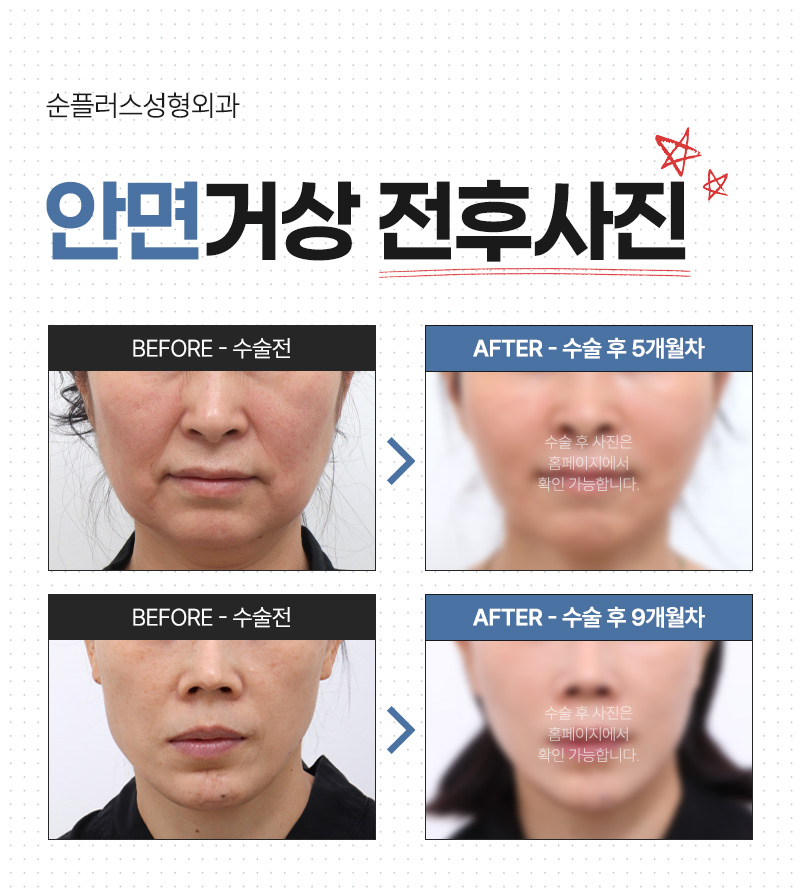
but a facelift may be considered for more fundamental improvement in cases where lifting results do not last long, where skin sagging has noticeably progressed, where the jawline has become blurred and a double chin has formed,
or where nasolabial folds and cheek sagging appear at the same time.
In particular, after the age of 40, not only the skin but also the tissue beneath the skin often moves downward,
so an approach that takes such structural changes into account may be important.
The biggest feature of facelift surgery is that it addresses the fundamental cause of facial sagging.
It improves facial sagging structurally, helps create a natural jawline, improves nasolabial folds and cheek sagging, and offers a lifting effect that is maintained for a relatively long time.
Recently, as surgical techniques have advanced, many procedures are performed with the goal of a natural youthful appearance rather than the over-pulled look seen in the past.

Because a facelift involves a large incision range, it is considered a relatively major surgery, so sufficient consultation and an accurate diagnosis are important.
The degree of facial sagging, skin elasticity, fat distribution, and overall facial proportions should all be carefully considered,
and because the way aging progresses differs from person to person, even with the same facelift, the design, surgical method, and scope may vary.
How naturally the improvement appears is also an important factor.
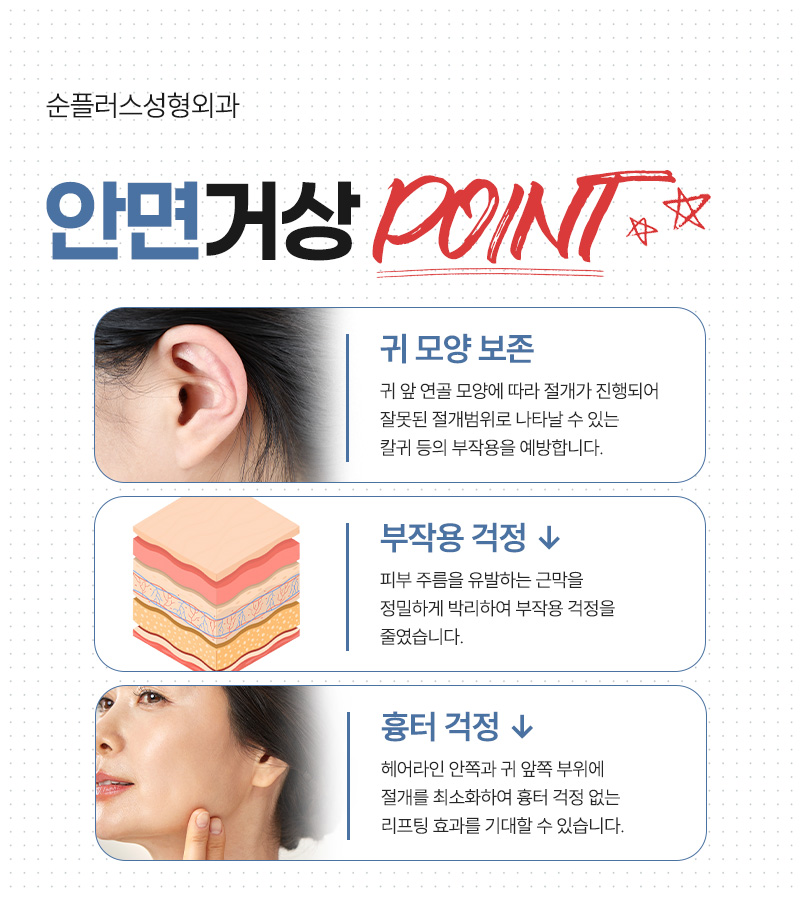
A method that simply pulls the skin strongly can instead produce unnatural results, so the procedure should be performed safely by considering the anatomical structure of the face, stably fixing the SMAS layer, and minimizing skin tension.
Facial aging is a natural change that happens to everyone.
However, if sagging becomes severe and changes your appearance or lowers your confidence, you may consider various lifting methods.
A facelift is one way to fundamentally improve a sagging face, and accurate diagnosis and planning tailored to the individual’s condition are important.
Choosing the method that suits you through 충분한 consultation can lead to natural and satisfying results.