

When looking at the face, there are cases in which the philtrum appears long or the area around the mouth feels elongated.
Not only the length of the philtrum, but also various factors—including the proportions between the nose and lips and the shape of the upper lip—work together to determine the overall perceived length of the face.
When the philtrum appears relatively long, the central part of the face may look elongated, creating an impression of appearing more mature than one's actual age.
Conversely, when the proportions between the nose and lips are well balanced, the overall facial proportions may appear more harmonious.
For these and other reasons, some people consider philtrum reduction surgery.
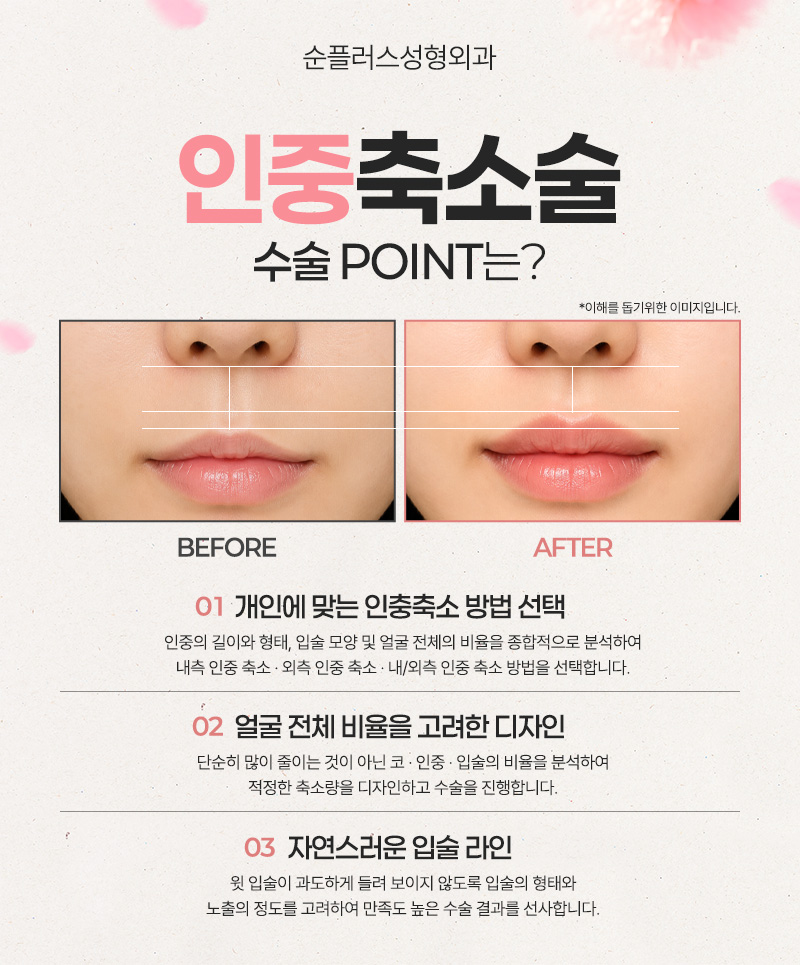
The philtrum refers to the area extending from below the nose to the upper lip. Rather than simply shortening the philtrum, the goal of philtrum reduction surgery is to adjust the distance between the nose and lips, helping improve the overall facial proportions and balance around the mouth.
The procedure is performed by removing skin from either the outer sides of the lips or the inner area beneath the nose, reducing the vertical length and allowing the upper lip to rise naturally.
As the philtrum becomes shorter during this process, the upper lip may appear relatively more defined, while an improvement in the vertical proportions of the central face may also affect the overall impression.
However, each person has different nasal features, philtrum length, upper-lip shape, and skin condition. Therefore, rather than taking an approach that reduces the philtrum by the same amount for everyone, it is important to plan the procedure based on the individual's facial structure and proportions.
'Why does the philtrum appear long?'
The fact that the philtrum appears long does not necessarily mean that its actual length is excessive.
For example, when the upper lip is thin or rolls inward, the space between the nose and lips may feel relatively longer.
The philtrum may also appear more prominent depending on the proportions of the midface or chin.
Therefore, when considering philtrum reduction surgery, it is necessary to examine not only the length of the philtrum but also the proportion it occupies within the entire face and the surrounding structures.
In addition to the proportions seen from the front, it is also helpful to assess the position of the nasal tip and lips and the degree of upper-lip projection when viewed from the side.

The effect that can be expected from philtrum reduction surgery is a decrease in the length of the philtrum extending from below the nose to the upper lip.
If the central part of the face appeared elongated because the philtrum was relatively long, reducing its length may make the vertical proportions of the face look different.
The second change is a more defined appearance of the upper lip.
As the philtrum becomes shorter, the upper lip may appear to sit relatively higher. In cases where the lips appear thin or rolled inward, the impression around the mouth may look different.
Another possible effect is a change in the overall facial proportions.
The proportions extending from the nose and lips to the chin can affect the overall impression of the face.
Therefore, rather than considering the philtrum independently, the design should take into account the harmony of the upper, middle, and lower facial proportions in order to aim for a natural result.

Philtrum reduction surgery does not use the same design for everyone. Even when the philtrum appears to be long to a similar degree, one patient may have a relatively long area beneath the nose, while another may appear to have a long philtrum because the upper lip rolls inward.
Therefore, before surgery, it is important to analyze not only the current length and shape of the philtrum but also the lip shape and the proportions of the entire face.
After philtrum reduction surgery, changes may occur not only in the length of the philtrum but also in the shape and degree of exposure of the upper lip.
The surgical plan should be established after sufficiently taking these aspects into consideration.
After philtrum reduction surgery, changes may occur not only in the length of the philtrum but also in the shape and degree of exposure of the upper lip.
The surgical plan should be established after sufficiently taking these aspects into consideration.