Hello. I am Dong-ho Kang, the director of the Sillim Branch of Yonsei U-Line Dental Clinic, located in Sillim-dong, Gwanak-gu.
Today, I would like to talk with you about solutions for gapped teeth.
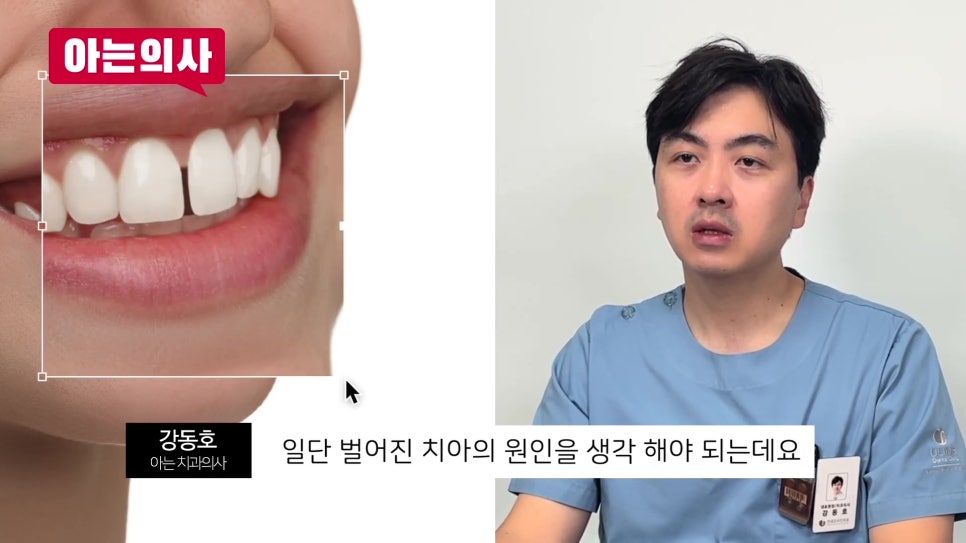
Many people wonder whether orthodontic treatment is necessary when there are gaps between their teeth.
However, before deciding which treatment to undergo, it is important to consider why the teeth have become spaced apart.
This is because the appropriate solution may vary depending on the cause.


There are several reasons why teeth may become spaced apart.
First, some people are born with naturally small teeth.
This is called a small tooth, and when the teeth are small, gaps can naturally form between them.
Gaps may be particularly noticeable when the front teeth are small.


The shape of the teeth can also have an effect.
For example, if you have pointed teeth like canines, there may be a greater chance of gaps forming between your teeth.


An imbalance between the sizes of the upper and lower teeth is another important factor.
Usually, the upper teeth are larger than the lower teeth, but if the ratio is not appropriate, gaps may form.
For example, if small lower incisors are positioned to fit against larger upper teeth, a gap may appear between the front teeth.

In cases like this, the gaps are often addressed by increasing the size of the teeth.
In other words, treatment methods for gapped teeth can generally be divided into two categories.
There is orthodontic treatment, which moves the teeth to align them, and prosthetic treatment, which fills the spaces by increasing the size of the teeth.




Orthodontic treatment naturally closes the spaces by moving the teeth.
One advantage is that the natural teeth can be preserved without removing tooth structure, but treatment may take a long time and wearing an appliance may be inconvenient.
When the teeth are generally misaligned as well as spaced apart, orthodontic treatment may be a good option.


Prosthetic treatments that may be used for gapped teeth include veneers and composite resin treatment.
Veneers involve slightly reshaping the tooth surface and attaching ceramic restorations to increase the size of the teeth.


The tooth color can also be adjusted, making this an aesthetically favorable option, but some people may be concerned about having to remove part of the tooth.
Composite resin treatment fills the gaps with resin without shaving down the teeth.



This treatment is simple and quick, but it may discolor over time and has the disadvantage of making it difficult to fundamentally change the shape of the teeth.



If the teeth are generally misaligned and have gaps, orthodontic treatment may be a good option.
On the other hand, if the tooth alignment is satisfactory and you want a quick aesthetic improvement, veneers or composite resin treatment may be considered.

The most appropriate treatment may vary depending on the extent and cause of the gaps, as well as the results you want.
It is therefore advisable to receive a diagnosis first, discuss your options thoroughly, and then make a decision.