Hello, I’m Kang Dong-ho, the chief director of Yonsei Uline Dental Clinic, Sillim-dong Branch, near Sillim Station in Sillim-dong, Gwanak-gu.
When consulting with patients about laminate at the clinic,
many people ask first, “Is this really a necessary treatment?”
In fact, laminate is mostly for aesthetic purposes,
so it’s best to understand it as a treatment that makes the visible parts look more attractive,
like cosmetic enhancement.
There are almost no cases where healthy teeth need to be shaved down
for treatment purposes,
and it is often chosen when people are concerned about appearance.
For example, if there is a gap between the front teeth,
or congenital scratches or discoloration on the tooth surface,
or if the shape is uneven, or there is a slight deformity caused by a small chip,
people may consider laminate.
Some people also come in wanting to change their overall impression,
seeking a “very white and neatly aligned tooth line.”
You could think of it as a kind of image improvement purpose.
However, compared with other cosmetic procedures,
laminate definitely has drawbacks, so caution is needed.
Plastic surgery can be good when done well,
but if it fails, it’s hard to reverse, right?
Laminate is the same.
Once a tooth is shaved down, it does not regenerate,
so how well the treatment is matched the first time
determines its overall lifespan.
If too much is removed at the beginning, then during retreatment
more of the tooth has to be shaved down,
and that weakens bonding strength and increases the risk of detachment.
That is why I emphasize that the quality of the initial design and the first procedure
is the most important.
Cases in which laminate is done for functional reasons rather than aesthetic purposes
are very rare.
As an exception, for people with what is called microdontia,
which refers to congenitally small teeth,
using laminate to adjust the proportions can be helpful.
For example, some people have the tooth next to the canine
shorter and narrower than the original teeth, so when they smile
the proportions look off.
In such cases, whitening or orthodontic treatment alone
cannot solve the problem, so normalizing the shape with laminate
creates a much more natural
and harmonious smile.
Also, after orthodontic treatment, there are cases where the teeth are narrow,
so the alignment is straight but the overall proportions
do not match.
The alignment is good,
but there is a slight gap between the front teeth,
or the teeth look relatively long.
In such situations, treatment that widens the tooth width with laminate
and rebalances the proportions can be helpful.
People whose teeth are congenitally yellow,
or who have dull brownish or grayish tones that do not improve even with whitening,
also consider laminate.
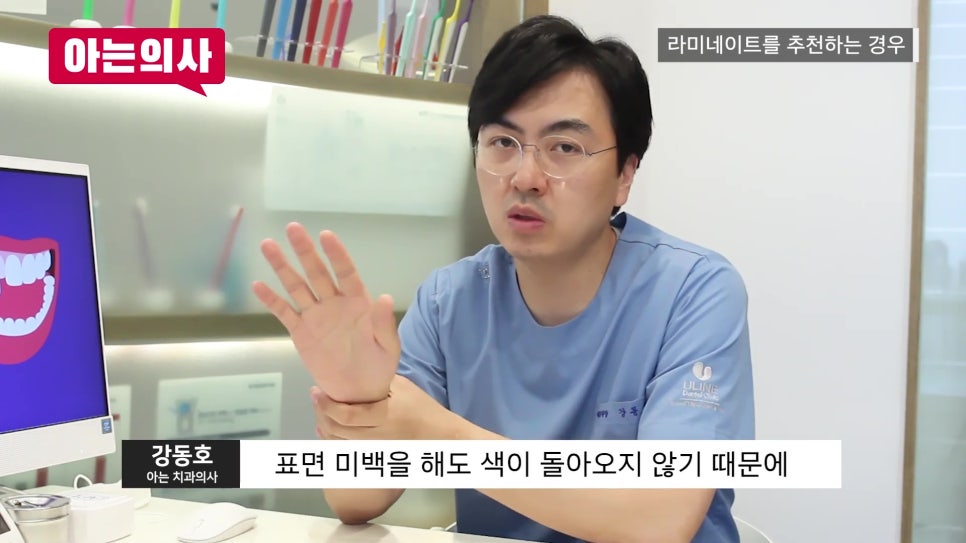
If the color inside the tooth itself is dark,
rather than simple staining, whitening will not solve it,
so it is better to design the surface thinly
and match it to a natural color.
In the end, laminate is a treatment chosen when you want to solve
issues of aesthetic proportion, color, and shape more than functional problems.
However, since teeth do not regenerate,
the initial design is extremely important,
and you should also remember that this is not a treatment to decide on too easily.
Gwanak-gu, Sillim-dong 1422-5 Yonsei Uline Dental Clinic
02-889-2822