Hello. I’m Shin Seung-hwan, the chief director of Yonsei Uline Dental Clinic, Garak branch, near Garak Market Station in Garak-dong, Songpa-gu.
After implant surgery, there is one question people ask first.

The question is, “Can I eat food right after getting an implant?”
To begin with, it is not a good idea to chew hard right away after an implant.


An implant is not finished just by placing it.
It needs time to bond firmly with the bone.
Usually, it takes at least about two months before it can reliably bear force.
So during this period, it is not good to keep touching the implant.
Applying force again and again while eating is not advisable, and pressing on it with your hand or tongue to check whether it is okay can also interfere with the process of the implant bonding with the bone.

In the early stage, it is important to minimize stimulation as much as possible.
After about two months, impressions are taken and the prosthesis is placed, and many people think that means they can start chewing normally now.

However, patients often say things like this at that time:
“the side with the implant is fine, but the opposite side tooth hurts,” or “it feels like my teeth are too high.”



In most cases, this is less about the height and more about the effect of not chewing on one side for a long time.
If you had a tooth extracted and did not eat on that side for several months, the opposing teeth were also actually resting and not working.
When a tooth that has been resting suddenly has to work, pain or discomfort can appear, almost as if it were startled.
To explain it simply, let’s say a bone was broken, surgery was done, and you used a wheelchair for two months.
Even if the bone has healed, you cannot run around right away.
That is because muscles and ligaments need time to adapt.
Teeth are the same.
“Now that I’ve had an implant, I should eat galbi for dinner tonight.”
It is not a good idea to eat hard foods like that right away.


At first, your jaw and muscles are not yet adapted to that movement, and because the opposite teeth have also been resting for a long time, applying force suddenly can cause an uncomfortable feeling, almost like being hit.

Fortunately, these symptoms usually improve gradually over about 1 to 2 weeks as you adapt.
So after getting an implant, instead of forcing yourself to eat hard foods from the beginning, it is better to start slowly with soft foods.

For example, you need a period of gradual adaptation: use it lightly at first, then if it feels okay, use it a little more the next day.
If you chew strongly from the beginning, discomfort is only natural.

There is one more thing you should know.
Among people who have had implants, some actually say they can chew harder foods better than before.
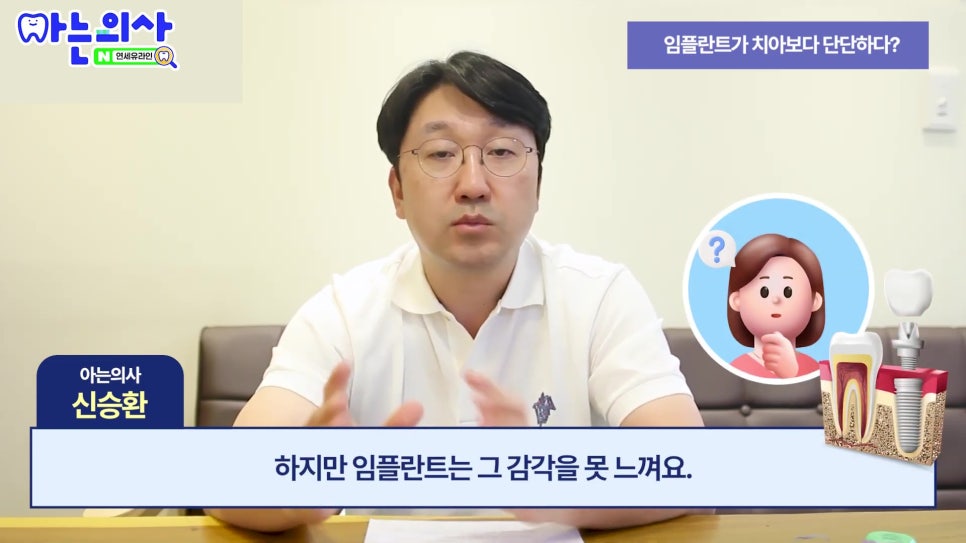
Why does this happen? Natural teeth have a sense of pain or surprise when you chew something hard.
If you bite down on a stone while eating, you feel it right away.
But implants have almost no such sensation.

So people may end up chewing very hard foods too forcefully.
If you keep applying excessive force like this, the prosthesis can break, and the implant post can also be damaged.

In severe cases, the implant itself can fracture or split.
An implant can be used like a natural tooth, but it is not stronger than a natural tooth.


You need to use it carefully and manage it well at all times in order to use it for a long time.
Many people also think that since an implant does not get cavities, they do not need to brush as much.
That is also a misunderstanding.

Implants do not get cavities, but they are actually more vulnerable to gum disease.
Natural teeth are structured so that the gums hold them tightly, but implants have relatively less of that close support.
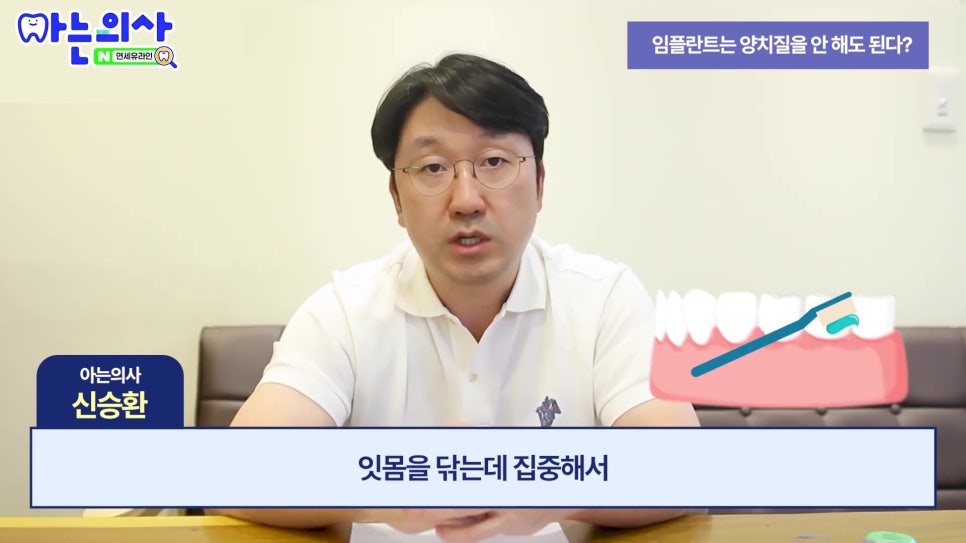
Because of that, food particles and foreign substances can get stuck more easily, creating an environment where gum inflammation can occur more readily.
For people with implants, you need to care for them very carefully, with the mindset not just of brushing teeth, but of cleaning the gums.
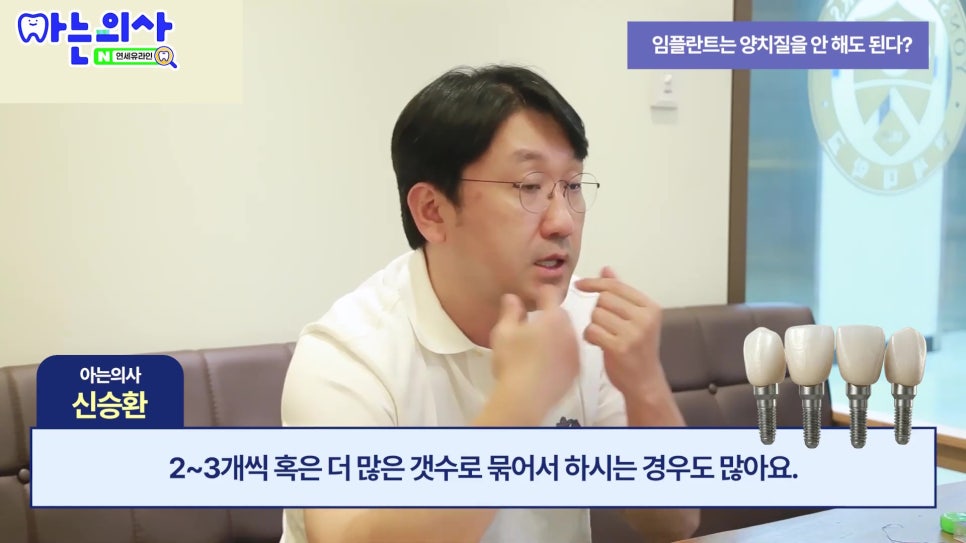
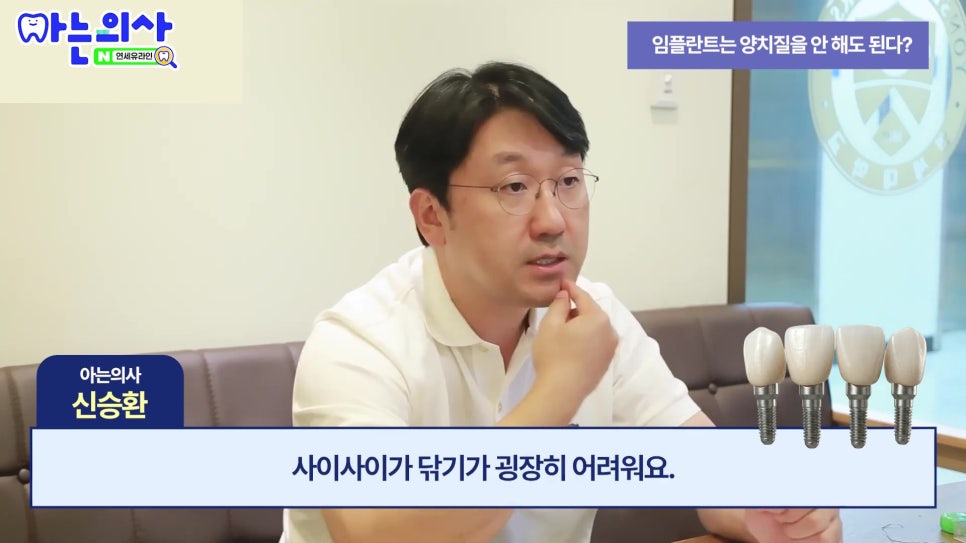
In particular, implants are often used by connecting multiple units together, so the space between teeth becomes narrower and sometimes floss alone is not enough for care.

In such cases, it is good to use auxiliary hygiene tools such as interdental brushes or a Waterpik together.
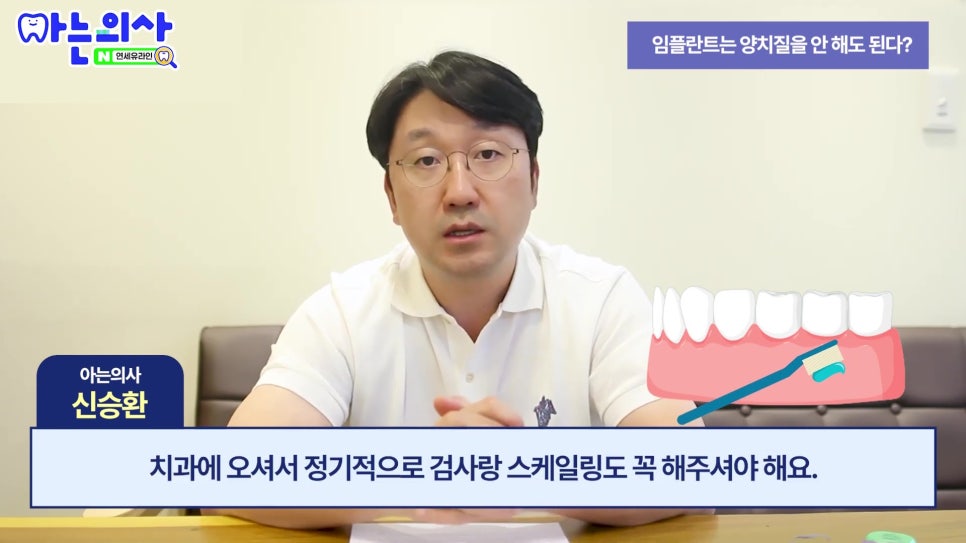
And no matter how well you manage things at home, there are limits, so it is important to visit the dental clinic regularly for scaling and gum care.
Only when care is handled well like this can the implant you worked so hard to get be used healthily for a long time.