Hello. I am Kang Dong-ho, the chief director of Yonsei Uline Dental Clinic, Sillim-dong branch, located right in front of Exit 7 of Sillim Station in Sillim-dong, Gwanak-gu.
An implant may look like a single solid piece,
but in fact, it is divided into three parts.
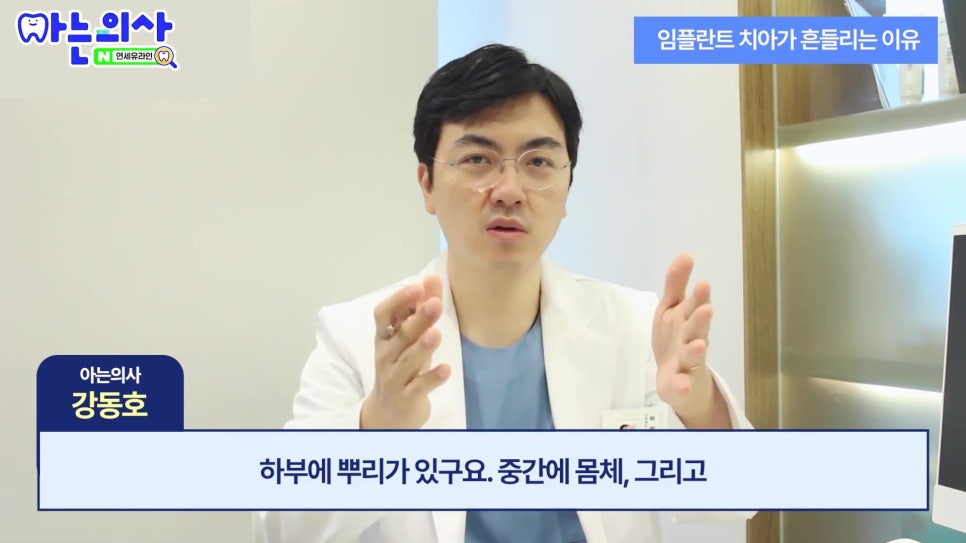
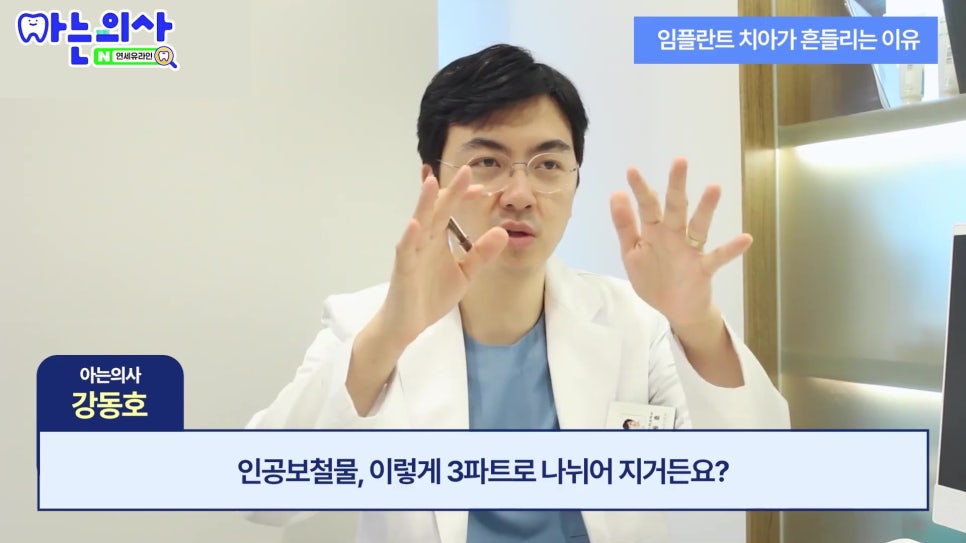
There is the fixture, which acts as the root and is placed in the bone,
a post that connects on top of it,
and the artificial prosthesis that we chew with.
There is a reason for making it in separate parts.
If it were bonded together as one piece from the beginning,
height adjustment would be difficult, and if a problem occurred,
partial replacement would not be possible.
In particular, if food gets trapped or inflammation develops,
it could even lead to a situation where the entire implant must be removed.
That is why the structure is separated so that only the affected part can be replaced.
So how is it connected?
Many people think it could just be bonded with adhesive,
but in reality, it is fixed with screws rather than glue.
Using adhesive can secure it,
but later removal is almost impossible.
In particular, adhesive that goes deep into the inner area of the gums
is very difficult to deal with if a problem occurs.
That is why implants are fixed by tightening them firmly with screws.
A representative phenomenon that can occur with this structure
is “screw loosening.”


As chewing force is repeatedly applied during use,
the internal screw can gradually loosen.
At this time, you may hear a clicking sound from the top of the implant,
or feel a slight sense of movement.
Fortunately, in most cases, it is not a major problem.
Through the small hole on top of the implant,
it can often be easily fixed by tightening it again with a driver.


However, this situation occurs more easily under certain conditions.
These include positions that receive a lot of force, such as molars,
when there is a habit of bruxism or clenching,
or when the number of teeth is insufficient and force is concentrated on a specific area.

The important thing is “leaving it untreated.”
If the screw remains loose for a long time, the inside may wear down or deform,
and even if it is tightened again,
it may no longer be firmly secured.
In this case, it may be necessary to replace not only the prosthesis
but also the connecting part itself.
There is one more point that many people wonder about.
Why is the implant root shaped like a screw?

This structure is designed to hold firmly in the bone.
If it were inserted in a simple cylindrical shape, it could come out easily,
but when it is made in a screw shape and turned into place,
the initial stability is much higher.
After that, when osseointegration occurs, where the bone firmly bonds to the implant,
it becomes able to withstand loosening forces more stably.
The implant surface and screw structure may also look simple,
but in reality, they are designed very precisely.
The screw spacing and shape are all calculated to maximize the contact area with bone
and distribute force evenly.
In conclusion, implant screw loosening is not uncommon,
and in most cases, it stems from the structural characteristics.
However, if it happens repeatedly or is left untreated, it can lead to problems,
so if you feel something is wrong, it is important to get checked promptly.
This has been Yonsei Uline Dental Clinic in Sillim-dong, Gwanak-gu.