Hello, I am Shin Seung-hwan, director of 연세유라인치과의원 Garak-dong Branch, located near Exit 4 of Garak Market Station in Garak-dong, Songpa-gu.
Laminate veneers are a cosmetic dental treatment that many people become interested in at least once.


In particular, as changes in celebrities’ teeth have become more widely known, more people have started wondering, “Could I look better if I got laminate veneers?”
However, not every tooth is suitable for laminate veneers.
Depending on the condition of the teeth, laminate veneers may produce good results, while in other cases they may not be recommended.
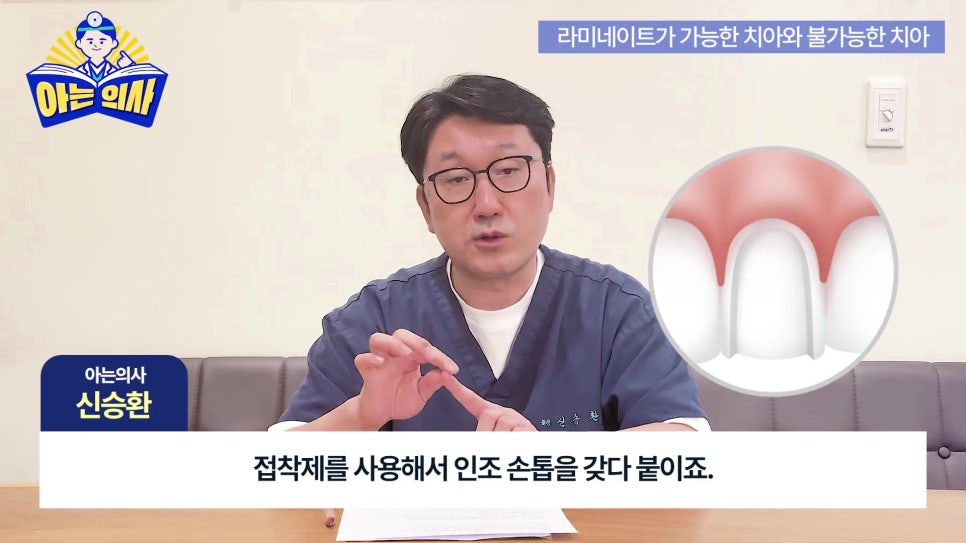
Simply put, laminate veneers are a treatment in which thin ceramic shells are bonded to the outer surfaces of the teeth.
It is often explained as being similar to attaching artificial nails.
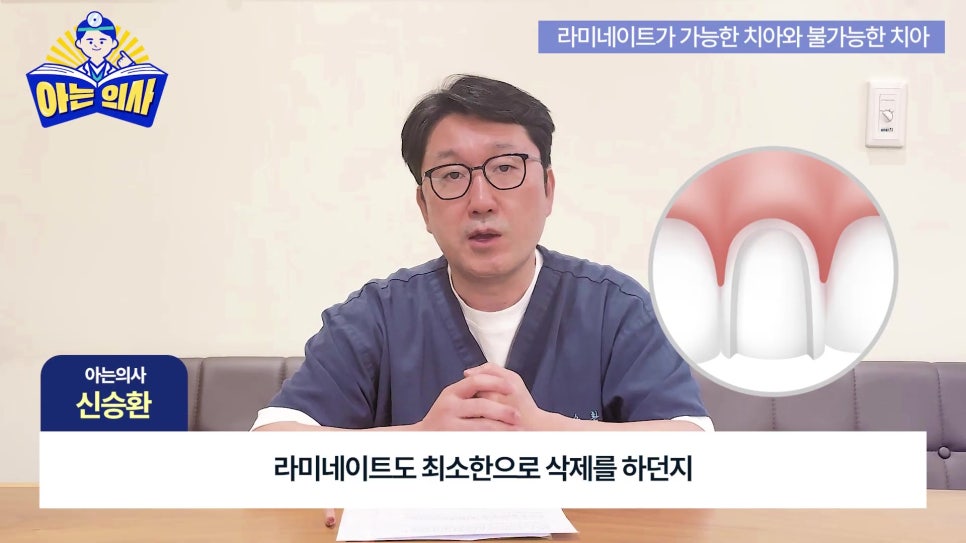

Just as artificial nails are attached to the surface without trimming away the entire nail, the outer surface of a tooth is minimally reshaped—or, in some cases, hardly reduced at all—before the ceramic is bonded on to improve its shape and color.


The greatest advantage of this treatment is that it requires relatively little tooth reduction.


In the past, crowns were often used to change the shape or color of teeth.
Because crowns cover the entire tooth, however, a relatively large amount of tooth structure had to be removed.

In some cases, the extensive tooth reduction could even lead to root canal treatment, which made many people feel concerned about the procedure.


Laminate veneers, on the other hand, often involve minimally reshaping only the areas that need it, allowing the teeth to be preserved relatively conservatively. This is why they are one of the preferred treatments for cosmetic work on the front teeth.

However, it is difficult to say that laminate veneers are always the best treatment.
What matters is the current condition of the teeth.



For example, if the teeth are naturally small and there are slight gaps between them, laminate veneers can often be placed relatively naturally.
This is because the desired shape can be created without removing much tooth structure.

The situation is different when the teeth are significantly crooked or protruding, or when the teeth are positioned very closely together.


If ceramic is bonded only to the surface in such cases without reducing the teeth at all, the teeth may look thicker, or the result may appear unnatural.

In other words, the more severe the protrusion or rotation, the more tooth reduction may be needed to achieve an aesthetic result.


It is understandable that patients want to have as little tooth structure removed as possible. However, reducing the amount excessively may ultimately result in dissatisfaction with both the shape and durability.



Laminate veneers are made from very thin ceramic materials.
Although this material offers excellent aesthetics, its inherent strength is somewhat lower than that of materials such as zirconia.



For this reason, laminate veneers are used in a way that supplements their strength through bonding with the teeth.
The concern is that if they are made excessively thin, the risk of chipping or breaking while eating may increase.

Therefore, to use them safely and reliably for a long time, it may actually be more advantageous to consider minimal tooth reduction within the necessary range.


There is another important point to consider.
A patient may visit the dentist wanting laminate veneers, but the dentist may recommend crowns instead.
In such cases, some people may worry, “Could this be unnecessary treatment?”
In reality, crowns may be more suitable because of the condition of the teeth.
Laminate veneers are primarily a treatment focused on the outer surfaces of the teeth.


However, if decay has progressed deeply on the inner surface or between the teeth, simply covering the outer surface may not be sufficient.




When the area affected by decay is extensive or the tooth has sustained significant damage, a crown that covers the entire tooth may be the more functionally and structurally sound choice.
Ultimately, laminate veneers are neither a treatment that means “never remove any tooth structure” nor a treatment that is possible for everyone.
It is important to consider the current alignment of the teeth, the degree of protrusion, the condition of any decay, and the bite before choosing the most appropriate method.
If you want a natural-looking result that lasts, it is best not to focus solely on the amount of tooth reduction, but also to determine whether the treatment is suitable for the condition of your teeth.
This has been 연세유라인치과의원 in Garak-dong, Songpa-gu.