
Hello. As many people have become interested in facial lifting, inquiries about Samseong Station Ulthera have been increasing. Ulthera is a non-invasive skin lifting device, and it is known as a procedure that targets the structural layers of the skin to help improve elasticity and reduce wrinkles. More people are also taking interest because it is a method that does not require relatively large incisions. In this post, we will look at how Ulthera works, how it differs from other lifting devices, the areas it can be applied to, the changes after the procedure, and how to maintain the results.
Basic principle of Ulthera: the use of ultrasound technology
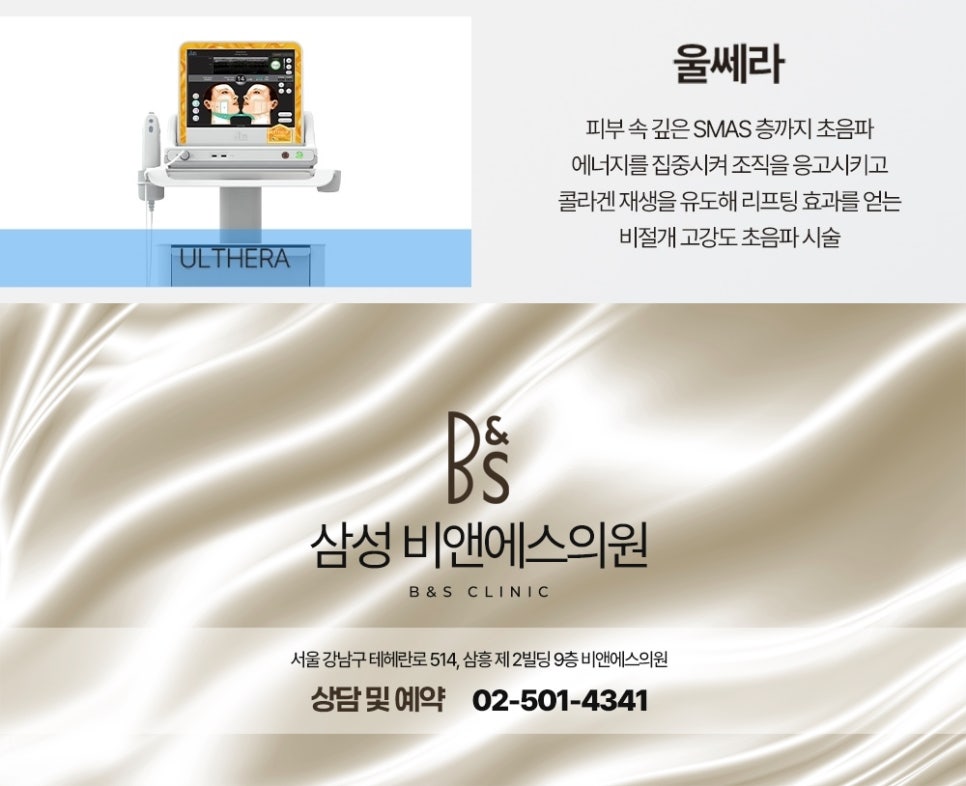
Ulthera uses high-intensity focused ultrasound (HIFU) technology to deliver energy to the SMAS layer, the deeper layer of the skin. As we age, the structures that support the skin weaken, leading to reduced elasticity and the appearance of wrinkles. Ulthera focuses on these areas and delivers thermal energy to stimulate the collagen production process.
Collagen is an important protein that maintains skin elasticity, and Ulthera helps improve skin firmness by inducing this collagen regeneration process. Since it is performed without incisions, it is also noted for being a relatively less burdensome method.

- Comparison between Samseong Station Ulthera and other lifting devices
There are many types of lifting devices, and each works differently. Samseong Station Ulthera has the feature of delivering ultrasound energy intensively to a specific depth of the skin. In contrast, Thermage uses radiofrequency (RF) to deliver thermal energy to the dermis layer of the skin, affecting the collagen structure.

In addition, Samseong Station Ulthera has the feature of being performed while checking the skin structure through real-time ultrasound imaging. This method is used because it allows the practitioner to confirm the energy delivery location during the procedure.

- Main application areas of Samseong Station Ulthera
Samseong Station Ulthera can be applied to various areas of the face, and it is typically used in the following areas.
Around the mouth and nasolabial folds: areas where sagging tends to appear
Marionette lines: wrinkles formed between the jawline and the area around the mouth
Double chin: an area where reduced firmness appears around the jawline
However, not all skin concerns can be resolved with Ulthera alone. For example, in areas where volume has decreased, lifting alone may not be sufficient, and in some cases, filler or other procedures may also be considered.

- Changes after Samseong Station Ulthera and how to maintain them
After an Ulthera procedure, some people may feel an immediate change in firmness, but as time passes, the collagen production process continues and changes may gradually appear. In general, changes become more noticeable after 2 to 3 months, and the duration of the results varies from person to person.

To maintain the effects for longer, proper care according to skin condition and healthy lifestyle habits are important. Depending on the situation, it may also be worth considering a plan that combines other lifting procedures.
- Understanding fat movement and changes in volume
As people age, facial structure and patterns of change differ, so it is necessary to choose an appropriate method through sufficient consultation. In such cases, methods such as fillers or fat grafting may also be considered. Because facial structure and patterns of change differ from person to person, it is necessary to choose an appropriate method through sufficient consultation.
- The importance of a customized treatment plan
Samseong Station Ulthera is one of the lifting procedures that can be applied to various areas and is used for the purpose of improving skin elasticity. However, the approach may differ depending on an individual’s facial structure and skin condition.
Therefore, it is important to fully assess the condition through consultation and compare several treatment methods, including Samseong Station Ulthera, in order to create a customized plan. Through this process, more natural-looking changes can be expected, and it may help in finding the right care direction for the individual.