
Implant
| 🦷 What is an implant? |
An implant is a treatment method in which an artificial root (titanium) is placed in the area where a natural tooth has been lost, and a prosthetic restoration is attached on top of it. It bonds firmly with the jawbone and can perform functions similar to a natural tooth.
🦷 A complete guide to full mouth implants: the placement process, material selection, and health insurance benefits
Because teeth do not naturally grow back once they are lost, a missing tooth can greatly reduce quality of life. In particular, when multiple teeth are lost or the gum bone becomes weak, a full mouth implant may be needed. Today, I’ll carefully organize the implant placement process, whether bone grafting is necessary, how to choose materials (zirconia and titanium), and finally the scope of health insurance coverage.
Implant
1️⃣ What is a full mouth implant?
Generally, when a single tooth is damaged, a single implant is placed, but when several teeth are lost, a full mouth implant is considered.
-
All-on-4 / All-on-6 method: A method of placing 4 or 6 implants in the gum bone and fixing a full prosthesis on top of them.
-
It is more stable than conventional dentures and provides functions closest to natural teeth in terms of chewing force and aesthetics.
Because the placement process and whether bone grafting is needed vary depending on the patient’s oral condition, a thorough diagnosis is essential.
Implant
2️⃣ Implant placement process
Implant surgery is carried out in stages.
① Detailed examination and treatment planning
-
A 3D CT scan and oral scan are used to check the condition of the gum bone and the location of nerves and blood vessels.
-
If there is insufficient bone, bone grafting may be necessary.
② Implant placement surgery
-
After the gums are incised, a hole is drilled into the alveolar bone, and the implant fixture (which acts as the root) is placed there.
-
At this time, titanium or zirconia may be used as the material.
③ Osseointegration period
-
This is the period during which the implant bonds firmly with the bone, and it takes about 3 to 6 months.
-
The implant must successfully complete this process to remain in place for a long time.
④ Abutment and prosthesis connection
- A post visible above the gums (an abutment) is connected to the fixture, and an artificial tooth (crown) is attached on top.
Implant
3️⃣ When bone grafting is needed
Because implants are fixed inside the gum bone, placement is impossible if the bone is insufficient or weak. Typical cases include the following.
-
A tooth has been missing for a long time and left untreated → alveolar bone resorption
-
Bone loss due to periodontal disease
-
Bone defects caused by accidents or trauma
👉 In these cases, the bone is reinforced using autologous bone, artificial bone, or allograft bone, and then the implant is placed.
Implant
4️⃣ Choosing implant materials: titanium vs zirconia
For the root portion of an implant (the fixture), titanium and zirconia are mainly used.
🔹 Titanium implants
-
The most commonly used standard material
-
Highly biocompatible, with an osseointegration success rate of over 95%
-
Strong durability and long-term stability
-
Disadvantages: rare possibility of metal allergy, and the upper part of the gums may show through
🔹 Zirconia implants
-
Metal-free material → almost no risk of allergy
-
Excellent aesthetics because it is similar in color to teeth
-
High strength, but long-term data are more limited than for titanium
-
More expensive
👉 In general, titanium implants are the standard, while zirconia implants are chosen when allergies or aesthetics are important.

Implant
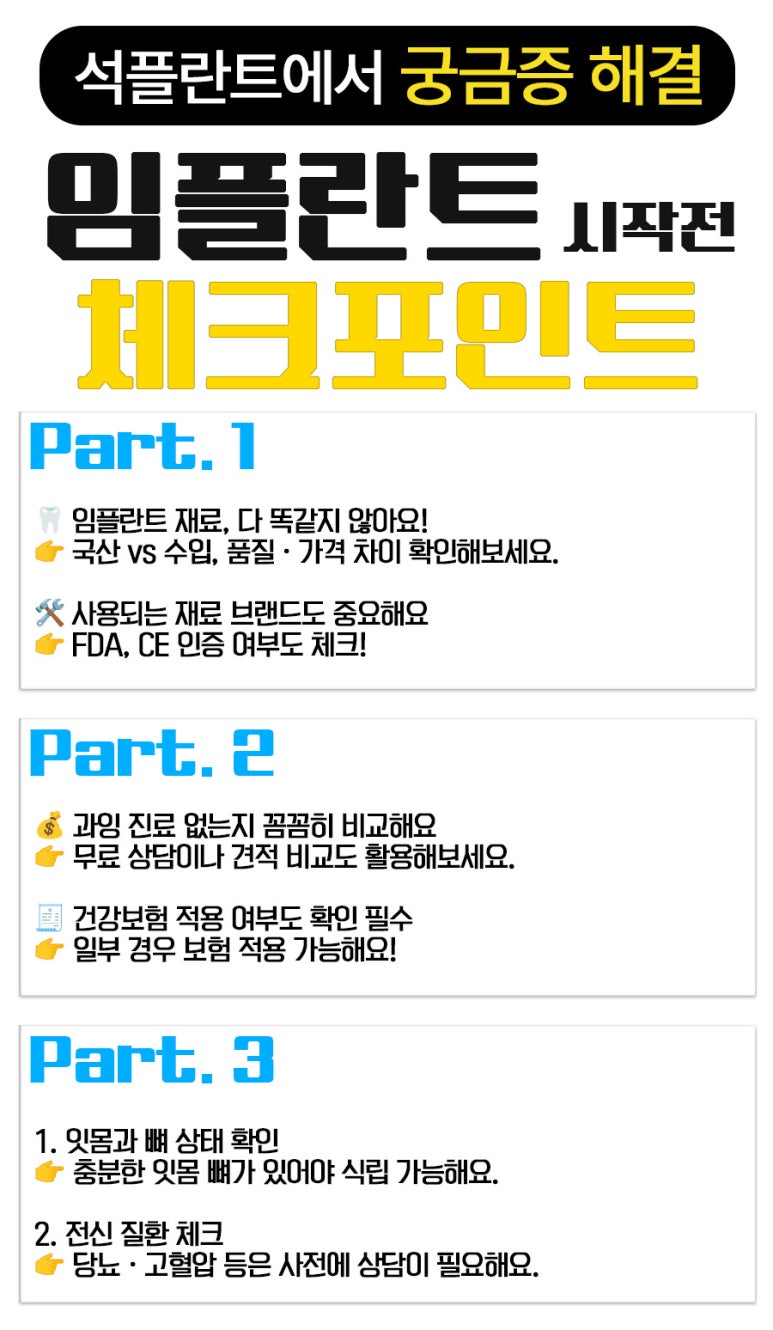
5️⃣ Scope of health insurance coverage
In the past, implants had to be paid for entirely out of pocket, but now some health insurance coverage applies to seniors aged 65 and older.
-
Eligible recipients: People aged 65 or older with partial edentulism
-
Coverage limit: 2 implants in a lifetime
-
Out-of-pocket rate: about 30%
👉 Coverage is limited for full mouth implants or when multiple teeth are placed, so the remainder must be paid out of pocket. However, some dental clinics also offer financial support programs or long-term installment plans during the transition from senior dentures to full mouth implants.

Implant
✅ Conclusion
A full mouth implant is a treatment that restores quality of life, not just replaces teeth.
-
In the placement process, thorough preoperative examination and judgment on whether bone grafting is needed are important.
-
Depending on the choice of material (titanium vs zirconia), the cost and outcome will vary.
-
Health insurance applies partially for those aged 65 and older, but full mouth implants still require a significant out-of-pocket payment, so a planned approach is necessary.
Because implants are a long-term treatment meant to be used for 10 or 20 years or more, when choosing a dental clinic, we recommend checking not only the price but also the surgeon’s experience, equipment, and follow-up care system.

Implant
🧑⚕️ Medical staff composition
Medical staff from Seoul National University School of Dentistry
Resident specialists in oral and maxillofacial surgery and integrated dentistry
Using extensive experience along with the latest digital equipment and technology to establish personalized diagnosis and surgical plans
We aim for patient-centered care and focus on reducing anxiety through sufficient consultation and explanation

Implant
🦷 Main treatment areas
Implants
General implants, high-difficulty implants involving bone grafting
Immediate placement implants
Aesthetic prosthetic treatment
Zirconia, ceramic prosthetics
Custom design for color and shape
Conservative and cavity treatment
Resin / inlay / crown, etc.

Osstem
✅ Seok Plant clinic hours
Mon–Thu: 10:00 AM ~ 9:00 PM evening treatment
Fri: 10:00 AM ~ 6:30 PM
Saturday: 10:00 AM ~ 5:00 PM
Lunch break: 1:00 PM ~ 2:30 PM
Closed on Sundays and public holidays

Seok Plant
Directions