
| 🦷 What Are Implants? |
Implants are a treatment method in which an artificial root (titanium) is placed in the spot where a natural tooth has been lost, and a prosthetic restoration is placed on top of it. Because it is firmly bonded to the jawbone, it can perform functions similar to those of natural teeth.
Full-mouth implants: important precautions and surgical process
As people get older or lose most of their teeth for various reasons, difficulties arise not only with eating and speaking, but also in everyday life as a whole. One treatment option in such cases is full-mouth implants. Today, let’s go over the basic concept of full-mouth implants, precautions, the surgical process, the scope of health insurance coverage, and cases where bone grafting is needed.
🌿 What are full-mouth implants?
As the name suggests, full-mouth implants are a method in which multiple implants are placed and used to secure a full prosthesis when the upper jaw (upper teeth), lower jaw (lower teeth), or both jaws have very few or no teeth. Because they are fixed rather than removable like dentures, they offer stability and the biting force and feel are closer to those of natural teeth.
Full-mouth implants are usually also called full-arch implants, and are considered for people with very few or no teeth. However, they are not automatically suitable for every patient, and the conditions of the oral cavity, gums, and bone must be checked carefully.

⚠️ Full-mouth implants: things to watch out for
When considering full-mouth implants, it is good to keep the following points in mind.
-
Sufficient consultation and examination
-
Full-mouth implants cover a wider area and require a more complex treatment plan than individual tooth implants. Therefore, a treatment plan should be established after comprehensively checking the amount of bone, gum condition, and bite condition through CT scans or oral scans.
-
Treatment period and recovery process
-
The process does not end with just one or two visits; multiple stages are required. Depending on the case, treatment may continue for several months, so you should be aware of this in advance.
-
Managing lifestyle habits
-
Unlike natural teeth, implants do not regenerate on their own. Smoking, drinking alcohol, and improper brushing habits can reduce the success rate, so lifestyle management is essential.
-
Importance of aftercare
-
Even after the procedure is completed, complications such as peri-implantitis must be prevented through regular checkups and scaling.
🛠️ How does the surgical process proceed?
The full-mouth implant surgical process can vary slightly depending on the patient’s condition, but the general flow is as follows.
-
Preoperative examination and treatment planning
-
The current condition is analyzed through CT scans, intraoral photos, model fabrication, and more, and the implant placement locations and number are planned.
-
Tooth extraction (if needed)
-
If remaining teeth cannot function properly, they are extracted first.
-
Implant placement
-
The implant fixtures are placed in the planned positions. If there is insufficient bone, bone grafting may be performed at the same time.
-
Healing period
-
A period is needed for the implant and bone to fuse firmly. This usually takes several months, and temporary restorations may be used during this time.
-
Placement of the prosthesis
-
Once the gums and implant condition have stabilized, the final prosthesis is placed. This restores chewing function and aesthetics.
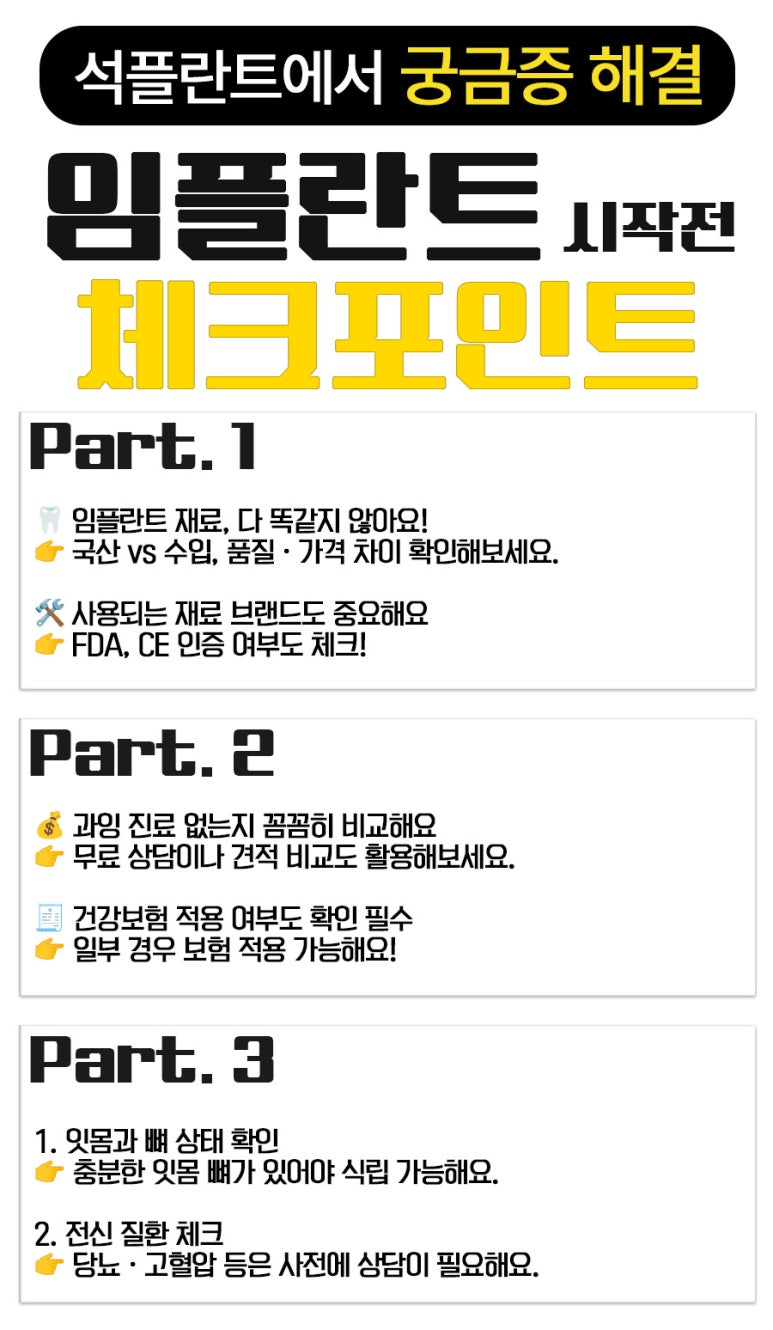
🩺 Scope of health insurance coverage
Because implants are generally not inexpensive, many people wonder whether health insurance applies. In South Korea, partial health insurance support is currently available for elderly patients aged 65 and older.
-
For patients with complete edentulism, it is difficult to receive full health insurance support for all implants.
-
However, health insurance applies to up to 2 implant procedures per person over a lifetime, reducing the out-of-pocket cost.
-
When planning full-mouth implants, you should prepare for the cost by considering both the insured portion and the non-covered portion.

🦴 Cases where bone grafting is needed
For an implant to succeed, the bone where the tooth will be placed must be strong and sufficient. However, if teeth have been missing for a long time or the bone has been resorbed due to periodontal disease, it may be difficult to place implants right away. In such cases, bone grafting is needed.
-
Small-scale bone grafting: when only a small amount of bone needs to be reinforced around the implant
-
Large-scale bone grafting: when a significant amount of alveolar bone has been resorbed and reinforcement is done using artificial bone or autologous bone
-
Sinus lift: when the upper jawbone is thin and close to the maxillary sinus (air cavity), a method of creating space and adding bone
Bone grafting requires additional treatment time, but it may be an essential step for long-term implant stability.

🧑⚕️ Medical team composition
Medical staff from Seoul National University School of Dentistry
On-site specialists in oral and maxillofacial surgery and integrated dentistry
Based on extensive experience as well as the latest digital equipment and technology, individualized diagnosis and surgical planning are carried out
Patient-centered care is emphasized, and efforts are made to reduce anxiety through thorough consultation and explanations
🦷 Main treatment areas
Implants
General implants, high-difficulty implants involving bone grafting
Immediate implant placement
Aesthetic prosthetic treatment
Zirconia and ceramic prosthetics
Color/shape-customized design
Conservative care and cavity treatment
Resin/inlay/crown, etc.

✅ Seokplant treatment hours
Mon–Thu: 10:00 AM – 9:00 PM, evening hours
Fri: 10:00 AM – 6:30 PM
Sat: 10:00 AM – 5:00 PM
Lunch break: 1:00 PM – 2:30 PM
Closed on Sundays/public holidays
Directions