Ansungmin Plastic Surgery never edits photos.
We used the patient’s before-and-after photos with consent, exactly as they are.
Lower eyelid under-eye fat repositioning surgery is a procedure that repositions fat protruding under the eyes to reduce shadowing and puffiness.
When performed appropriately, it can create a relatively natural appearance, but there are also quite a few people who visit us after a previous surgery because puffiness returns under the eyes, or they develop concerns such as hollowness, asymmetry, or a pulling sensation and start considering revision surgery.
In such cases, many people are told that “revision of under-eye fat repositioning is difficult” or even that “revision surgery is impossible,” which naturally makes them anxious. In reality, revision surgery is indeed more complicated, but the reason is not that the surgery itself is impossible; rather, it is because the condition of the under-eye tissue has changed significantly after the first operation.
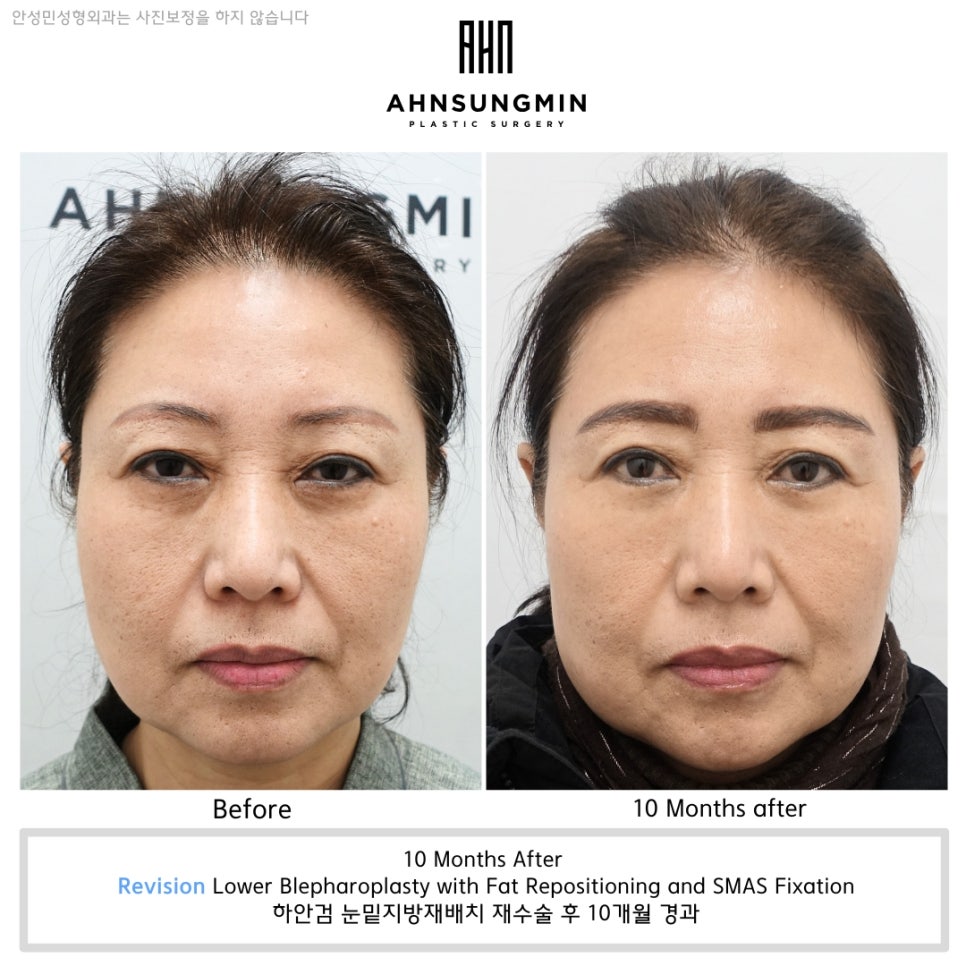
If the tissues have become firmly adherent due to the previous surgery, if excessive fat removal has caused hollowness, or if the structures supporting the eyelid have become weakened, it is difficult to solve the problem with simple fat movement alone. If surgery is forced in this state, it may instead lead to secondary problems such as pulling or eyelid deformity.
That is why revision surgery for lower eyelid under-eye fat repositioning requires a completely different approach from the first surgery. What matters far more than how much fat is removed is how the remaining tissue is preserved, organized, and rebalanced. The key is to safely release the adherent tissue, accurately identify the position and condition of the remaining fat, and then rearrange it so that the under-eye contour flows smoothly. At the same time, consideration must also be given to the supporting structures to prevent eyelid sagging or pulling.
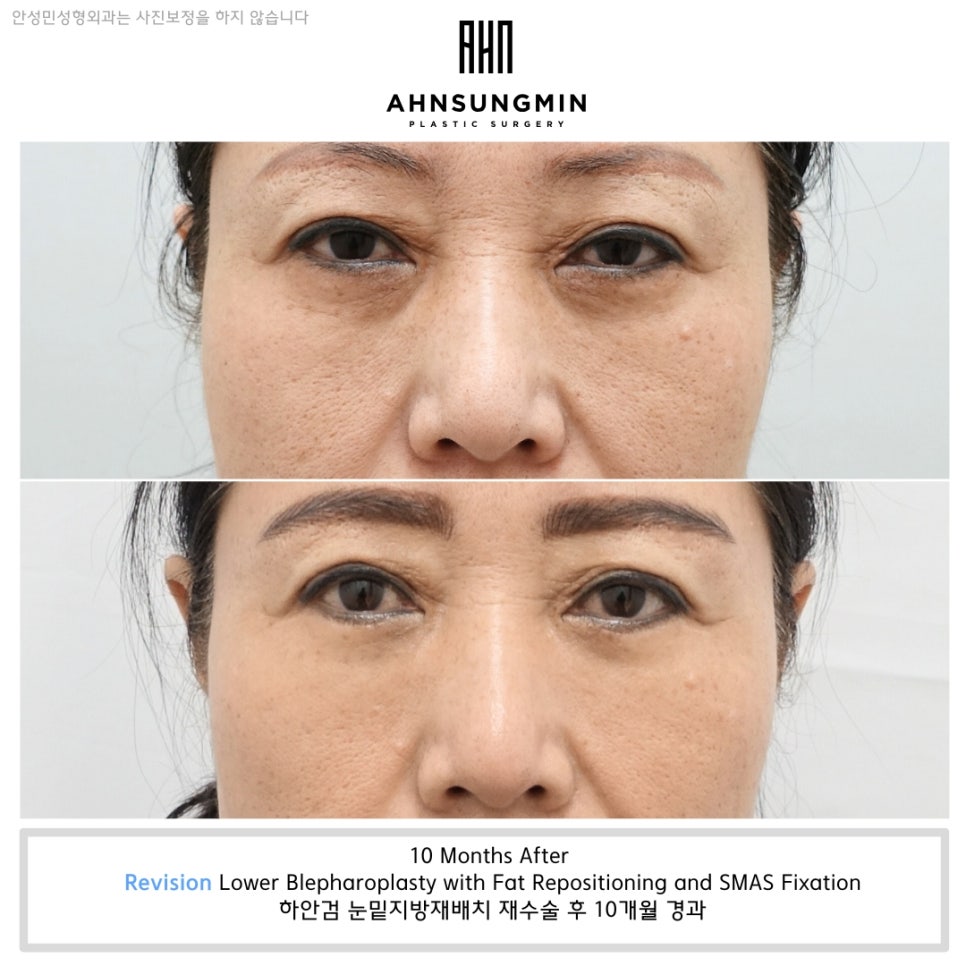
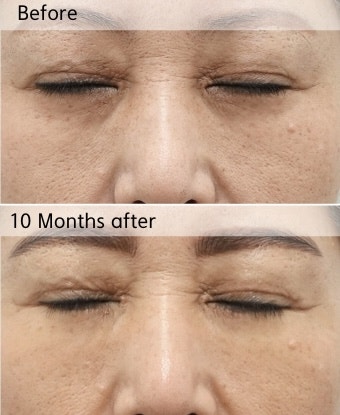 Fine wrinkles under the eyes also improve after lower eyelid surgery.
When evaluating revision surgery results, it is not enough to judge only by whether the puffiness has decreased. It is important to look at whether the under-eye area appears naturally connected from the front, whether there is any pulling sensation when smiling or speaking, whether the curves under both eyes are harmonious, and whether the result remains stable over time without feeling unstable. For these reasons, before-and-after comparisons for lower eyelid revision surgery should be carefully assessed from multiple angles.
Since the patient has already experienced one surgery, an even more cautious decision is needed when determining whether to proceed with revision. It is most important to receive a sufficient explanation of why the current problem occurred, confirm whether the under-eye tissue is suitable for revision surgery, and decide only after checking whether the plan considers not just short-term changes but also medium- to long-term stability.
Lower eyelid under-eye fat repositioning revision surgery is not simply a repeat operation; it is closer to a process of reunderstanding and reorganizing the under-eye structure. For that reason, revision surgery requires an even more careful approach based on experience and anatomical understanding.
Ahn Sung Min Plastic Surgery
Ahn Sung Min Plastic Surgery is a clinic that specializes only in eye surgery and revision surgery.
Based on Director Ahn Sung Min’s expertise and extensive revision surgery experience,
we carry out customized surgeries for patients, aiming for stable, natural, and long-lasting results even in the most complex revision cases.
A H N S U N G M I N
E Y E P L A S T I C S U R G E R Y
#LowerEyelid #LowerEyelidSurgery #UnderEyeFatRepositioning #UnderEyeFatRepositioningSurgery #UnderEyeFatRepositioningRevisionSurgery #LowerEyelidRevisionSurgery #EyeRevisionSurgery
#UnderEyePuffiness #UnderEyeHollowness #UnderEyeAsymmetry #UnderEyePulling #LowerEyelidSideEffects #EyeRevisionSurgerySpecialist #EyeRevisionSpecialist #UnderEyeSurgerySpecialist #AhnSungMinPlasticSurgery #LowerEyelidFollowUp
Lower eyelid revision surgery · No. 1 plastic surgery clinic specializing in difficult eye revision surgery
Ahn Sung Min Plastic Surgery
Inquiry: 02.414.1114
Consultation: 010. 3507. 3009
Go to Naver reservation now
KakaoTalk ID: kr.asmps