When consulting about uneven ptosis,
there is one question I hear most often.
“Can’t I just have surgery again on the drooping eye only?”
To put it simply, that choice often ends up making the unevenness even worse.
Uneven ptosis is not a problem of “appearance”
Uneven ptosis is not a problem of the double-eyelid line or external appearance, but a balance problem in the strength used to open the eyes.
The causes vary, including genetics, habits, previous surgery, and trauma, but behind the visible difference there is always an internal structural cause.
Why does correcting only one side make the problem bigger?
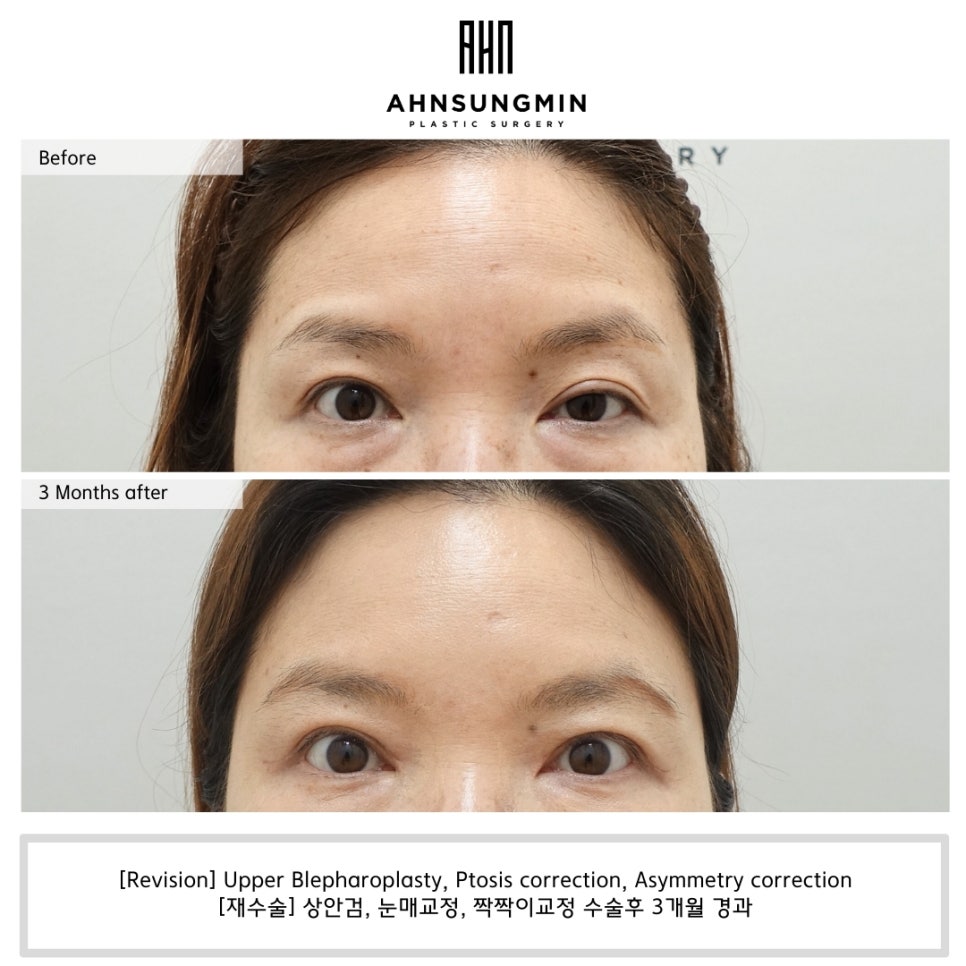
The patient below is a case in which the uneven ptosis became more severe after two surgeries at another clinic.
Looking at the condition before surgery, the eye with more severe ptosis was opening by overusing the forehead muscles.
If a “surgery to lift only the drooping eye more” is performed in this state, our body responds immediately.
The eyes do not move independently (Hering’s law)
The eyes work like a seesaw.
If one eye is corrected to open better,
the brain reduces the signal sent to the opposite eye.
As a result, the eye that originally looked fine can end up drooping instead.
This phenomenon is called Hering’s law.
If one eye is repeatedly corrected without considering this principle, the unevenness becomes more severe over time.
That is why the principles for correcting uneven ptosis are clear
-
Both eyes must be evaluated at the same time, and
-
The patient must open their eyes during surgery, and
-
A process is needed to balance the strength used to open the eyes
For this reason, it is a surgery with limitations when performed without incision or under sleep anesthesia.
The more revision surgeries there are, the more careful you need to be
As the number of revision surgeries increases, damage to the muscles that open the eyes and adhesions become more severe.
In some cases, the muscles may hardly respond at all.
So for revision surgery for uneven ptosis, the more important question is not “How much more can it be lifted?” but “Can it be prevented from getting worse?”
Uneven ptosis: judgment comes before surgery
Whether surgery is needed now, whether it is better to wait a little longer, or whether additional surgery is actually at a risky stage.
Without making this judgment, choosing to correct only one eye can make the results worse.
Revision surgery for uneven ptosis should always be decided after 충분한 상담 with a board-certified plastic surgeon.
Anseongmin Plastic Surgery
Ptosis · Revision Eyelid Correction Surgery
Inquiry: 02.414.1114
Consultation: 010. 3507. 3009
KakaoTalk ID: kr.asmps