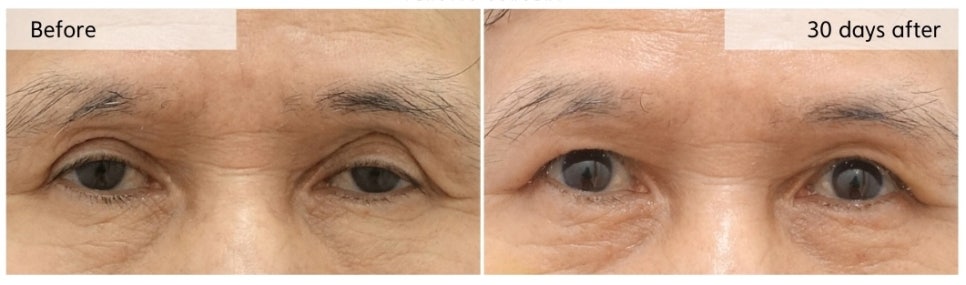
[Before surgery / 30 days after surgery]
30 days after revision ptosis correction, orbital fat repositioning, and lowering of the double eyelid crease
Sunken eyelids are often approached as a problem of insufficient volume. As a result, fat grafting is often suggested as the solution.
But in this case, adding volume was not the answer.
This patient had already undergone fat grafting three times.
The patient had a history of receiving upper eyelid fat grafting three times at another hospital through abdominal liposuction.
Even so, the hollowing kept recurring over time.
This history alone shows that simply restoring volume is not the fundamental solution.
The cause of the hollowing may not actually be a loss of volume.
Of course, fat reduction due to aging and other factors can be a cause, but ptosis can also be a factor.
Because of long-standing compensatory eye opening and repeated tension, the eyelid tissue had become excessively stretched.
In such cases, filling the seemingly empty area with fat does not address the cause.
Why fat grafting was not appropriate.
Fat grafting involves transplanting fat that has been completely separated from its original blood supply into the eyelid.
Because the eyelid is a highly mobile area, fat survival is not as easy as one might think.
If, like this patient, the effect did not last even after multiple fat graftings, there is no reason to repeat the same choice.
Therefore, we addressed the underlying cause with ptosis correction and chose orbital fat repositioning.
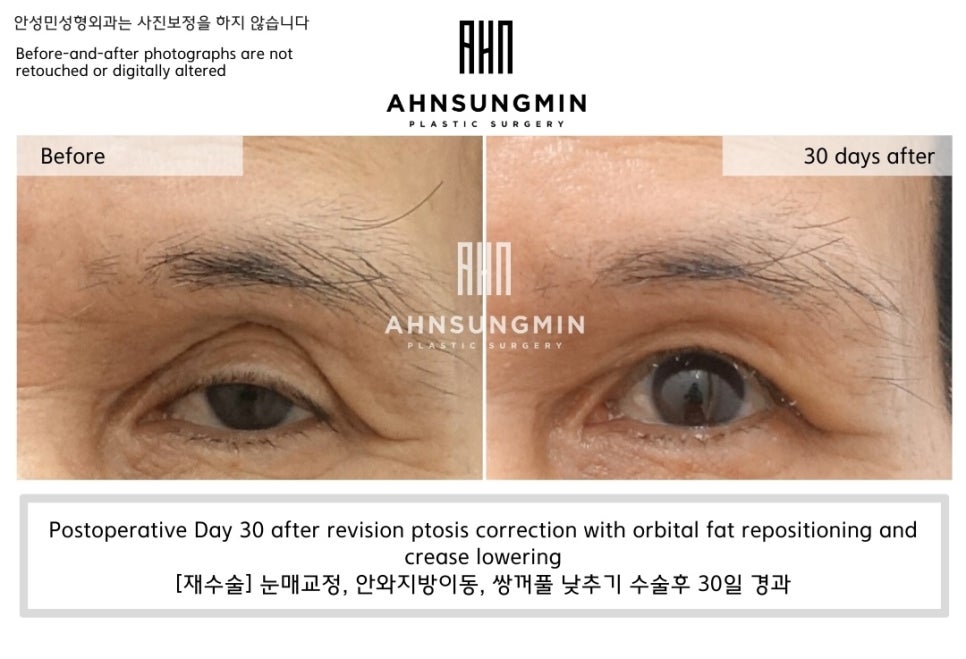
The amount of orbital fat remaining in this patient was not large.
We drew out as much as possible and repositioned and redistributed the orbital fat.
Orbital fat repositioning uses the patient's own fat while preserving blood flow, allowing for more stable and physiological volume support.
We restored balance, not volume.
Along with orbital fat repositioning, revision ptosis correction and lowering of the double eyelid crease were performed.
Once the eye opening stabilized, excessive tension decreased, and the eyelid settled into a natural position on its own.
No additional volume supplementation was needed.
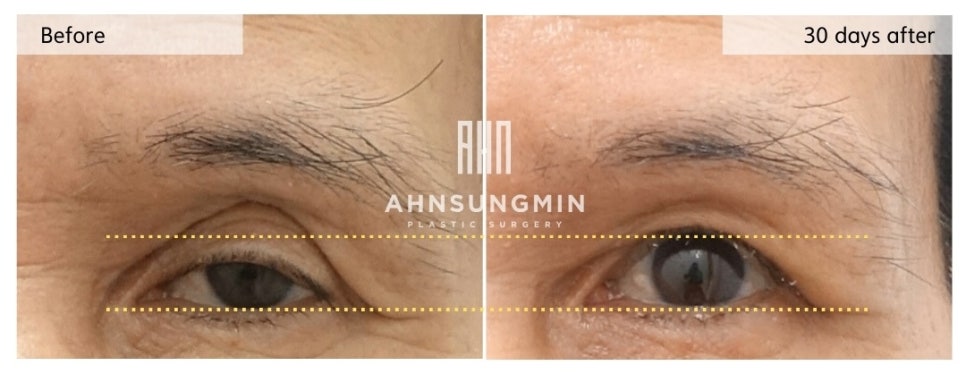
As time passed, the contour of the upper eyelid became softer and more stable.
Through ptosis correction surgery, the eyes open better, so the eyelid skin no longer turns inward.
In addition, the sunken eyelid improved sufficiently without grafted fat or foreign materials.
This case shows an important principle in eyelid revision surgery.
For sunken eyelids, injecting a foreign material based only on appearance is merely a temporary fix, and the underlying cause is not treated.
The key is not deciding what to add, but what needs to be corrected.
Seeing the Eye as a Whole, Not in Parts
A Clinic Dedicated to Eyelid Revision Surgery in Korea
Ahnsungmin Plastic Surgery
Ahnsungmin Plastic Surgery
Ptosis · Revision Ptosis Correction
Inquiries: 02.414.1114
Consultation: 010. 3507. 3009
KakaoTalk ID: kr.asmps