A common pattern observed in patients with ptosis.
Patients with ptosis show a common pattern of behavior.
Rather than relying on the eyelids to open their eyes, they lift their forehead to open them.
Because the muscles responsible for opening the eyes are not functioning sufficiently, the forehead muscles are used instead to secure the field of vision. This compensatory mechanism is repeated over time and eventually becomes a habit. As a result, most patients do not realize that they are using their forehead to open their eyes.
The true condition of the eyes, revealed when compensation is no longer possible.
When the forehead muscles can no longer help open the eyes, the eye’s true condition is revealed. This is often seen in patients who receive forehead Botox to reduce forehead wrinkles.
Patients who have long relied on lifting their forehead to secure their field of vision often say that their eyes feel heavier after Botox. As the forehead comes down, they may feel as if their eyes are puffy, and they may also feel that it has become harder to open their eyes.
These changes do not mean that Botox has created a new problem.
They reveal the eye condition that had long been hidden by compensatory actions.
How can ptosis be evaluated?
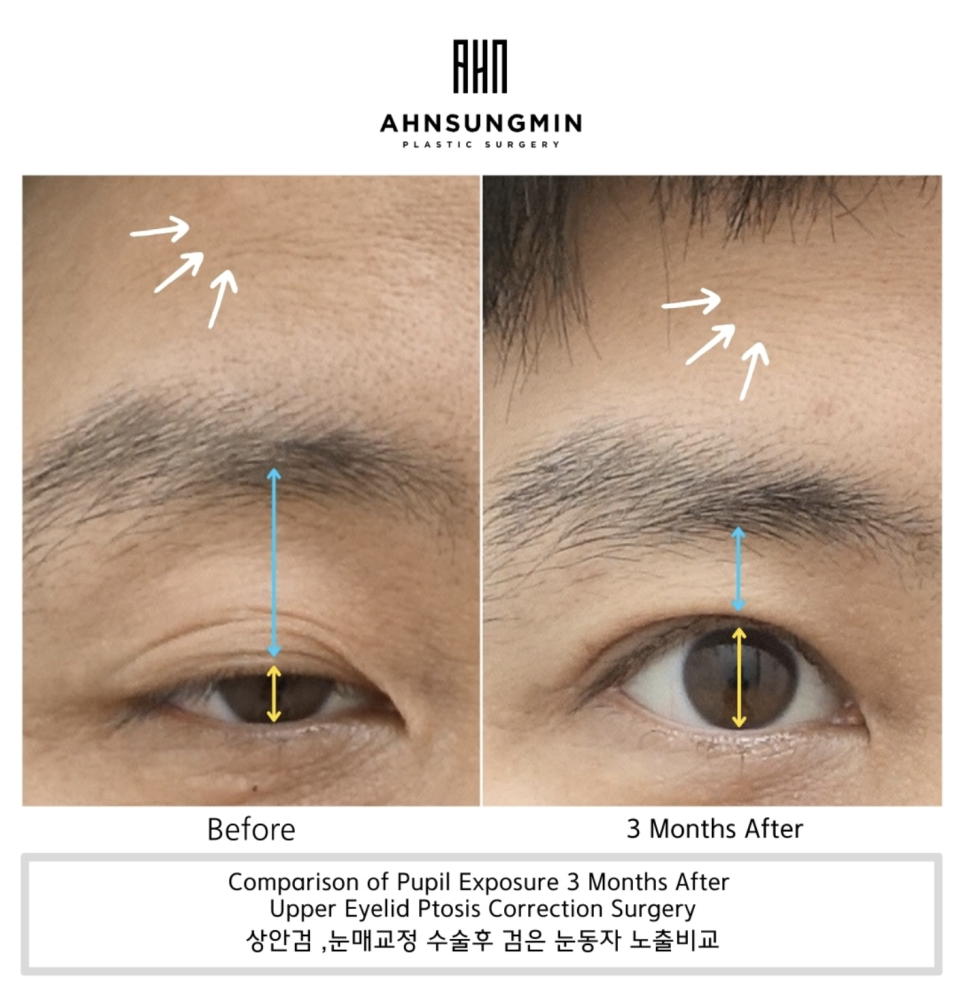
Ptosis can be evaluated relatively simply based on how much of the black pupil is exposed.
When the eyes are opened naturally without using the forehead, the normal range is considered to be when the upper eyelid covers about 2 mm of the black pupil.
If more of the pupil is covered than this, ptosis can be suspected.
Even in such cases, if there is no clear discomfort in daily life, it may not be a major functional problem. However, from an aesthetic standpoint, it often gives the impression that the eyes look sleepy or tired.
When surgery is needed.
When more than half of the black pupil is covered, patients tend to rely on stronger compensatory actions to secure their field of vision. They may continually lift their forehead, or unconsciously raise their chin.
If these compensatory patterns continue, unnecessary tension accumulates across the face. It is not uncommon for deep forehead wrinkles to develop even at a young age.
At this stage, the issue can no longer be seen as a matter of appearance alone.
Eyelid correction is not surgery to make the eyes larger, but a procedure needed to restore normal eye-opening function and remove compensatory actions.
Before-and-after comparison of eyelid correction.
In the photo below, you can compare the degree of black pupil exposure before upper eyelid eyelid correction surgery and at three months after surgery.
This comparison does not show a change meant to make the eyes look larger.
It shows that the compensatory muscles used to open the eyes are no longer needed.
Seeing the Eye as a Whole, Not in Parts
A Clinic Dedicated to Eyelid Revision Surgery in Korea
Ahnsungmin Plastic Surgery
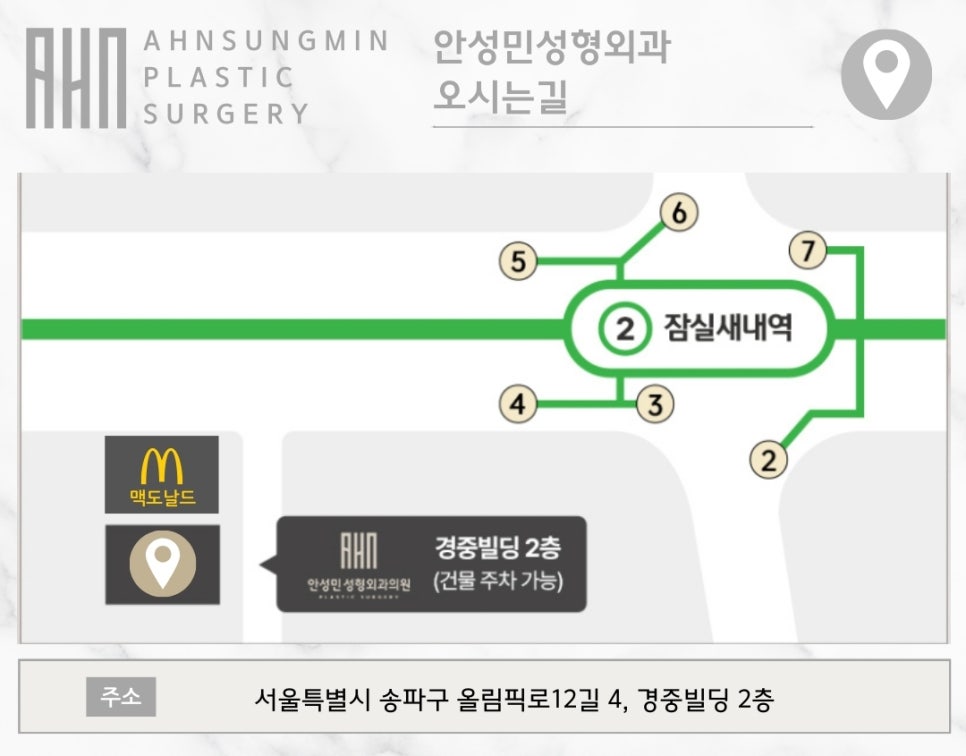
Ahn Sung Min Plastic Surgery
Ptosis · Eyelid Correction Revision Surgery
Inquiry: 02.414.1114
Consultation: 010. 3507. 3009
KakaoTalk ID: kr.asmps