The moment fat removal becomes the start of hollowness
When consulting about lower eyelid surgery, there is one thing I hear most often.
“Please just remove the protruding fat cleanly.”
If the under-eye area looks puffy, it is easy to think that removing the fat will solve the problem. Technically, removal is not difficult. It is even simpler than repositioning.
With fat removal, the visible bulge flattens immediately. But the lower eyelid is not simply an area that should be made flat.
It is a structural transition point where the eye and cheek meet. In this area, volume is not just excess; it is part of the support structure. Therefore, removing fat without considering support can later cause the side effect of a sunken under-eye appearance.
Postoperative Month 5 After Lower Eyelid Fat Repositioning Surgery
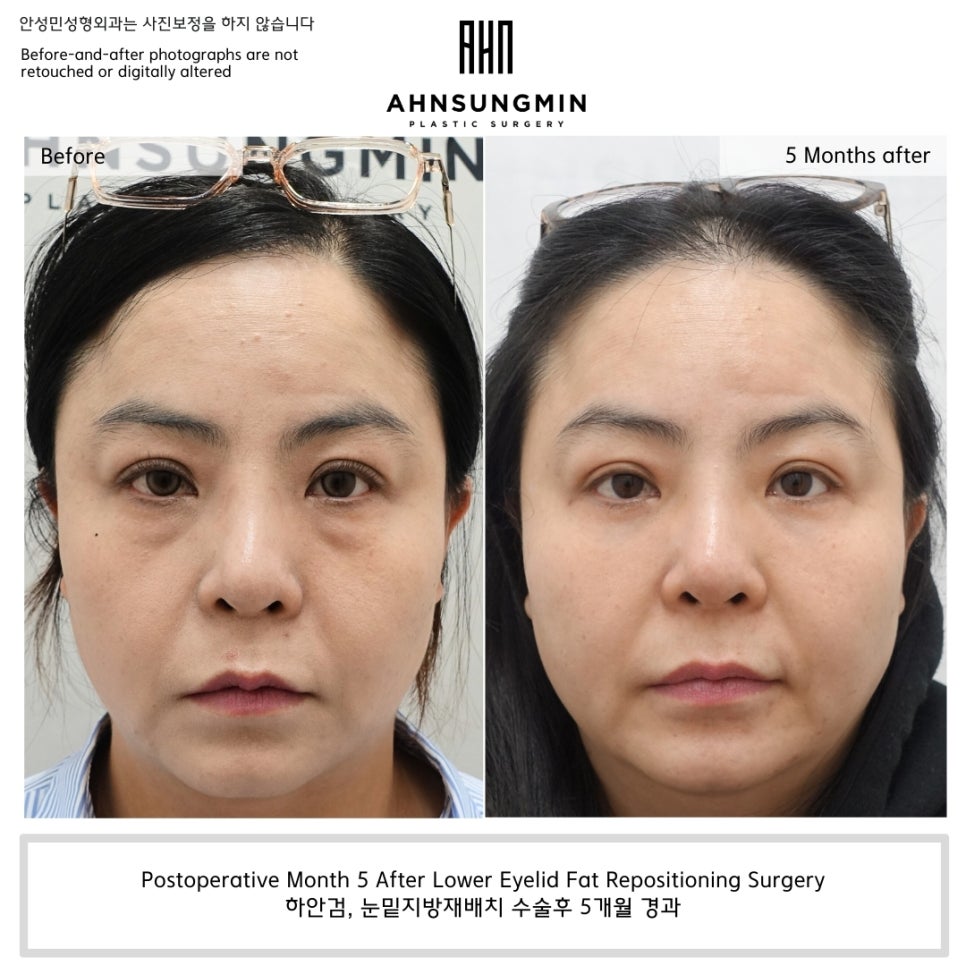
The photo above shows 5 months after lower eyelid fat repositioning surgery.
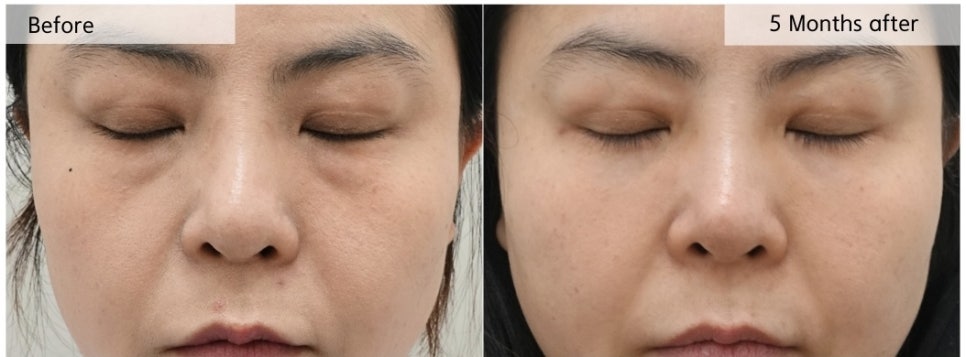
Volume comparison when the eyes are closed after lower eyelid fat repositioning surgery
Hollowness is harder to manage than puffiness
If too much fat is removed, other problems begin.
-
The under-eye area can look skeletal
-
The tear trough can appear deeper
-
The boundary between the lower eyelid and cheek becomes sharper
Once an area becomes hollow, it is not easy to restore. Recovering with fat grafting after scar tissue has formed is less predictable.
That is why judgment in the first surgery matters.
Postoperative Month 5 After Lower Eyelid Fat Repositioning Surgery
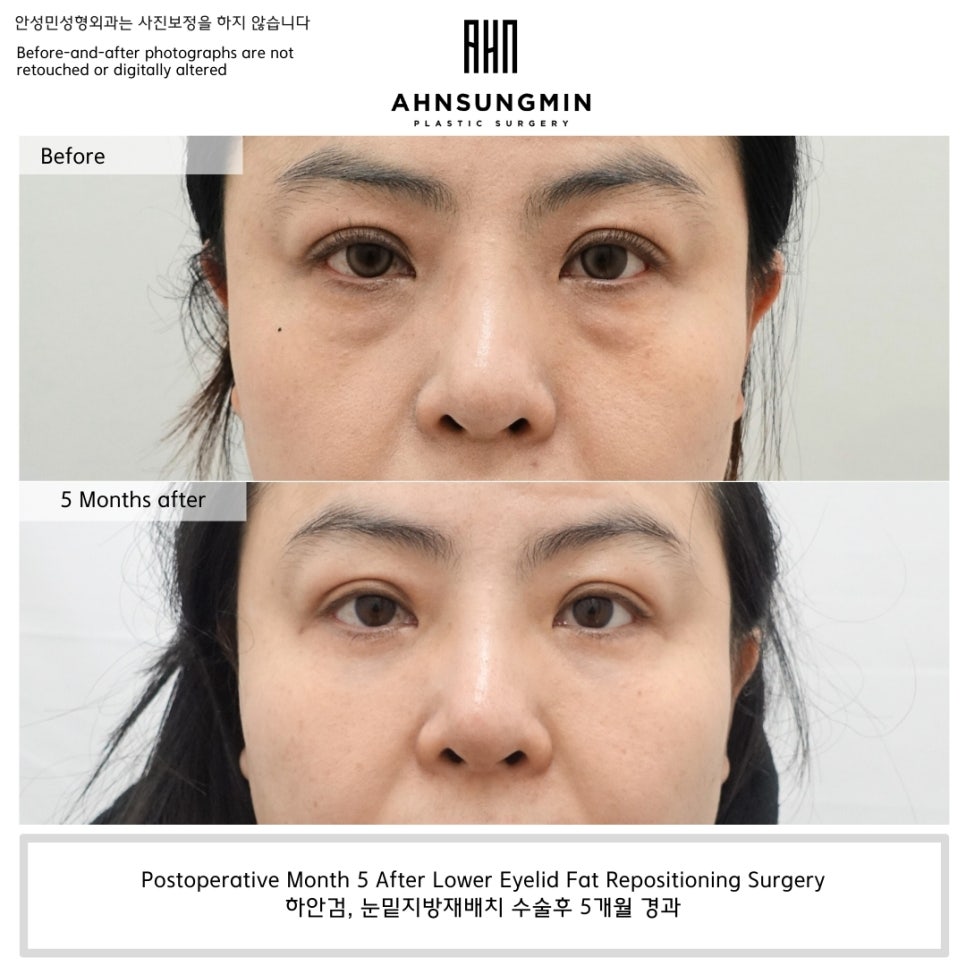
In the close-up, because the fat was repositioned rather than removed,
the transition area is connected smoothly. The structure was organized through repositioning, not emptied through removal of volume.
Dark circles may not be a fat problem
Many people think dark circles are caused by protruding fat.
But darkness caused by pigmentation or visible blood vessels does not improve even if the fat is removed. If you try to solve color by reducing volume, the darkness may remain while hollowness is added.
Understanding the true cause accurately helps prevent unnecessary surgery.
Long-term stability is more important
At first, you may feel like you want to remove “more” fat, but excessive removal can, over time, become the beginning of recession and hollowness.
In lower eyelid surgery, the parts we decide not to remove often are what protect the result.
Ptosis · Revision Surgery for Eye Shape Correction
Inquiries: 02.414.1114
Consultation: 010. 3507. 3009
KakaoTalk ID: kr.asmps