Why Recurrence Happens After Lower Eyelid Surgery and the Real Limits of Revision Surgery
Lower eyelid surgery is not simply an operation to remove under-eye fat.
If you do not understand the structure, the result may only be temporary.
The question I hear most often in recent consultations is this:
-
“I had surgery, but the bulging came back.”
-
“Can’t you just remove a little more?”
-
“Why can’t revision surgery be done right away?”
These questions share one common misunderstanding.
The problem is assumed to be the fat.
But in reality, that is not the case.
1. Why the bulging comes back
There are three main reasons why the area under the eyes can become bulgy again.
① The fat was not properly repositioned
Under-eye fat repositioning is about “moving,” not “removing.”
If the repositioning is incomplete, the structural transition may not be smooth, and it can again appear as if the area is protruding.
② The orbital septum has weakened
If the septum is damaged or weakened, the fat can be pushed forward again.
In this case, simple removal will not solve the problem.
③ Lack of structural support
If midface support, muscle tension, or skin laxity is insufficient, instability can appear over time.
In other words, recurrence does not happen because “the fat grew back.”
In most cases, it is a structural issue.
2. Another problem caused by excessive fat removal
“If it bulges, why not just remove it?”
Technically, removal is not difficult.
But excessive removal creates new problems.
-
The under-eye area becomes hollow like bone
-
Shadows become deeper
-
The boundary between the eye and cheek becomes sharper
-
The risk of the skin being pulled downward increases over the long term
Bulging can be adjusted through repositioning.
But volume that has been removed too much is much harder to restore.
That is why preservation is not a passive choice, but a strategy.
3. Pigmentation is not a fat problem
Not all dark circles are caused by fat.
-
Skin pigmentation
-
Vascular permeability
-
Skin thickness
These issues cannot be solved by removing fat.
If volume is removed to eliminate color,
the darkness remains and only the hollowing is left behind.
The cause must be analyzed first.
4. Why revision surgery must wait
Lower eyelid revision surgery
should, in principle, be performed after waiting at least 6 months.
In some cases, 1 to 2 years may be needed.
The reason is simple.
The imbalance seen early on is mostly swelling and tissue response.
Time is part of the treatment.
5. The real limit of revision surgery is the skin
The most important factor in revision surgery is not fat.
It is the skin.
Once skin is removed, it does not grow back.
Fat can be adjusted.
Muscle can be controlled.
The septum can be reinforced.
But insufficient skin is a structural limitation.
If over-resection has been done,
revision surgery moves from correction to reconstruction.
That is why leaving enough skin during the first surgery is
a choice that considers the future.
6. There is no surgery that can smooth every wrinkle
A method that removes as much skin as possible in order to eliminate every wrinkle completely
is not natural.
Skin needs a minimum amount of room.
A slight amount of volume may be part of structure, not aging.
The goal of lower eyelid surgery is
not a “perfectly flat surface,” but
“stable balance.”
Lower eyelid surgery is not a removal procedure.
-
If the structure is not understood, it may look like recurrence
-
Excessive removal creates other problems
-
The key to revision surgery is skin allowance and time
More important than what and how much to remove
is what to leave behind.
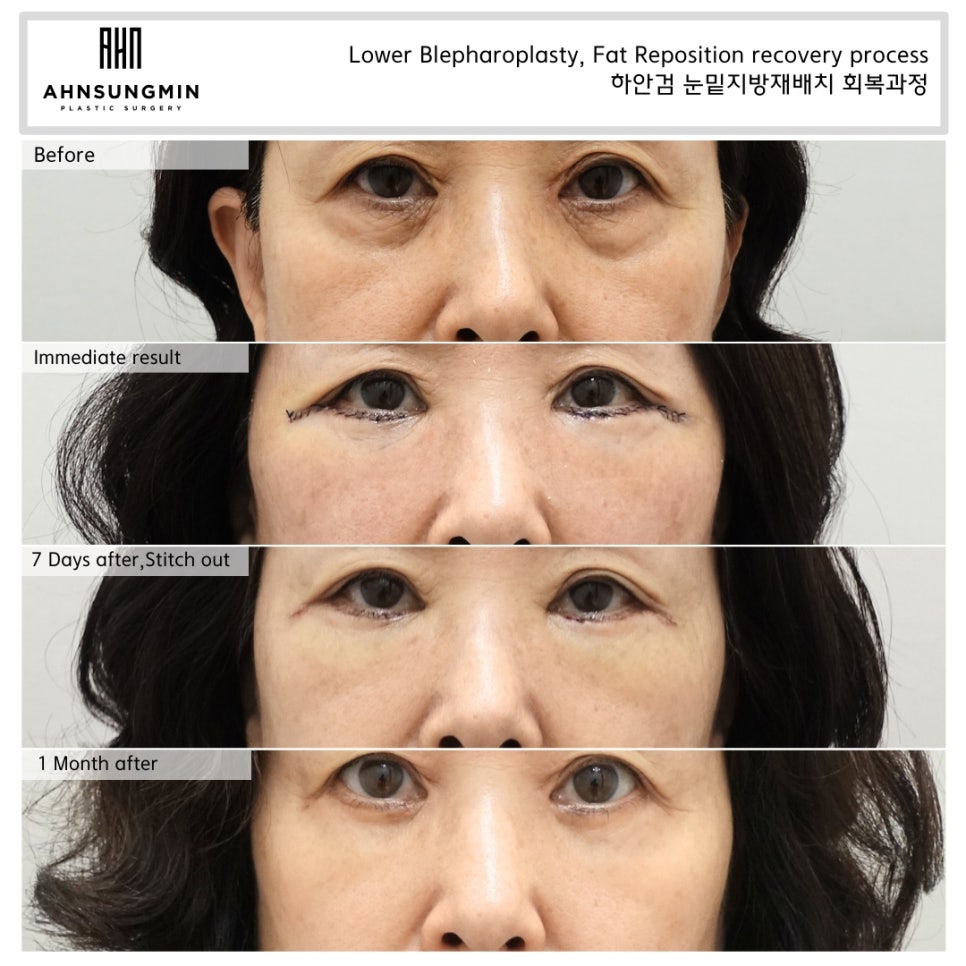
Anseongmin Plastic Surgery does not retouch photographs.
Before-and-after photographs are not retouched or digitally altered.
#lowereyelid #under-eyefatrepositioning #lowereyelidrevisionsurgery #under-eyerecurrence #lowereyelidoverresection
#undereyehollowing #lowereyelidsurgeryreview #lowereyelidrepositioning #undereyefatremoval #AnseongminPlasticSurgery
Anseongmin Plastic Surgery
Ptosis correction · Revision eyelid surgery
Inquiry: 02.414.1114
Consultation: 010. 3507. 3009
KakaoTalk ID: kr.asmps