One of the first changes many people notice when looking in the mirror as they age is hollowing of the upper eyelids.
Many people visit a clinic because their eyes look more sunken than before, multiple folds appear above the double eyelids, or fine lines increase, making them look more tired and older than their actual age.
Many people think that this hollowing is simply caused by a loss of fat. Of course, a decrease in fat volume due to aging can be one contributing factor.
However, in many cases, structural changes in the eyelids are a greater cause than fat loss itself.
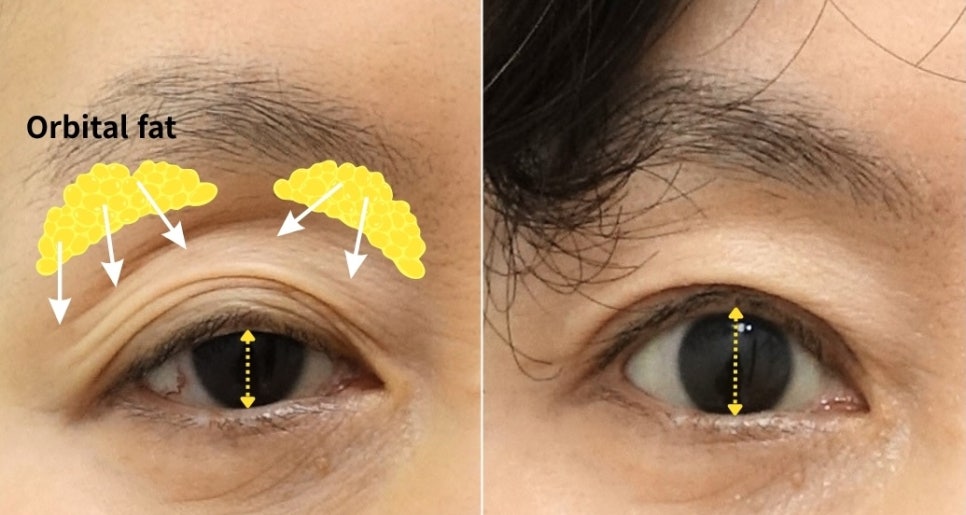
One of the representative causes is ptosis.
When the muscles that open the eyes become weaker, the eyelids cannot be raised sufficiently. Changes in the structures that support the eyelids can also cause the orbital fat to descend.
When the orbital fat moves downward in this way, the upper eyelids appear more hollow, and repeated folding of the skin leads to multiple creases and fine lines.
In other words, not all cases of eyelid hollowing are caused by a lack of fat.
It is also very common for hollowing to appear more severe when ptosis and changes in the position of the orbital fat occur together.
Orbital fat repositioning is not a fat-injection procedure.
Orbital fat repositioning does not involve adding new fat or creating excessive volume.
It is a procedure that moves your own descended orbital fat back to its original position to naturally support the upper eyelid.
Because it is important to restore the structure while preserving as much of the fat as possible, a more natural and stable result can be expected over time.
In particular, when ptosis is also present, a more satisfactory result can be achieved by improving not only the position of the fat but also the function of opening the eyes.
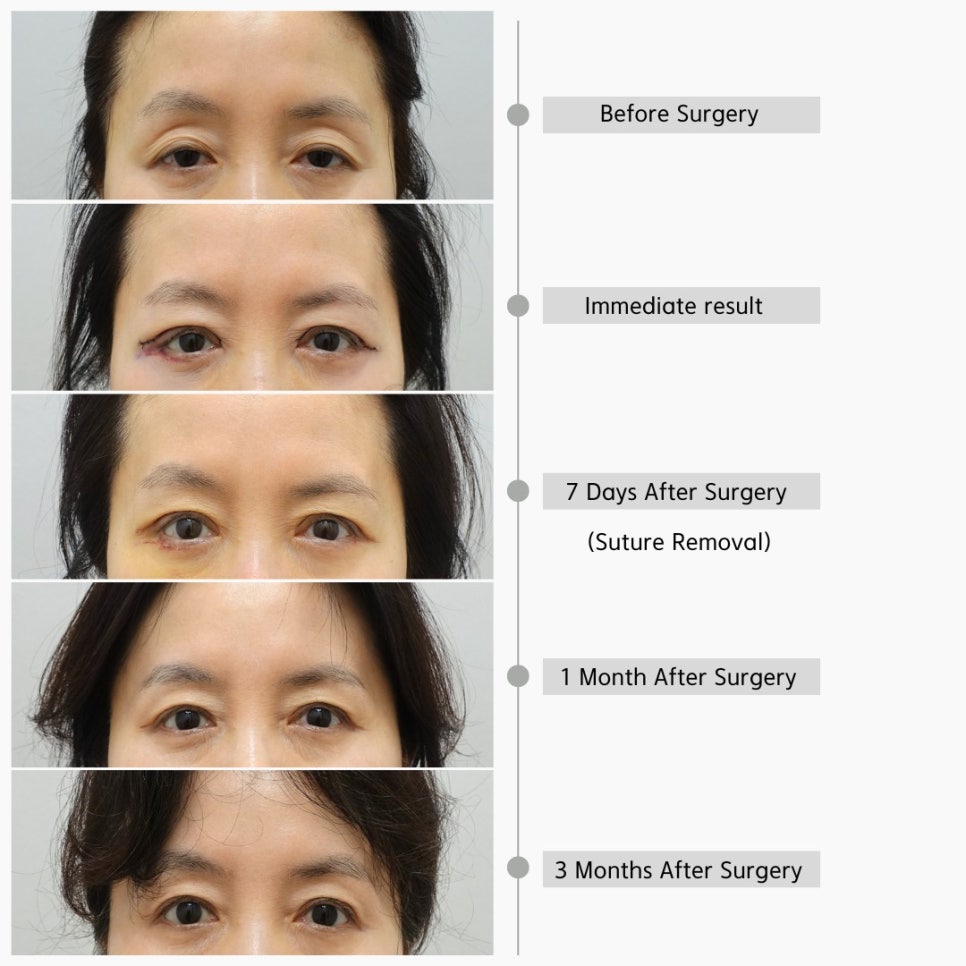
Recovery becomes more natural over time
Orbital fat repositioning and ptosis correction are procedures that gradually settle over time rather than immediately after surgery.
In the early stages, swelling and tension in the tissues may make the appearance feel somewhat unfamiliar. However, over the course of one week, one month, and three months, the volume and contours of the eyelids gradually settle into a more natural appearance.
Therefore, it is important to assess the surgical results together with the recovery process.
Actual surgical case
This patient had the following conditions:
Rather than simply adding volume,
✔ correcting the ptosis,
✔ naturally adjusting the high double eyelid crease, and
✔ moving the descended orbital fat back to its original position
were performed to restore the structural balance of the entire eyelid.
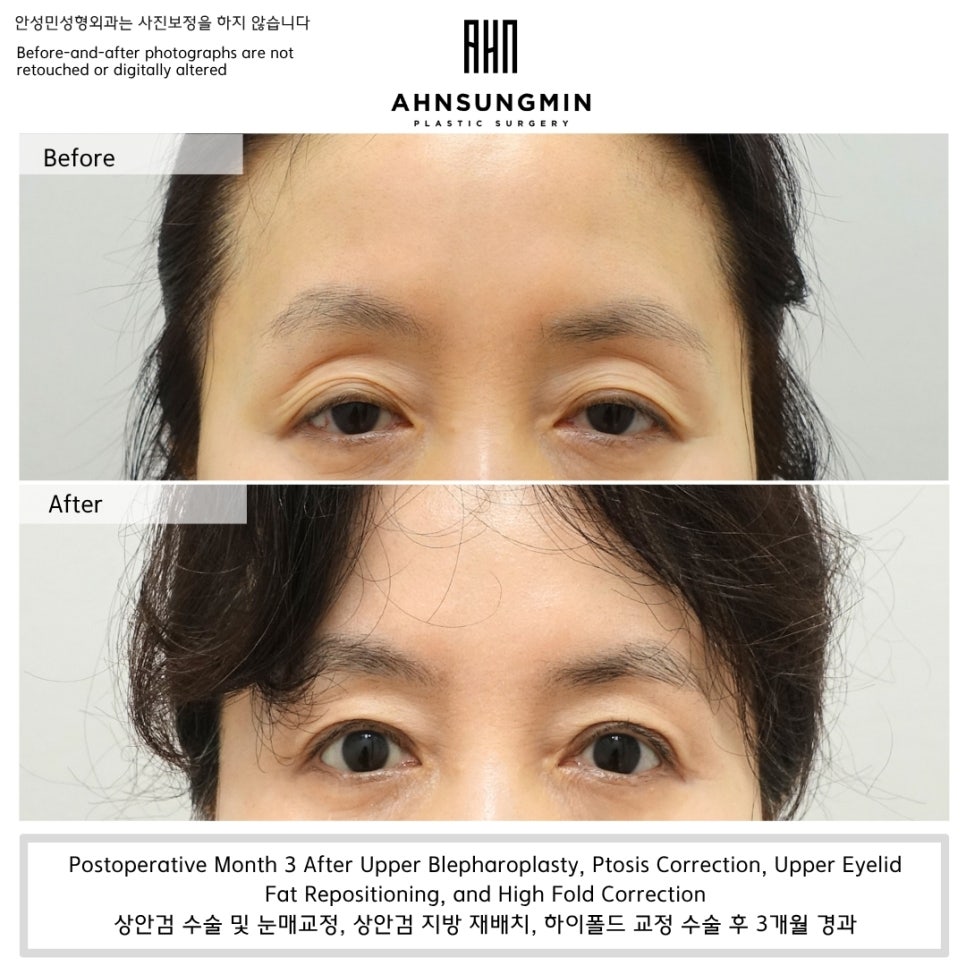
Three months after surgery, the multiple creases had decreased, the upper eyelid hollowing had naturally improved, and the strength used to open the eyes had also become more stable.
The key to orbital fat repositioning is not simply creating volume, but restoring the eyelid structure by returning the tissue originally present to an appropriate position.
Therefore, not everyone with eyelid hollowing requires the same procedure.
The most important step is to accurately determine whether the cause of the hollowing is fat loss, ptosis, or a combination of both, and then establish a surgical plan accordingly.
안성민성형외과 does not retouch or alter photographs.
Because the cause of eyelid hollowing and the eye structure differ from patient to patient, the most suitable method is selected after thoroughly analyzing each individual's condition.
#OrbitalFatRepositioning #OrbitalFatRearrangement #UpperEyelidHollowing #EyelidHollowing #Ptosis #EyeOpeningCorrection #UpperBlepharoplasty
#EyelidCreases #MultipleEyelidCreases #EyelidAging #UpperEyelidPlasticSurgery #EyePlasticSurgery #RevisionEyeSurgery #안성민성형외과
안성민성형외과
Ptosis · Eye-Opening Correction Revision Surgery
Inquiries: 02.414.1114
Consultation: 010. 3507. 3009
KakaoTalk ID: kr.asmps