Hello,
Are you worried about secondary caries?
Prioritizing the preservation of patients’ natural teeth as much as possible,
I am Oh Tae-hoon, chief director of D-Day Dental Clinic
and a specialist in Comprehensive Dentistry.

I always make it a rule to provide honest treatment,
only doing what is truly necessary for my patients’ dental health. :)
A treated tooth
started hurting again,
and they said decay had returned inside...
A few years ago,
at the place where I had cavity treatment,
the resin fell out,
and the inside was black with decay,
so I was shocked.
This time they say I may even need
root canal treatment.
Was the first treatment not done properly?
We see many patients
who come in saying things like this.
The reason is 바로 'secondary caries.'
Caries that develops again in a tooth that has already been treated,
I think nothing is more discouraging for patients than this.
What is even more upsetting is that once secondary caries is found,
it usually requires much more extensive and complex treatment
than the initial treatment.
What could have ended with a simple resin treatment
may turn into a situation requiring an inlay, crown,
or even root canal treatment.

Treatment costs increase several times over,
treatment takes longer,
and, most importantly, it becomes an unfortunate situation in which even more of your precious natural tooth must be removed.
If you are reading this article now,
you are probably either someone who is worried about secondary caries
or someone who is about to undergo their first treatment.
You may not understand why a treated tooth would decay again,
and
I imagine you may have wondered why this happens and how it can be prevented.
Today, I will explain the three main causes of secondary caries
based on my clinical experience up close.
If you read this article to the end,
you will be able to receive proper treatment from the very first time
and maintain healthy teeth for life.
Table of Contents
-
Secondary caries,
when the extent of decay was not accurately identified during the initial diagnosis
-
Secondary caries,
when infected tooth structure was not completely removed
-
Secondary caries,
when inappropriate treatment materials or techniques were chosen
-
Secondary caries,
when the extent of decay was not accurately identified during the initial diagnosis
The biggest cause of secondary caries is that,
during the initial diagnostic stage,
the actual extent of the decay was not accurately identified.
Even if it looks like a small cavity on the surface,
in many cases it has actually progressed deep inside the tooth.
In particular, proximal caries that occurs between teeth is almost impossible to see with the naked eye.
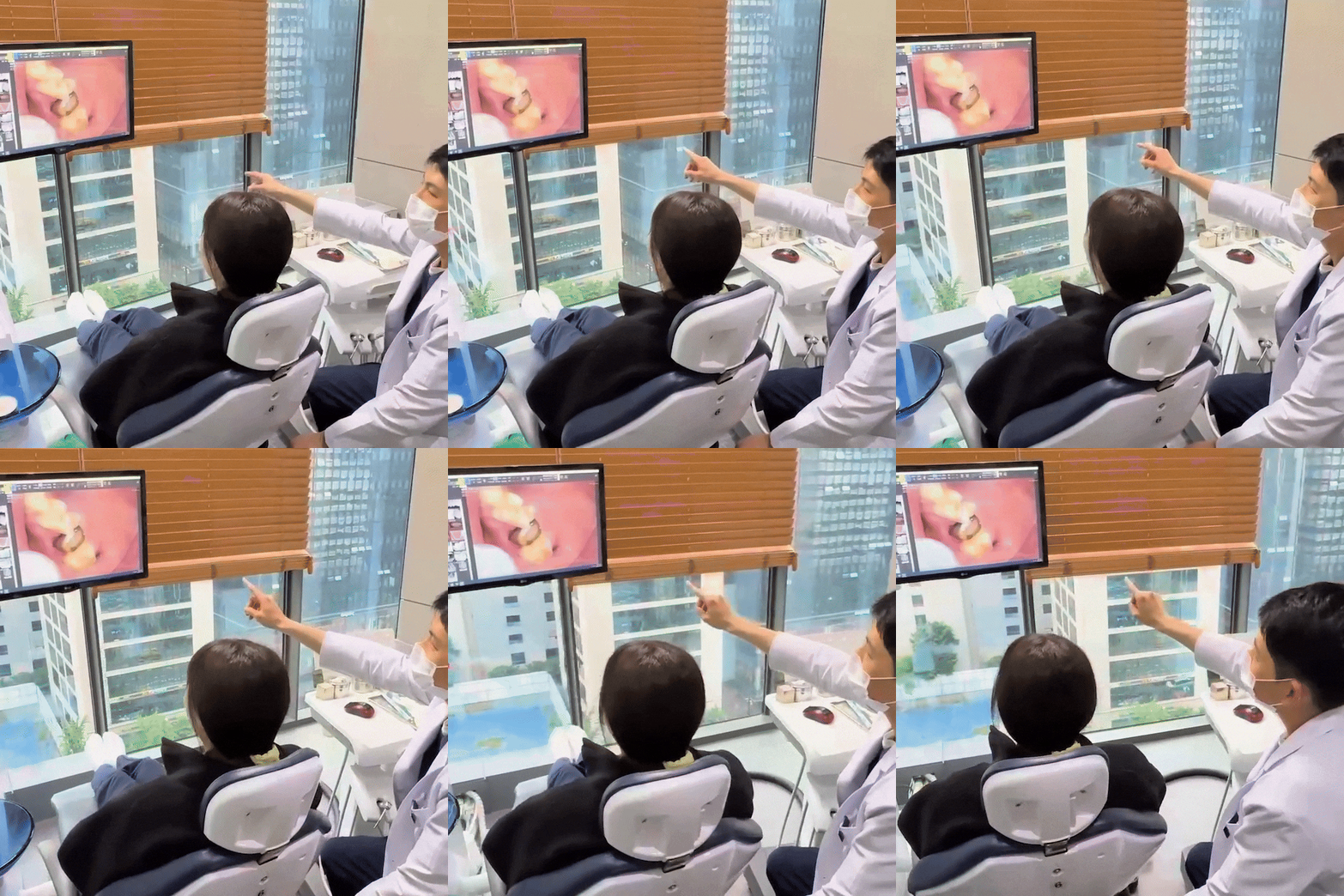
A panoramic X-ray has its limitations,
so precise diagnosis is difficult in reality.
Like the tip of an iceberg,
what is visible on the surface may be small,
but in most cases it has actually progressed much more extensively.
If treatment is done for less than the actual extent of the decay in such situations,
the remaining infected tooth structure will allow the decay to start again.
In the end, the patient returns a few years later
with a more serious condition.
- Secondary caries,
when infected tooth structure was not completely removed
The second cause is that,
during the process of removing the decay,
the infected portion was not completely eliminated.
Tooth structure infected by cavity-causing bacteria
differs from healthy tooth structure in color and hardness,
but the boundary is often not clear.
If, because of time pressure or a desire to avoid excessive removal,
some infected tooth structure is left behind,
decay will progress again in that area.
In particular, with deep decay, it must be removed carefully
as it gets closer to the nerve,
and incomplete removal can occur in this process.
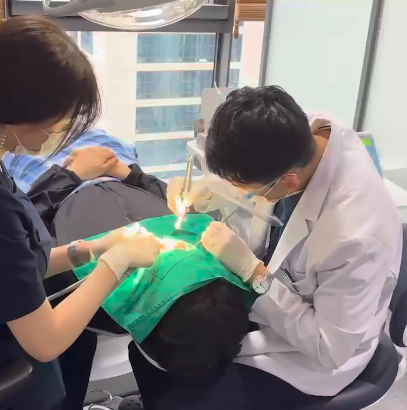
Also, if drying and cleaning the tooth structure thoroughly after caries removal is insufficient,
residual bacteria or saliva contamination can create a gap
between the treatment material and the tooth.
These tiny gaps become a pathway for bacteria to enter
and are the starting point of secondary caries.
- Secondary caries,
when inappropriate treatment materials or techniques were chosen
The final cause is choosing a treatment method
that is not suitable for the patient’s oral condition,
the location of the decay, or its size.
For example, even though the cavity is extensive,
it may be treated with a simple resin filling,
or a material with poor durability may be used in an area exposed to strong biting forces.
Differences in the quality of treatment materials are also an important factor.
Low-cost materials are more likely to discolor or shrink over time,
creating gaps at the boundary with the tooth.
In addition, the type of adhesive and how it is used
can make a big difference in long-term success.
Above all, what matters most is
carefulness during the treatment process.
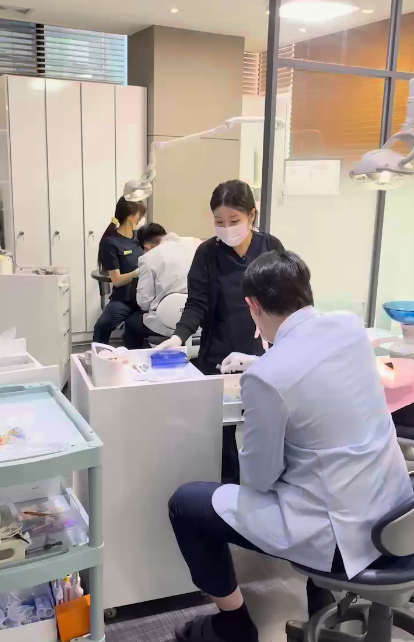
Carrying out cavity treatment may seem simple,
but in reality it must go through a very precise and complex process.
Each step requires the correct technique
and sufficient time,
and if this is neglected, problems are bound to occur.
Secondary caries does not happen simply
because of bad luck.
If the basics are solid — accurate diagnosis, complete removal of infected tooth structure, and appropriate choice of treatment method and materials —
it is a problem that can be sufficiently prevented.
Now you may understand how important the first treatment is.
Even if it costs a little more at first,
receiving an accurate diagnosis and systematic treatment
is a much more economical and wiser choice in the long run.
I hope you can use your precious natural teeth
healthily for life,
and if you have any questions about treatment,
please feel free to consult us anytime. :)
| A place that honestly recommends only the treatment that is truly necessary | D-Day Dental Clinic Naver Reservation ✔ |
| Contact for treatment at Seoul D-Day Dental Clinic |
|---|
| Main phone number: 02-568-2877 (Go directly) Naver TalkTalk inquiry (Go directly) |
| This post was written directly by D-Day Dental Clinic for the purpose of providing medical information and promoting the clinic, in compliance with Article 56, Paragraph 1 of the Medical Advertising Act. However, the information provided on this blog should be used for reference only, and for an accurate understanding of an individual’s symptoms, we recommend visiting a medical institution in person and confirming with medical professionals. All procedures and surgeries performed at the dental clinic (including implants) may cause side effects depending on the individual (such as inflammation, bleeding, swelling, nerve damage, etc.). Therefore, please make decisions only after sufficient consultation with medical staff in advance. The treatment photos in this post were taken with the consent of the patient who completed the entire treatment process at our clinic. The before-and-after photos are of the same person and were taken under the same conditions. |
Secondary Caries: 3 Reasons the First Treatment Fails







