임플란트구조, 의사가 알려주는 2가지 핵심 구성요소
Hello.
Are you looking into implant structure?
I’m Kim Moo-jin, chief director of D-Day Dental Clinic.

A while ago, one patient said to me,
“Doctor, I know what an implant is,
but I’m curious about what it actually looks like.”
They said that with a smile.^^
In fact, many people undergo implant treatment without really knowing much about its structure.
Implants
aren’t they all the same?
There are too many brands,
and I don’t know
what the differences are
A lot of people say that.
But if you understand implant structure properly,
you can better understand the treatment process,
and above all, the maintenance method becomes clear.
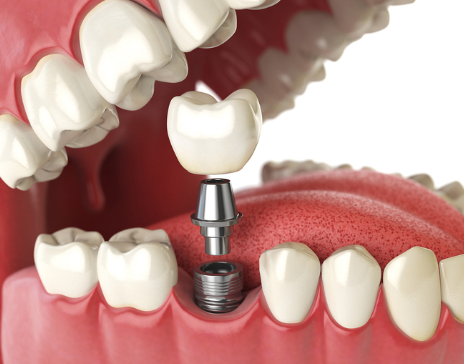
In particular, if a problem arises later, it becomes easier to identify exactly where the issue occurred.
So today, as a practicing dentist, I will personally explain the two core parts of an implant in an easy way.
I’m confident that just reading this one post will completely change your understanding of implants.
<Table of Contents>
-
Implant structure,
the root-like part of an implant, the implant fixture
-
Implant structure,
the superstructure that functions as the tooth
If you receive treatment without understanding implant structure, you may later face truly confusing situations.
For example, after implant treatment,
even if only the upper part has a problem years later,
many people worry,
“Could it be that I need to
have the entire implant redone?”
But if you know the structure,
you don’t need to worry unnecessarily like that.
- Implant structure,
the root-like part of an implant,
the implant fixture
The most essential part of an implant is
called the “implant fixture.”
This is a screw-shaped structure that is directly placed into the jawbone.
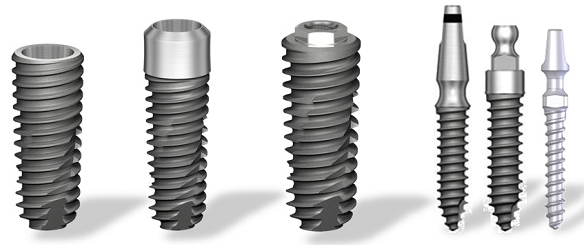
You can think of it as the part that corresponds to the root of a natural tooth.
Just as a tree sends its roots deep into the ground
and becomes firmly anchored,
the implant fixture also bonds tightly with the jawbone
and supports the entire implant.
This fixture is mainly made of
a metal called titanium.
Titanium is not only harmless to the human body,
but also has the property of bonding well with bone,
which is why it is most commonly used as an implant material.
The surface of the fixture has
screw-like grooves,
designed to allow it to be more firmly
anchored when placed into the jawbone.
Thanks to these screw grooves, it gains initial stability,
and over time the process of complete bonding with bone proceeds more stably.
It usually takes about 3 to 6 months
for the fixture to settle properly.
During this period, the biological process in which the bone and fixture bond is called osseointegration.
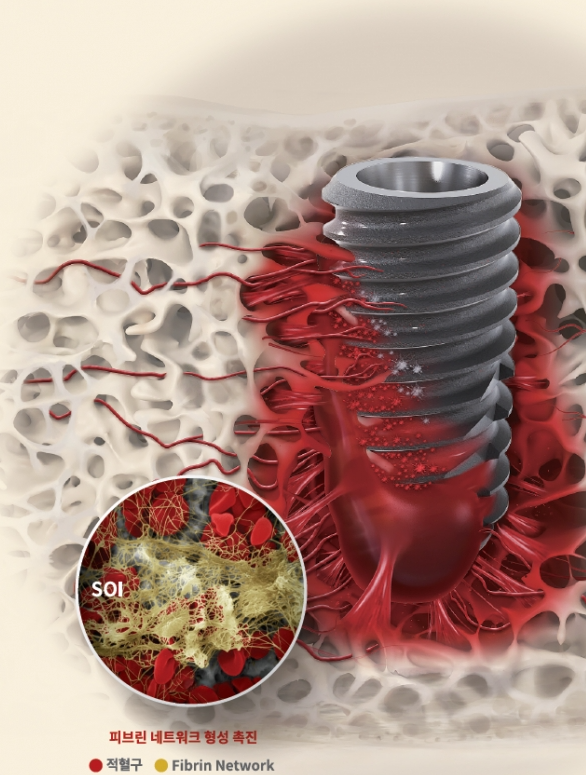
Only when this process is successfully completed
does the implant gain a strong foundation
that can be used for a lifetime.
- Implant structure,
the superstructure that functions as the tooth
The second key component of an implant is
the “superstructure.”
This is the part that actually functions like the tooth we use when chewing food.
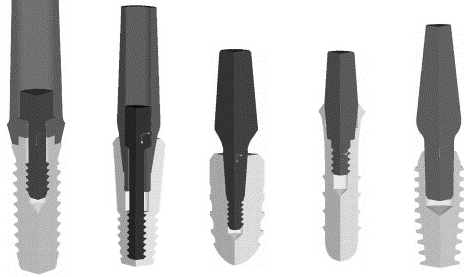
The superstructure is broadly divided into two parts.
First, there is the pillar-shaped part called the “abutment,”
and on top of it sits the artificial tooth called the “crown.”
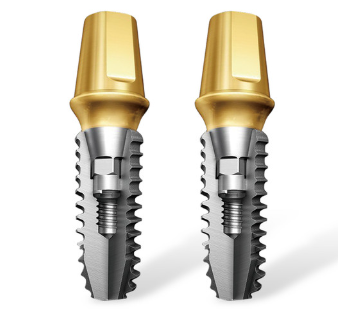
The abutment acts as a bridge connecting
the fixture placed in the jawbone and the crown visible in the mouth.
Just as columns in a building
support the entire structure,
the abutment also plays an important role in transferring chewing force to the fixture.
The crown is an artificial tooth
that looks just like a real tooth.
From color to shape, it is carefully made to blend naturally with the surrounding teeth.
It is mainly made from materials such as ceramic or zirconia,
and these materials have strength similar to natural teeth
while also offering excellent aesthetics.
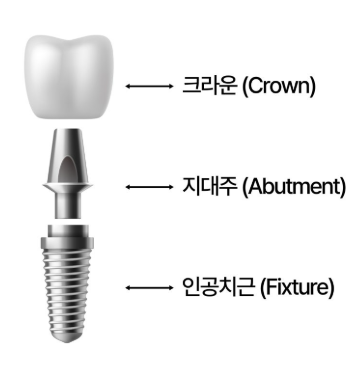
The most important point is that these superstructure parts
are connected to the fixture with screws.
So even if there is a problem with the crown or abutment,
you can leave the fixture in place and replace only the upper part.
This is one of the major advantages of implants.
In this way, an implant is made up of two core components: the fixture and the superstructure.
Because the role of each part is clearly separated,
when a problem occurs, it becomes possible to identify exactly which part caused it.
I hope that any questions or concerns you had about implant structure have now been resolved.
Above all, once you understand these structural characteristics,
the maintenance method will also become clearer.
Please remember that while the fixture, once properly placed, can last semi-permanently, the lifespan of the superstructure may vary depending on how it is maintained.
| A place that honestly recommends only the treatment you truly need | D-Day Dental Clinic Naver Reservation ✔ |
| Seoul D-Day Dental Clinic Treatment Inquiry |
|---|
| Main phone number: 02-568-2877 (Go now) Naver TalkTalk Inquiry (Go now) |

| This post was written directly by D-Day Dental Clinic in compliance with Article 56, Paragraph 1 of the Medical Advertising Act, for the purpose of providing medical information and promoting the clinic. However, the information provided on this blog should be used for reference only, and for an accurate understanding of your individual symptoms, we recommend visiting a medical institution directly and confirming them with medical staff. All procedures and surgeries performed at the dental clinic (including implants) carry the possibility of side effects depending on the individual (such as inflammation, bleeding, swelling, nerve damage, etc.). Therefore, please make your decision after充分 consultation with medical staff in advance. The treatment photos in this post were taken with the consent of the patient who completed the entire treatment process at our clinic. The before-and-after photos are of the same person and were taken under the same conditions. |
Implant Structure: 2 Key Components Explained by a Doctor