Hello. I am Kim Moo-jin, the chief director of D-Day Dental Clinic, with a goal of providing pain-free treatment.
Have you ever seen your parents at a family meal slowly chewing food only on one side with a back molar?
You may have felt uneasy watching them quietly pass on the ribs they used to enjoy and choose only soft side dishes. You may want to suggest, “You’d feel better if you got an implant…,” but then hesitate when you hear that once it’s placed, that’s it.
An implant is not only expensive, but if it is placed incorrectly, it can become a treatment you regret for the rest of your life. Since reviews all say different things, you may feel even more lost about where to get it done.
If you focus for just 3 minutes, I’m sure I can help you clearly reduce the things you may regret before deciding on an implant.
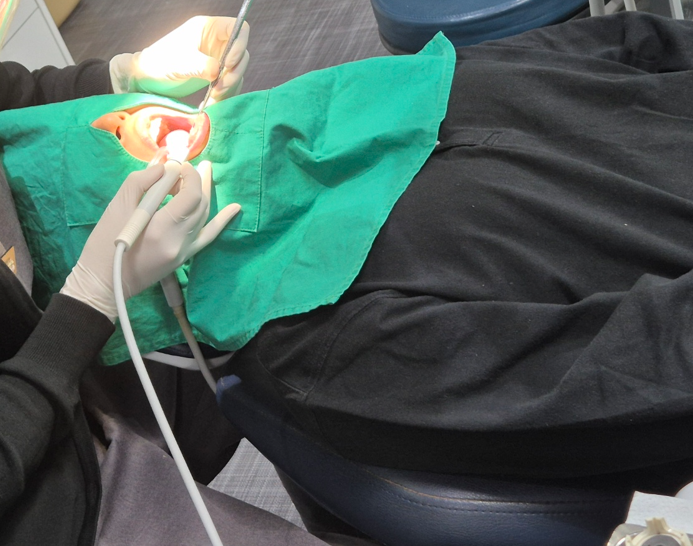
― 1. Implants are difficult to reverse once placed
You’ve probably heard in consultations, “Once it’s placed, it lasts a lifetime.” But that statement leaves out half the truth.
Natural teeth are suspended in the gums by thin ligaments, which helps distribute impact. Implants, however, are firmly anchored into the jawbone, so once they settle into place, they must endure for a lifetime in that same position.
If the position, angle, or depth is even slightly off when it is first placed, it becomes extremely difficult to correct later. If gum inflammation keeps recurring or begins to affect adjacent teeth, removing it may require a larger surgery.
That is why, when patients come for a consultation, I ask first: “Does this tooth really need to go straight to an implant now?” If there is still a way to save the natural tooth, that is a much better option.
― 2. Half of the pain is determined at the anesthesia stage
“How much will it hurt since it’s surgery?” That is the question I hear most often in the treatment room.
To be honest, more than half of implant pain is determined during the anesthesia stage. If the gum startles when the needle goes in, then even if the medicine spreads well afterward, patients stay tense and feel every sensation twice as strongly.
That is why I inject the anesthetic slowly, allowing the gums time to adapt to the medicine. If it is not rushed all at once, most patients barely feel the anesthesia itself.
Another principle I follow is to complete, as much as possible, all procedures that may cause pain on the first day and send patients home. That way, they can come back comfortably afterward without pain. It is not the surgery that is frightening; it is the unknown that is frightening.
― 3. At Daechi Station Dental Clinic, one doctor takes full responsibility from start to finish
In the end, implant results depend on the doctor’s hands and judgment. But these days, it is common for one staff member to handle the estimate, another doctor to perform the surgery, and yet another doctor to place the prosthetic.
I do not like this approach. It is like an architect drawing up plans and sending them out without ever visiting the site. To determine a safe angle, the gum condition, bone thickness, chewing habits, and the opposing teeth all need to be checked directly.
That is why, at D-Day Dental Clinic, I personally take responsibility for the consultation, surgery, prosthetics, and aftercare. This helps ensure that the person in charge does not change midway and that no explanation is left out.
After meeting nearly 10,000 patients, one thing has stood out to me most clearly: no matter how well a treatment goes, if the patient does not understand and accept it, it is not a good treatment. That is why I review the examination results together with patients and explain until they fully understand why the implant needs to be placed in that position.
To summarize today’s message in one line, for implants, “who does it” and “who takes responsibility until the end” matter far more than “where you do it.”
A mealtime where your parents, who used to chew carefully on only one side, can once again enjoy ribs comfortably on both sides and laugh together. That is the true purpose of an implant. It is not about filling an empty space, but about returning to everyday life.
Because it is a treatment that is difficult to reverse once placed, I will help you make your decision after enough explanation so that you can fully understand and feel confident.
A treatment that does not hurt, and a treatment that makes sense. Thank you for reading this long post.
Sincerely,
Kim Moo-jin, D-Day Dental Clinic