Cavity Treatment Without Pain
A Seolleung Station Dentist Explains
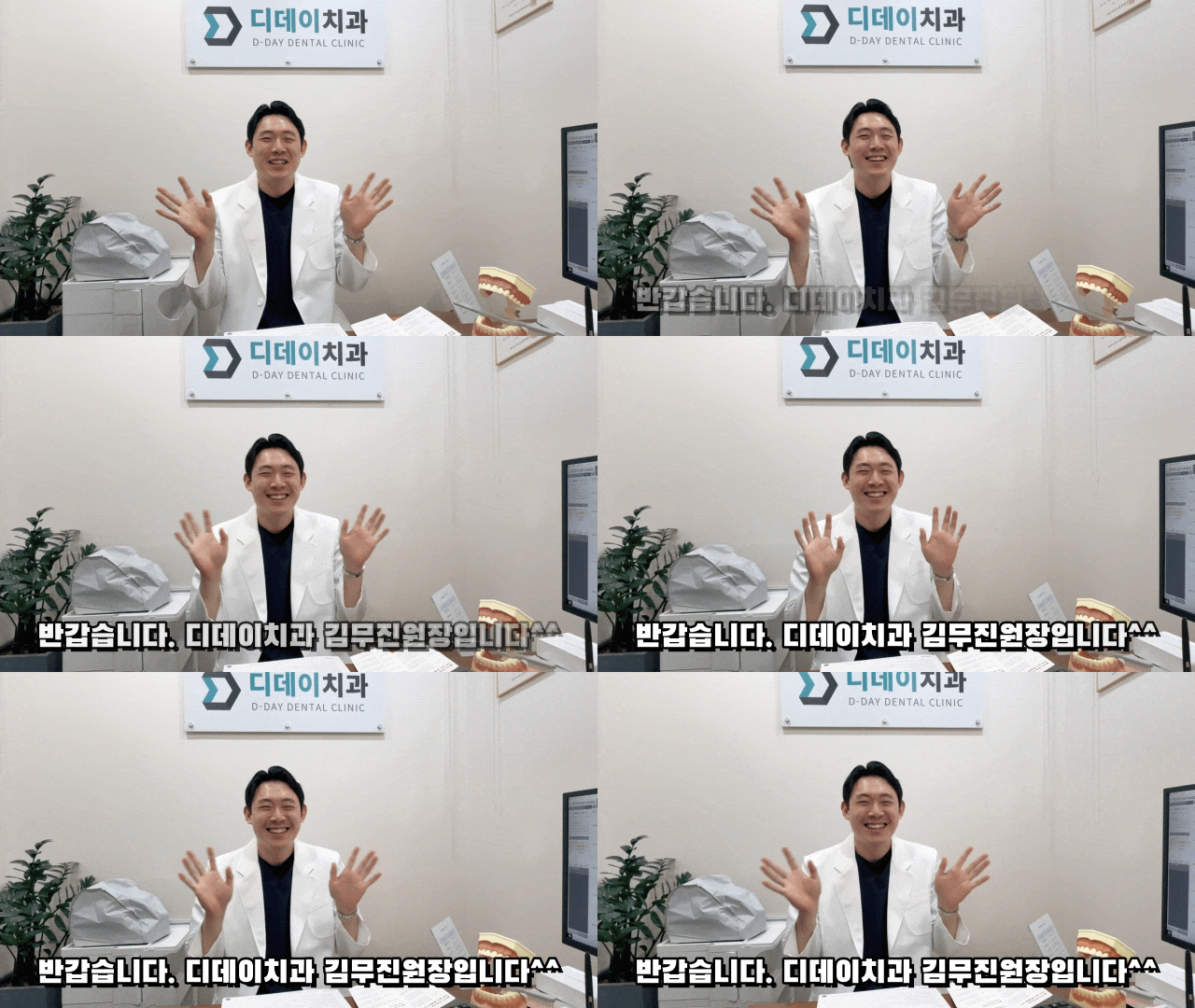
Hello.
I am Kim Moo-jin, Director of D-Day Dental Clinic,
with the goal of providing treatments that involve as little pain as possible.
"Isn't cavity treatment supposed to hurt a little?"
This is something I hear very often in the treatment room.
And because of this one sentence,
even though they know they need to visit the dentist,
more people than you might expect
put it off for several months.
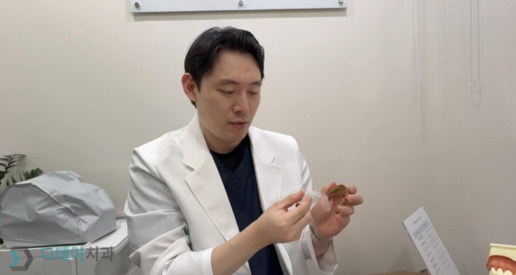
Director Kim Moo-jin personally handles everything from consultations to anesthesia and treatment
Let me be honest.
The reason cavity treatment was painful
was, in most cases,
not because of the treatment itself,
but because of how the anesthesia was administered.
Even with the same cavity, anesthesia can hurt when administered too quickly,
while allowing the gums time to adjust
can sometimes allow the treatment to finish with almost no sensation.
If you read just this article,
regardless of which dental clinic you visit in the future,
you will clearly understand
where the difference lies between
people who receive treatment without pain
and those who do not.
|
|---|
| 1. The real reason cavity treatment was painful 2. What needs to be different for painless anesthesia 3. How anesthesia is administered makes the difference |
- The Real Reason Cavity Treatment Was Painful
Many people
remember it as,
"It hurt because the tooth was drilled."
But in reality, the point where the pain begins
is usually earlier than that—
at the anesthesia stage.
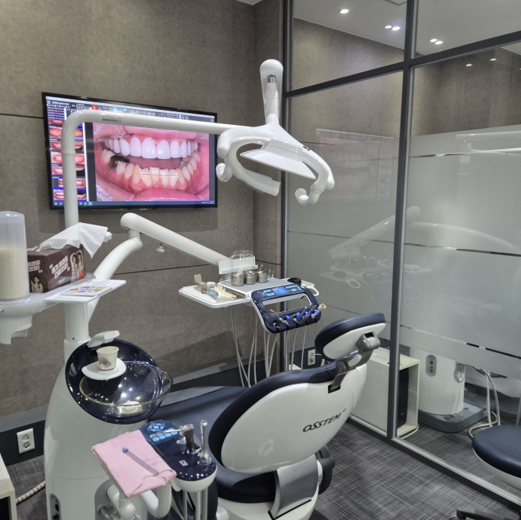
D-Day Dental Clinic treatment room
With conventional anesthesia,
the syringe is pushed by hand
to inject the medication.
When the medication enters the gums quickly,
the tissue suddenly expands,
and that pressure is transmitted
as a tingling or dull, aching sensation.
In addition, if the anesthetic solution is colder than body temperature,
the temperature difference alone
can cause the gums to react sensitively.
In other words, the pain was not because
the cavity treatment itself
was unusually painful.
It depended on
how quickly and in what condition
the medication was injected.
Conversely,
this also means that
if these conditions are changed,
the pain can be reduced
as much as possible.
- What Needs to Be Different
for Anesthesia Not to Hurt
There are exactly two key factors:
sequence and speed.
Before the injection is administered,
the surface of the gums is anesthetized in advance.
When the surface is numbed,
the needle entering
causes much less of a prickling sensation.
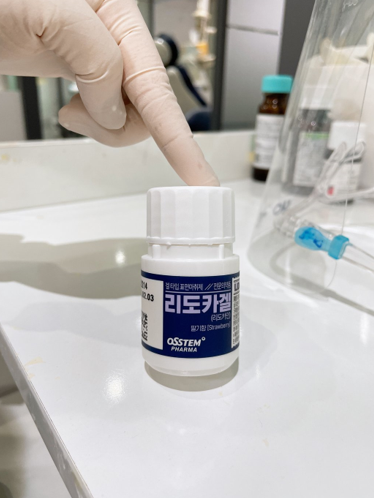
Topical anesthetic gel (lidocaine) applied to numb the gum surface before injection
The next step is especially important:
the anesthetic solution must be injected very slowly.
If air is blown in all at once,
a balloon becomes taut as if it might burst,
but if it is added little by little,
the rubber stretches gradually and withstands it.
The gums work the same way.
When the medication is allowed to flow in slowly,
the tissue has time to adjust to the pressure,
so you barely notice the sensation of the injection itself.
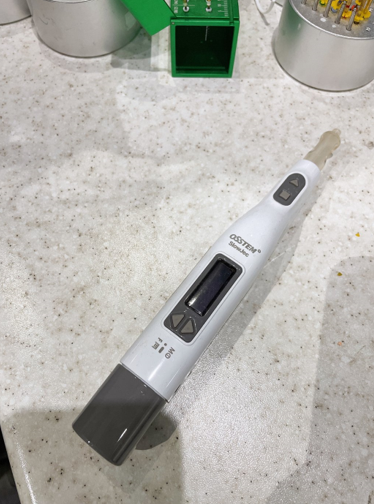
An automatic anesthesia device (OSSTEM SlowDec) that slowly injects anesthetic solution at a consistent speed
If the anesthetic solution is also warmed
to approximately body temperature,
the temperature stimulus is eliminated as well.
Ultimately, low-pain anesthesia
is not completed by one special machine,
but depends on how carefully the following process is observed:
surface anesthesia → thin needle →
slow injection → body-temperature solution.
- How Anesthesia Is Administered Makes the Difference
The problem is that
if this process is rushed even for a few seconds,
the pain can return.
That is why I never rush anesthesia
or leave it to someone else.
Because I personally handle everything
from consultation to anesthesia and treatment,
there is no need at D-Day Dental Clinic to
"increase the injection speed because we have to see the next patient quickly."
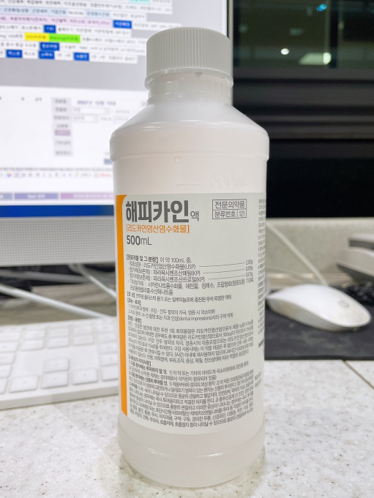
▲ Local anesthetic solution used for treatment (lidocaine-based)
There is another principle I follow.
For procedures that may cause pain,
I try to complete everything on the first day
before sending the patient home.
That way, from the next visit onward,
you can come in comfortably
without being in pain.
If pain is expected that day,
I always explain it beforehand, before starting.
There is a completely different experience
between being in pain without warning
and knowing about it in advance and preparing for it.
After seeing approximately 10,000 patients,
there is one thing I have become certain of.
A treatment that the patient cannot understand or accept
is not good treatment,
even if it is theoretically correct.
To summarize what I have discussed today in one sentence:
Whether or not cavity treatment hurts
depends not on the procedure itself,
but on the approach to administering anesthesia.
At the beginning of this article,
I mentioned
the difference between people who receive treatment without pain
and those who do not.
That difference ultimately begins with
how slowly and carefully
one administration of anesthesia is handled.
It is not a special secret,
but rather an attitude of not rushing.
If you have been postponing treatment because you are afraid,
you do not have to keep putting up with it.
If you have any questions,
please feel free to contact us at any time.
D-Day Dental Clinic promises treatment that is always as painless as possible
and that you can understand and feel comfortable with.
The relationship between the method of anesthesia and pain has also been confirmed by various studies.
5 Frequently Asked Questions
Q1. I am most afraid of the anesthetic injection. Is there a way to make it painless?
A1. Before administering the injection, the surface of the gums can first be numbed with topical anesthesia or a mouthwash anesthetic. Adjusting the injection speed to be slow can reduce the pain even further.
Q2. If the cavity is small, can I just leave it alone and monitor it?
A2. If it is at a very early stage, there are cases where the progress is monitored without drilling right away. However, it is difficult to determine this on your own, so we recommend having it checked regularly.
Q3. Is cavity treatment for children done in the same way as for adults?
A3. The basic principles are similar, but the approach is adjusted depending on the child's cooperation and stage of tooth development.
Primary teeth, in particular, are thinner than adult teeth, and space must be preserved for the permanent teeth to emerge. Therefore, there are differences in the treatment methods, materials, and behavior-management techniques used.
Q4. I still feel sensitivity after cavity treatment. Is this normal?
A4. It is common for sensitivity to remain for several days immediately after treatment. It usually gradually subsides within one to two weeks. However, if the symptoms continue for a long time, please have them checked again.
Q5. How long does cavity treatment usually take?
A5. Early-stage cavities can sometimes be treated in as little as 10–20 minutes. On the other hand, deep cavities or cases requiring root canal treatment may be handled over several visits.
| D-Day Dental Clinic Naver Reservation — Recommending Only the Treatment You Really Need, Honestly ✔ |
| Seoul D-Day Dental Clinic Treatment Inquiries |
|---|
| Main phone: 02-568-2877 (Go directly) Naver TalkTalk inquiry (Go directly) |