Can You Get Dental Implants Even If You Have Diabetes?
A Dentist’s Answer
Hello.
I am Kim Mujin, director of D-Day Dental Clinic,
with the goal of providing treatments with minimal pain.
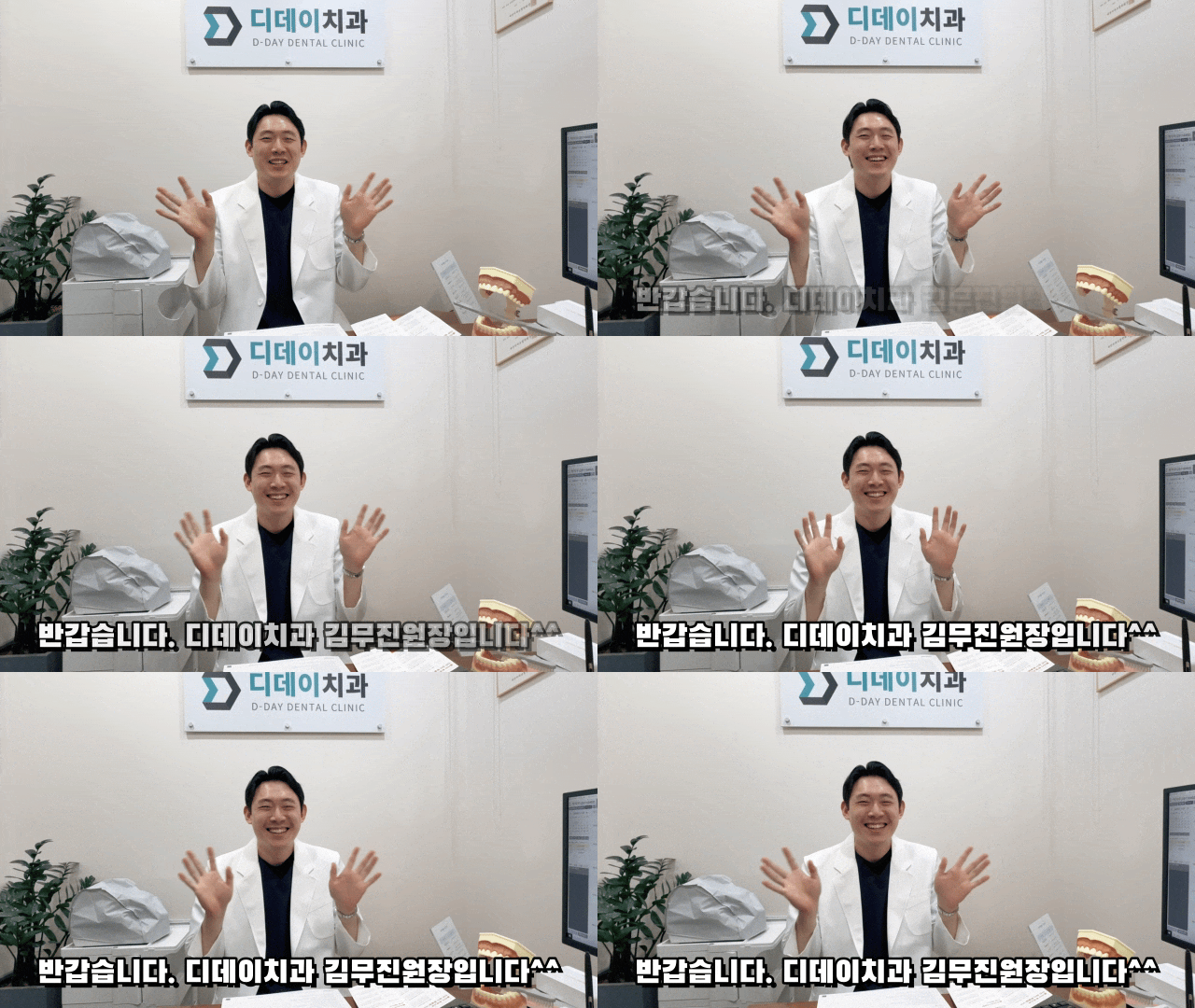
“Doctor, actually,
I have diabetes...
Is it really okay for me to get dental implants?”
Most people who ask this question in the consultation room
lower their voices a little.
They have heard somewhere
that “something terrible will happen if a person with diabetes gets implants.”
Some people have even left their missing teeth untreated for years.
They gradually became accustomed to chewing on only one side,
and began hesitating in front of foods they used to enjoy.
“What if the surgery goes wrong?”
“Am I creating an unnecessary problem for myself?”
That anxiety—
I have seen it countless times while meeting nearly 10,000 patients.
If you read this article to the end,
you will not simply learn whether it is “possible or impossible.”
You will gain the criteria to judge for yourself
“under what conditions it is possible.”
|
|---|
| 1. The claim that people with diabetes cannot get implants is only half true 2. Then, what should you prepare before surgery? 3. Why D-Day Dental Clinic has one person take responsibility from start to finish |
- The claim that people with diabetes cannot get implants is only half true
After being diagnosed with diabetes,
many people tense up as soon as they hear the word “surgery.”
But to give you the conclusion first,
patients with well-controlled blood sugar can receive dental implants.
There is a reason, however, why such rumors circulate.
When high blood sugar persists for a long time,
wounds heal more slowly,
and the body becomes more vulnerable to bacterial infections.
Sinnonhyeon Station Dental Clinic
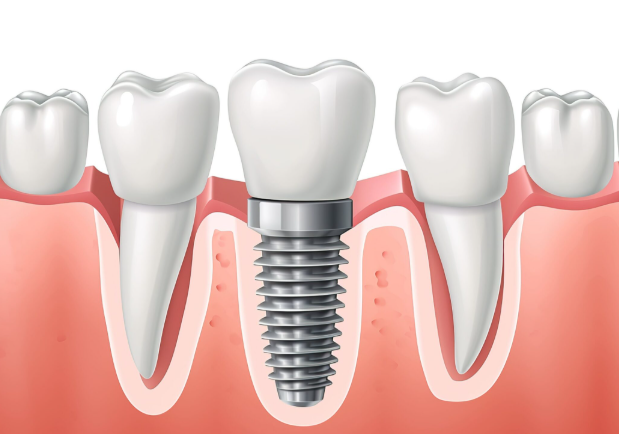
Dental implants succeed or fail based on the process of “osseointegration,”
in which the artificial root firmly bonds with the jawbone.
When blood sugar is high, this process may be at risk of becoming unstable.
You can think of it as similar to curing cement during the rainy season.
It will harden, but it will take longer,
and its strength may be reduced if things do not go well.
So what matters is not whether you have diabetes,
but what condition your blood sugar is currently in.
- Then, what should you prepare before surgery?
There is a measurement that serves as a standard.
It is HbA1c,
an indicator that shows your average blood sugar level over the past two to three months.
In general, if this value is over 8%,
the priority is to stabilize your blood sugar first
in consultation with your internal medicine physician.
If it is well controlled,
you may expect results that are not significantly different
from those of patients without diabetes.
Reviewing the medications you are taking,
prescribing antibiotics when necessary,
and planning a shorter surgery
are also part of the preparation process.
There is one more thing I pay particular attention to
for patients with diabetes.
It is pain.
Pain and tension can cause blood sugar levels to fluctuate.
Sinnonhyeon Station Dental Clinic
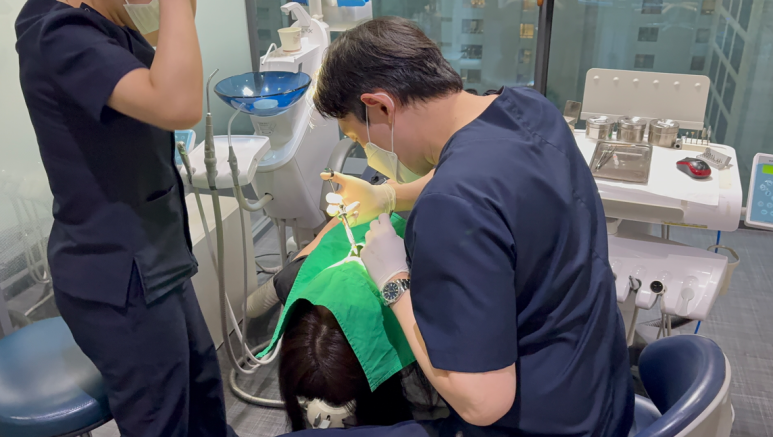
That is why I inject the anesthetic solution slowly,
so the procedure can be performed with almost no sensation,
and complete as much as possible on the first day
of any treatment likely to cause pain before you go home.
From your next visit onward,
you can come in without being in pain.
But one question remains:
who will continue to take care of all this preparation and monitoring until the end?
- Why D-Day Dental Clinic has one person take responsibility from start to finish
For patients with diabetes,
dental implant treatment does not end on the day the implant is placed.
We need to consistently monitor
whether it is bonding well with the bone
and whether there is any inflammation in the gums,
as well as the overall healing process.
That is why I personally handle everything—from the consultation and surgery
to the follow-up examinations—as the clinic director.
Sinnonhyeon Station Dental Clinic
In a system where you only consult with a clinic manager
and meet the dentist for the first time on the day of surgery,
variables such as blood sugar can easily be overlooked along the way.
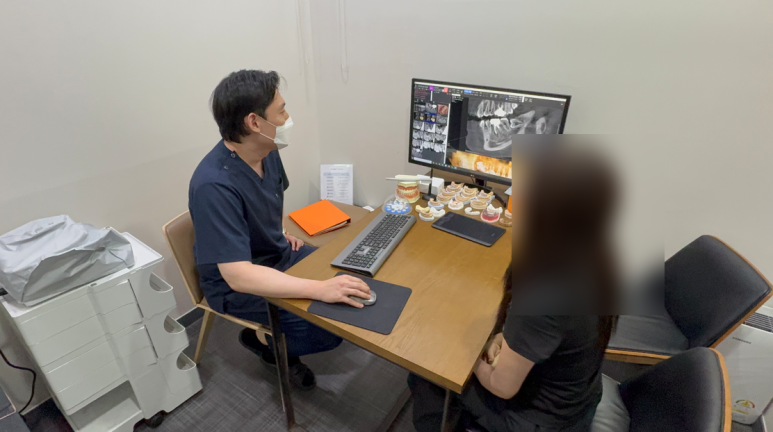
Sinnonhyeon Station Dental Clinic
Last month, I told a patient whose HbA1c result was high:
“The time to place the implant is not now.
Let’s get your blood sugar under control first and meet again.”
Although this meant postponing treatment for the time being,
it was the right order to follow.
I believe that surgery performed without the necessary conditions in place
is not good treatment,
no matter how sound it may be in theory.
Today’s message can be summarized in one sentence:
Diabetes is not a wall that prevents dental implants;
it is simply a condition that can be monitored and managed before moving forward.
You can now feel comfortable asking
the question that once made your voice grow quiet in the consultation room.
Rather than looking for reasons it cannot be done,
we can work together to create the conditions under which it can be done.
The longer someone has postponed treatment,
the more often we have found that the solution was closer than expected.
I will explain everything thoroughly
and help you make a decision after you understand and agree with the plan.
Thank you.
Kim Mujin, Director of D-Day Dental Clinic
| D-Day Dental Clinic, where we honestly recommend only the treatment you truly need — Naver Reservation ✔ |
| Inquiries about treatment at D-Day Dental Clinic in Seoul |
|---|
| Main phone: 02-568-2877 (Go directly) Naver TalkTalk inquiries (Go directly) |